



Swiftype built its name as a hosted site search product, then became part of Elastic in 2017. Since then, the branding and the roadmap have moved. Elastic now steers customers toward native Elasticsearch, and the App Search lineage that many Swiftype users rely on is winding down. If you run search for a content-heavy site, that shift is a good reason to look at what else is available.
The bigger reason is AI. Site search in 2024 mostly meant keyword matching. In 2026, buyers expect semantic search, direct AI answers grounded in their own content with cited sources, and conversational search that remembers context. This guide covers eight Swiftype alternatives, what each one does well, where each falls short, and current pricing. AddSearch is listed first because it is the product this guide is published by, and every option below includes its limitations so you can compare honestly.
Where Swiftype stands in 2026
Elastic acquired Swiftype in November 2017 (GlobeNewswire, November 9, 2017). It later folded the technology into Elastic App Search and Elastic Enterprise Search. Those products are now on a retirement path. Here are the dates to plan around:
- Elastic deprecated App Search and Workplace Search on April 15, 2025 (Elastic blog, April 15, 2025).
- Elastic Enterprise Search 8.x reaches End of Maintenance on January 15, 2027 and End of Support on July 15, 2027 (Elastic End of Life page).
- There is no successor version. Elastic’s guidance is to move to native Elasticsearch or Elastic Cloud Serverless, which is a re-platform, not an upgrade.
The standalone hosted Swiftype Site Search at swiftype.com is still live and still accepts signups. But it is a legacy product. It has no modern AI answer layer and no conversational search, and Elastic’s public roadmap points elsewhere. So the practical question for most teams is not whether Swiftype still runs. It is whether to invest more in a product with no AI future, or move to a platform built for how people search now.
What to look for in a Swiftype alternative in 2026
Use these criteria to compare options. They reflect what buyers now expect from AI search.
- Keyword search quality. Fast, relevant results remain the foundation.
- Semantic and vector search. Matching by meaning, not only exact words.
- AI answers grounded in your content. Direct answers with cited sources, so users and reviewers can verify them.
- Conversational search. Multi-turn dialogue that remembers earlier questions and keeps context.
- Content control and governance. Choose which sources the AI can answer from, exclude sensitive or draft content, and control freshness.
- AI analytics. Query volume, answer success rate, follow-up rate, and unanswered questions, so you can improve your content.
- Deployment flexibility. You can implement yourself using ready-made UI solutions, UI libraries, and APIs, or work with the vendor’s team.
- Transparent pricing. Published, predictable pricing beats quote-only when you need to plan a budget.
- Security and accessibility. SOC 2 Type II, GDPR, and documented accessibility conformance.
The 8 best Swiftype alternatives
1. AddSearch
AddSearch is a search, AI answer, and conversational discovery platform for organizations with large content estates. It connects users to the exact information they need across your content, whether that is a single website or a network of authenticated, multi-product portals. It grounds every answer and conversation in your own content, with sources.
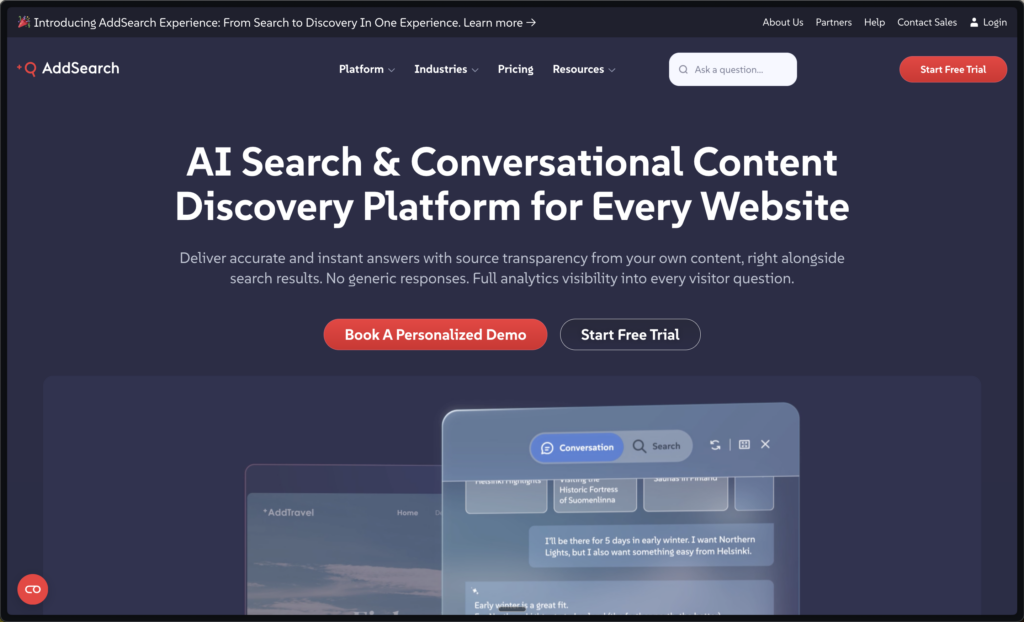
It brings three capabilities together on one platform: Keyword Search, AI Answers, and AI Conversations. You choose how much to deploy, and all three are available from the start.
- Keyword Search is the foundation: fast, relevant results with synonyms, autocomplete, ranking control, and personalization.
- AI Answers returns a direct, generative answer to a question instead of only a list of results, with source links. It runs a retrieval-augmented generation (RAG) pipeline over your indexed content, so answers stay grounded in what you publish.
- AI Conversations supports multi-turn dialogue. It remembers context, streams answers as they generate, cites sources, and switches to keyword results in one click.
Under the hood, AddSearch indexes content with vector search, runs a RAG pipeline, and generates answers with an external large language model. Your index is stored by AddSearch, your content is never used to train any model, and the AI is instructed to answer only from your indexed content. Responses target under three seconds.
Implementation is a spectrum, not one path. You can implement yourself using ready-made UI solutions, UI libraries, and APIs, or work with AddSearch’s team. Content is indexed through the AddSearch crawler and API-based indexing, including gated and authenticated content. That means new content goes live in search quickly, without waiting on a connector roadmap.
What makes AddSearch different from Swiftype
- One platform with keyword search, grounded AI answers, and conversational search, versus a legacy product with no AI answer or conversational layer.
- Published, predictable pricing, versus Swiftype’s legacy quote-based model.
- Live in days, with no dedicated search team required.
- Answers grounded in your content with cited sources, plus content governance and AI analytics.
AddSearch pricing
- Keyword Search: Core $119/month, Growth $299/month, and Advanced $599/month billed annually (Core $155, Growth $389, Advanced $779 billed monthly). Enterprise is custom.
- AI Answers: from $8,400/year.
- AI Conversations: custom-quoted by content volume and usage.
- A 14-day free trial is available.
Other things worth knowing about AddSearch
- AI Answers and AI Conversations are priced on top of Keyword Search, so a full three-capability deployment costs more than keyword search alone.
- AI Conversations is newer, launched January 2026, and some setup is handled with the AddSearch team rather than fully self-serve.
- Image indexing is on the roadmap and not yet supported.
- AddSearch holds SOC 2 Type II and GDPR compliance, and provides accessibility conformance documentation (VPAT).
Best for: organizations with content-rich or gated sites that want keyword search, grounded AI answers, and conversational content discovery on one platform, live in days, without building it themselves.
2. Elastic (Elasticsearch)
Elastic is the platform behind Swiftype’s lineage, so it is the most direct migration target. Elasticsearch is powerful search infrastructure with a modern AI stack: semantic search through ELSER, vector and hybrid search, reranking, an AI Playground for RAG, and Agent Builder, which reached general availability around January 2026 (Elastic, January 2026).
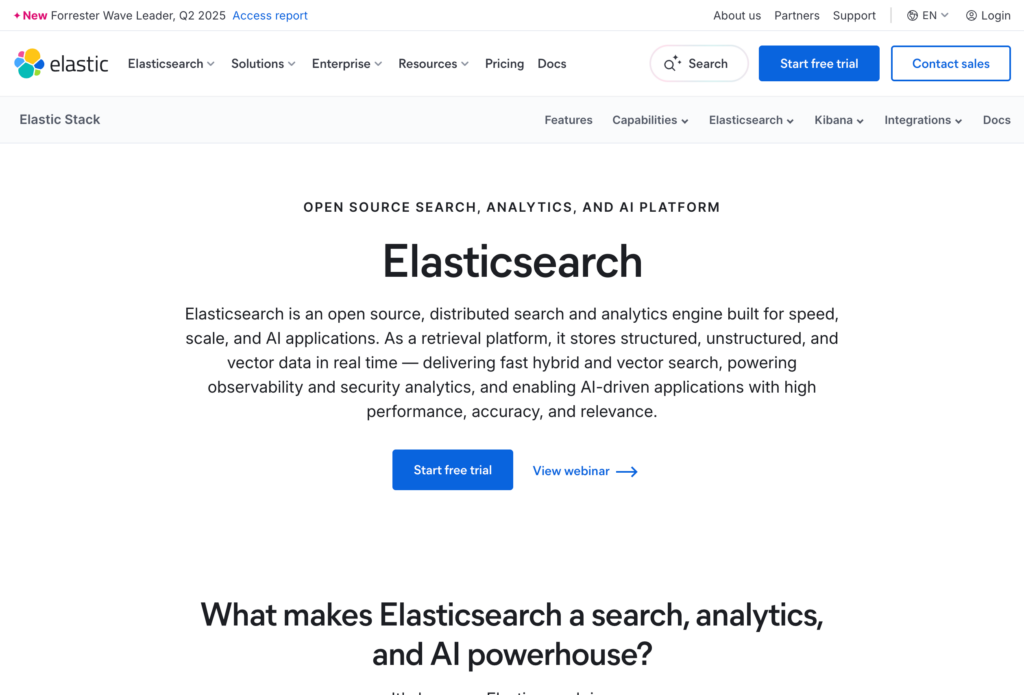
The trade-off is build versus buy. Elasticsearch gives you control and depth, but you assemble and operate the answer layer yourself.
Elastic limitations to consider
- No business-facing dashboard for non-technical marketing or web teams.
- No managed AI answers or conversational search ready to use; you build that layer.
- Meaningful engineering to configure, scale, secure, and maintain.
- The Swiftype-lineage App Search and Enterprise Search are retiring (End of Maintenance January 15, 2027).
Elastic pricing
- Self-managed Elasticsearch is free and open source; you carry the operational cost.
- Elastic Cloud Hosted runs roughly $95 to $184 per month for small-to-enterprise configurations, and Serverless is metered (Elastic examples range from about $24 to $210 per month depending on workload). Treat these as vendor examples and confirm for your workload.
Best for: engineering teams that want full control and are ready to build and run the search and answer layer themselves.
3. Coveo
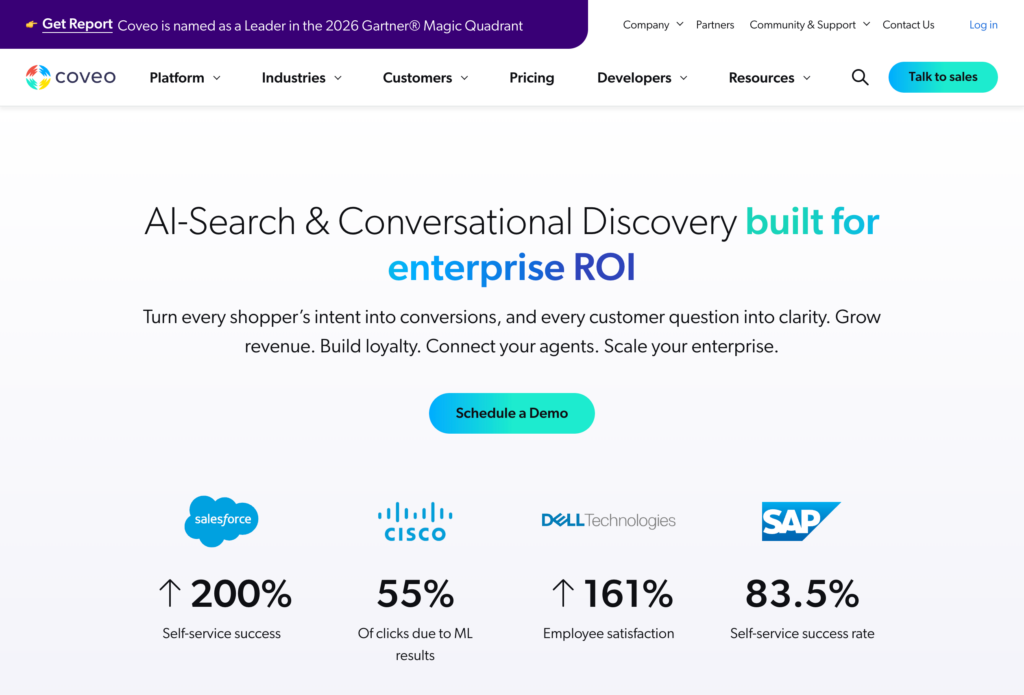
Coveo is an enterprise AI search and personalization suite. Its strength is federated search across many connected systems, with deep integrations for Salesforce, ServiceNow, Sitecore, and SAP. Its Relevance Generative Answering produces answers grounded in your content with citations, and its Passage Retrieval API reached general availability in February 2025 (Coveo, February 2025). It also offers conversational search.
Coveo limitations to consider
- Generative and conversational features are paid add-ons on top of a substantial base platform.
- Implementations often run for months and benefit from a dedicated in-house search team.
- Consumption-based query pricing can be hard to forecast at scale.
Coveo pricing
- Coveo does not publish standard pricing; its plans are quote-only, with a base unit of 100,000 queries per month. A Coveo for Salesforce listing has been reported at around $100,000 per year.
Best for: large enterprises that need federated search and personalization across many systems, with the team and budget to run it.
4. Algolia
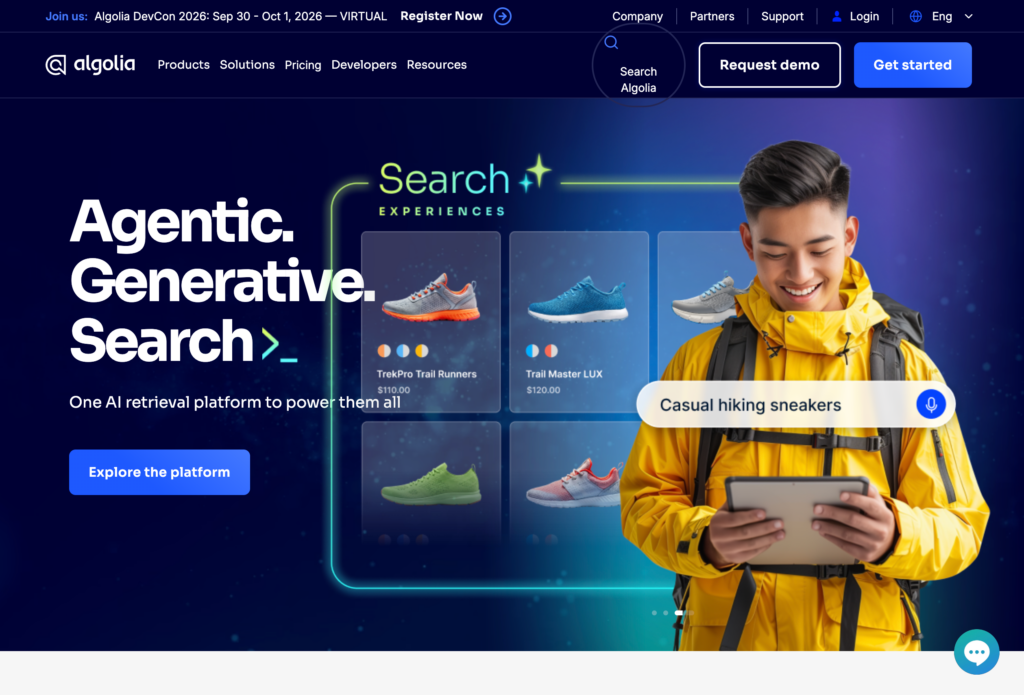
Algolia is a developer-first, API-first search platform known for speed. Its NeuralSearch combines keyword and vector search. Its Ask AI feature returns generative, cited answers and supports a bring-your-own-model approach, and Agent Studio (launched 2025) adds agentic workflows. Algolia’s grounded, cited answers are RAG-based, the same category as the answer layers described elsewhere in this guide.
Algolia limitations to consider
- Implementing and tuning generally requires engineering effort.
- AI features sit on higher tiers, and semantic search plus real-time personalization are reserved for the custom-quoted Elevate tier.
- It is optimized for product, documentation, and app search, so configuring it for broad content can take extra work.
Algolia pricing
- Build: free, with 10,000 search requests per month and 1 million records.
- Grow: pay-as-you-go at $0.50 per additional 1,000 requests.
- Grow Plus: adds AI ranking and advanced personalization at $1.75 per additional 1,000 requests.
- Premium and Elevate: custom annual pricing with NeuralSearch and real-time personalization.
Best for: engineering teams that want fast, API-driven search and are comfortable assembling AI features across tiers.
5. Cludo
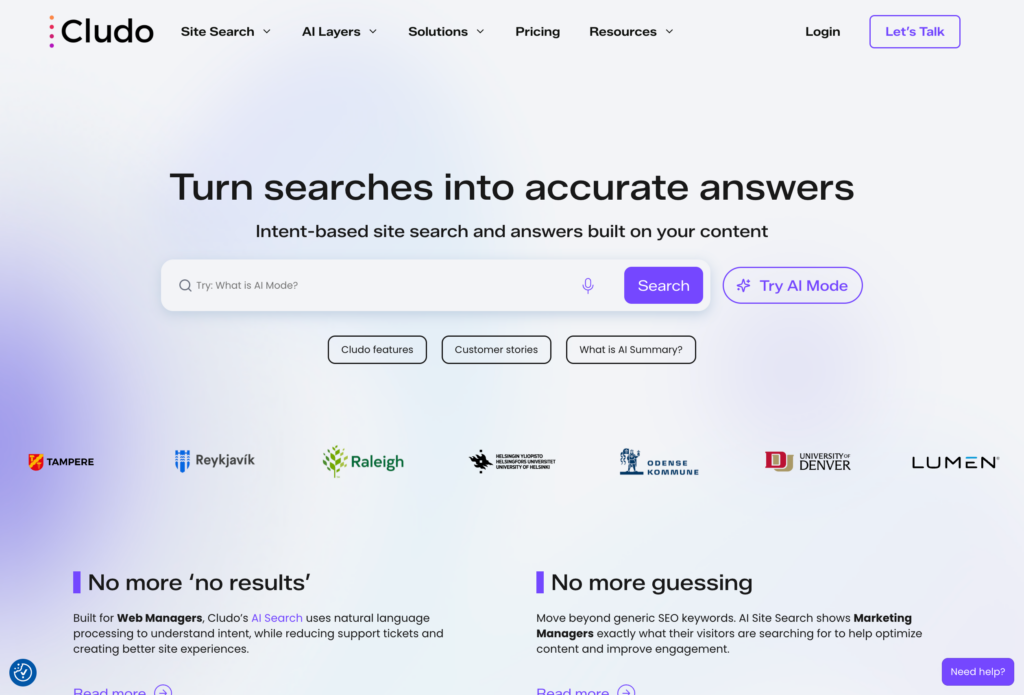
Cludo is a dedicated AI site search product with strong roots in higher education and government. It combines keyword and semantic search with AI Layers: AI Summary, a cited answer above results; AI Chat, conversational with follow-ups; and AI Mode, a full-screen conversational experience that keeps context. It is built to be managed by marketing and web teams, and it aligns to W3C accessibility guidance and the European Accessibility Act.
Cludo limitations to consider
- AI is delivered as three separately priced layers, so the AI you want determines the cost.
- AI Mode is currently a custom implementation.
- The base search license is quote-only.
Cludo pricing
- AI Search and Enterprise Search are quote-only. AI Layers start from $8,000 per year, per layer.
Best for: higher-education and public-sector teams that want managed AI site search with staged AI layers.
6. SearchStax
SearchStax is a site search specialist with a large higher-education and public-sector footprint; the company states it powers search for more than 700 customers across more than 20 countries (SearchStax, 2025). It offers a marketer-facing Site Search Solution and a hosted Managed Search built on Solr. Its Smart Answers feature, launched July 15, 2025, adds natural-language summaries at the top of results, similar in shape to an AI overview (SearchStax, July 15, 2025). It also offers Smart Ranking and connectors for Acquia, Optimizely, Sitecore, and Modern Campus.

SearchStax limitations to consider
- Its AI focuses on the summary layer rather than multi-turn conversation.
- The Site Search versus Managed Search split adds a scoping decision.
- Pricing is quote-based.
SearchStax pricing
- Quote-based, scaling with indexed content, monthly searches, and analytics retention. A 14-day trial and nonprofit discounts are available.
Best for: higher-education and public-sector sites that want a managed site search specialist with AI summaries.
7. Squiz Funnelback
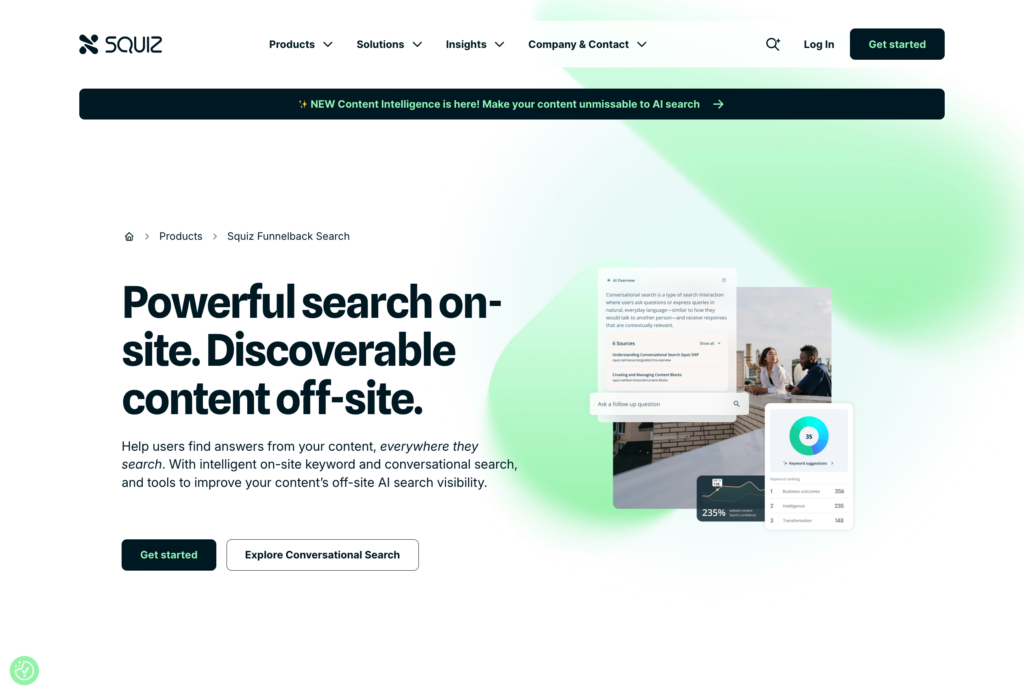
Squiz Funnelback is an enterprise site search product with deep higher-education and government roots. It is available on its own or inside the Squiz digital experience platform. It combines keyword search with conversational AI search grounded in your own content, draws on more than 70 ranking signals, and offers Content Intelligence to audit content for AI-readiness and accessibility. It also ships higher-education templates.
Squiz Funnelback limitations to consider
- It relies on developers for custom templating (Freemarker).
- Implementation is heavier and usually involves professional services.
- Pricing is quote-only.
Squiz Funnelback pricing
- Not published; custom-quoted per deployment.
Best for: higher-education and government teams that want enterprise site search and are prepared for a developer-supported implementation.
8. Google Programmable Search Engine
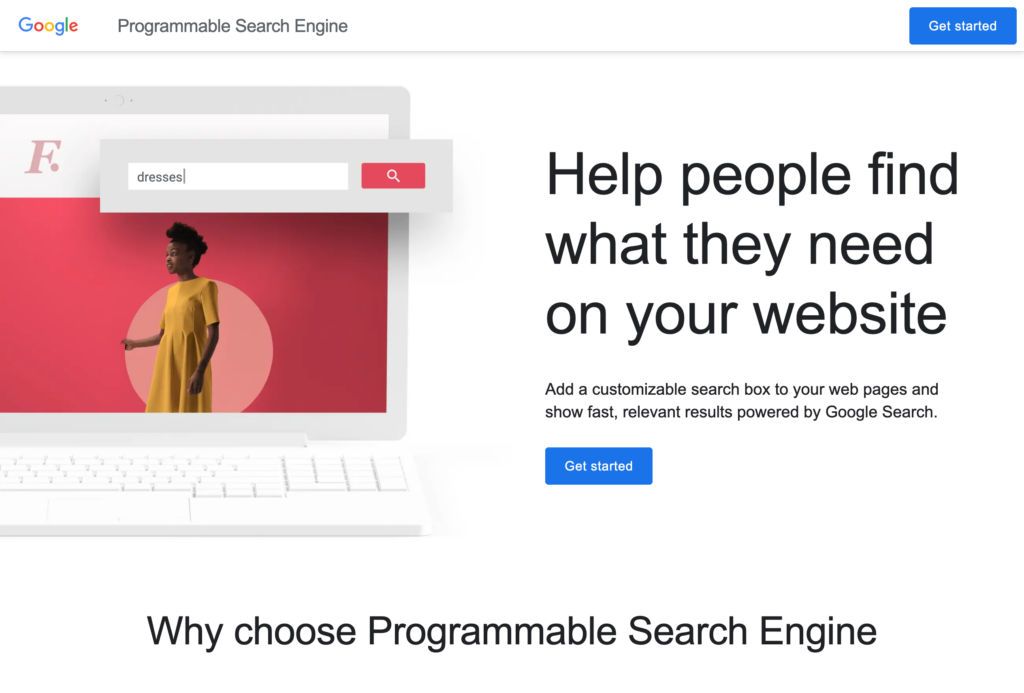
Google Programmable Search Engine, formerly Custom Search Engine, is a drop-in search element for websites. It is free and ad-supported, with an ads-free edition for qualifying government, education, and nonprofit organizations. It is the fastest option to add, but it is limited.
Google Programmable Search Engine limitations to consider
- No managed AI answers or conversational search in the free product; those live in Google’s Vertex AI Search.
- No analytics on the free tier, limited relevance and branding control, and indexing that is not real-time.
- The Custom Search JSON API is closed to new customers. Existing customers pay $5 per 1,000 queries until January 1, 2027, and Google points new customers to Vertex AI Search (Google, transition deadline January 1, 2027).
Google Programmable Search Engine pricing
- The basic search element is free and ad-supported. Vertex AI Search starts around $2.50 per 1,000 queries plus ingestion and storage, with AI features priced higher (Google Cloud pricing, 2026).
Best for: small sites or nonprofits that need a free, basic search element and do not need AI answers, analytics, or deep control.
How these Swiftype alternatives compare
A quick side-by-side. Read each section above for the detail behind these summaries.
| Platform | Semantic / vector | Grounded AI answers (cited) | Conversational search | One platform | Published pricing |
| AddSearch | Yes | Yes | Yes | Yes | From $119/mo + AI |
| Elastic | Yes | You build it | You build it | No, you build | Free + Cloud |
| Coveo | Yes | Yes (add-on) | Yes (add-on) | Partial | Quote-only |
| Algolia | Yes | Yes (higher tier) | Assembled | Partial | Yes (free tier) |
| Cludo | Yes | Yes (AI layer) | Yes (AI layer) | Staged layers | Layers from $8k/yr |
| SearchStax | Yes | Summaries | No (summary only) | Yes | Quote-only |
| Squiz Funnelback | Yes | Yes | Yes | Partial | Quote-only |
| Google PSE | No (free tier) | No (free tier) | No (free tier) | No | Free / ad-supported |
Pricing and capabilities verified September 2026. Quote-only pricing and third-party figures are labeled in each section. Re-verify before publishing.
AddSearch vs. Swiftype: how they compare
- Pricing. AddSearch publishes predictable pricing. Swiftype uses a legacy quote-based model.
- AI. AddSearch offers grounded AI answers and conversational search. Swiftype’s hosted product has neither, and its App Search lineage is retiring.
- Content estate. AddSearch indexes public and gated content through crawling and API-based indexing, so new content is searchable quickly.
- Time to value. AddSearch is live in days, with no dedicated search team required.
- Security. AddSearch holds SOC 2 Type II and GDPR compliance.
Frequently asked questions
Is Swiftype being discontinued?
The standalone hosted Swiftype Site Search is still available at swiftype.com. However, the Elastic App Search and Enterprise Search products that share Swiftype’s lineage are on a retirement path, with End of Maintenance on January 15, 2027 (Elastic End of Life page). Elastic steers customers to native Elasticsearch or Elastic Cloud Serverless.
What is the Elastic App Search end-of-life date?
Elastic deprecated App Search and Workplace Search on April 15, 2025. Elastic Enterprise Search 8.x reaches End of Maintenance on January 15, 2027 and End of Support on July 15, 2027 (Elastic, April 15, 2025; Elastic End of Life page).
What replaced Swiftype?
Elastic’s guidance is to move to native Elasticsearch or Elastic Cloud Serverless and build the search and answer layer there. Teams that do not want to build it themselves usually choose a managed platform such as AddSearch, Cludo, or SearchStax.
What is the best Swiftype alternative for higher education and government?
Higher-education and government teams are well served by AddSearch, Cludo, SearchStax, and Squiz Funnelback. AddSearch adds keyword search, grounded AI answers, and conversational search on one platform, live in days.
Do these tools give AI answers with citations?
AddSearch, Coveo, Algolia, Cludo, SearchStax (as summaries), and Squiz Funnelback offer AI answers grounded in your content with sources. Elastic can, but you build the answer layer. The free Google Programmable Search Engine does not.
Which alternatives publish pricing?
AddSearch and Algolia publish starting pricing, and Elastic publishes Cloud and Serverless pricing. Coveo, Cludo’s base license, SearchStax, and Squiz Funnelback are quote-only.
Final thoughts
Swiftype served its era well, but site search has moved on. The next era rewards platforms that understand meaning, answer from your own content with cited sources, and keep a conversation going. AddSearch brings keyword search, grounded AI answers, and conversational content discovery together on one platform, live in days. If you are planning your move off Swiftype, try out AddSearch with your own content – start a free trial now.
