



Two in three Google searches now end without a single click to any website. People get their answer right in the search results, or from an AI assistant, and never visit a site at all.
So it is worth asking a simple but uncomfortable question. What is content actually for, when users get answers instead of visits?
To think it through, I sat down with Raisa Yogiaman, Senior Content Marketing Manager at saas.group, for Episode 2 of Beyond the Search Box. Raisa runs content across a portfolio of B2B SaaS brands, at different stages of maturity and in different niches, so she sees this shift play out many times over rather than once.
What follows is the conversation, distilled.
TL;DR
- The job of content has not changed. The way we measure it has. As Raisa put it, “the scoreboard broke, and we’re only noticing now because it stopped agreeing with us.”
- Content built only to catch a click is being absorbed by AI answers. What survives is what only you could make: proprietary data, customer stories, real experience, a clear point of view.
- Getting cited by AI is mostly good SEO, plus one habit most teams underrate: being talked about off your own site, on Reddit, YouTube, reviews, and LinkedIn.
- Refresh old content properly with real updates, not date swaps. Run every piece through three questions: have the facts changed, is anyone still asking, does it still connect to what you sell.
- Stop leading with traffic. Watch branded search, how AI represents your brand, and patterns like topics that keep coming up in sales calls.
The scoreboard broke
Raisa’s starting point is that the purpose of content is exactly what it always was.
“The job for content hasn’t changed. I’m still using content to make people convert to the brand. It’s just the way that we measure it that changed. The scoreboard broke, and we’re only now noticing because it stopped agreeing with us.”
For years, traffic was the number we led with. It made sense at the time. More traffic usually meant more people in the funnel, so it worked as a rough health check for whether content was doing its job.
It was never a perfect measure. It was just good enough that nobody questioned it.
AI search changed that. A lot of the questions people used to click through to answer are now answered directly in an AI overview or an assistant, so the click never happens.
What this looked like in practice
Raisa saw it firsthand with one of the brands she works with.
- The brand had strong organic traffic, and most of its best content was top of funnel: “what is X,” “how does X work.”
- That is exactly the content AI now answers directly, so traffic to those pages dropped.
- Leadership’s first instinct was to treat it as a content problem, as if something had gone wrong.
Her job in that moment was to reset the framing. This is not a failure of the work. It is happening across the board, the pre-AI traffic is not coming back, and that is simply where this type of content sits now.
The goal itself is unchanged: reach the right people, be useful, build credibility, and eventually earn the conversion. What got harder is proving that it worked.
Traffic was always a proxy
Part of why proving it is harder is that almost nobody converts in a single step anymore.
Raisa walked through a typical path:
- Someone sees a LinkedIn post and learns about your product for the first time. They are interested, but not ready.
- A week later they convert, but not through LinkedIn. They saw a review, an affiliate, or a video somewhere else first.
If you only look at the last touch, you would say the LinkedIn post did nothing. Often it is the reason the rest of the chain happened at all.
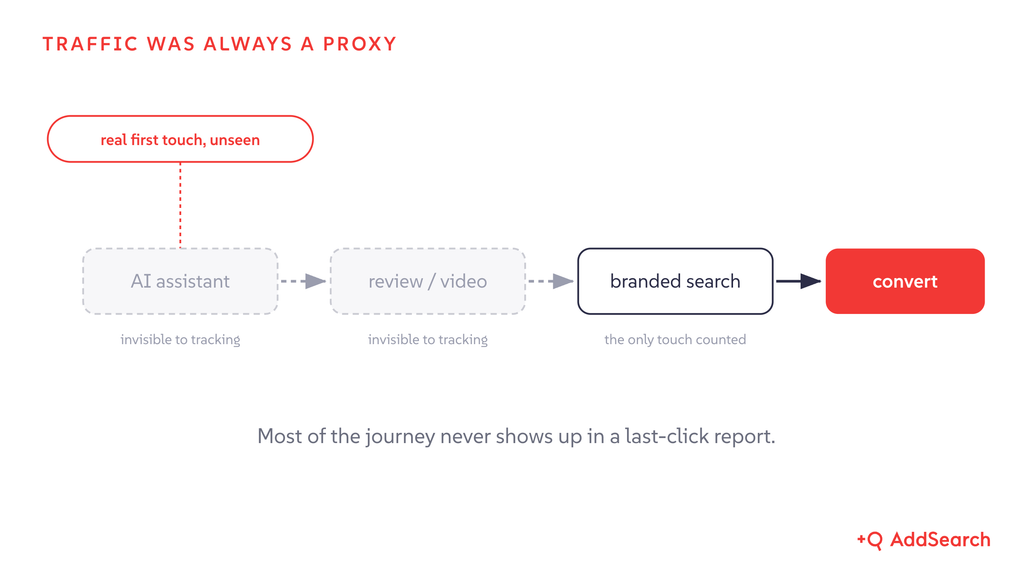
I see the same thing at AddSearch. Recently, a signup told our sales team they had searched on an AI assistant, found AddSearch suggested there, then went back to Google and searched our name directly. Our tracking logged it as an organic search lead. The real first touch, the AI assistant, was invisible.
That is the trap with traffic as a headline number. It measures less and less of what actually drives conversion, and multi-touch is the reality now whether or not your reporting admits it.
If you started today with no traffic reports
I asked Raisa what she would tell a content lead starting fresh, with no legacy traffic dashboards to anchor to.
Her advice:
- Still track the traditional SEO signals, traffic and clicks included, but do not make them the main point of your reporting.
- Look at how AI represents you. When someone asks an assistant about your space, does it name your brand as the tool for the job, or just pull your blog in as one of many sources? Those are very different outcomes.
- Factor in affiliates, partners, and creators, since they play a real part in the journey too.
- Look at the whole path across your content efforts, and connect the dots.
What content is still worth making
If explainers get absorbed, what is left worth creating?
Raisa’s answer: content that loses something when it is compressed.
- Proprietary data that comes from your product.
- A customer story.
- Genuine expertise and experience, the kind of thing thought leadership is built from.
This kind of material is unique because only you can produce it, or you can only produce it after doing real work.
A simple example: the pricing page
Take a pricing comparison page.
| Section | Can AI reproduce it? | Why |
|---|---|---|
| A feature table comparing plan A and plan B | Yes | AI can visit your site and repeat the same facts in one line |
| A customer explaining why they chose plan A, or why they switched from A to B | No | The value is not the facts, it is the thinking behind a real decision |
The features table is table stakes. The customer’s reasoning is the part that survives, because it is not something anyone could assemble from public information.
The test
Raisa’s filter for whether a piece will last is one question:
Could anyone else have written this from public information alone?
If yes, it probably will not survive. If no, it is worth writing.
Another way she frames it: if you deleted every sentence that could have been written by someone who never touched the product or talked to a customer, how much would be left? If most of it survives, the piece is distinctive. If almost nothing does, it was just long.
What to stop making
The clearest thing to cut is the generic explainer that exists mainly to rank for a broad term.
- The “beginner’s guide to X” is the first thing an AI answer absorbs completely, because there is nothing in it only you could have written.
- It rarely sets you apart from ten competitors publishing the same post from the same handful of sources.
Raisa used to think these were safe bets: low effort, decent search volume, easy to approve. Now she would rather skip them and put that time into one piece that actually needed her team to make it. Even one of those does more than five generic guides.
Publish less, but know each piece’s job
On the “publish more to stay visible” versus “publish less but better” debate, Raisa lands firmly on fewer and better.
Publishing more used to mean more chances to be found. Now that anyone can produce a full blog draft in fifteen minutes, volume is exactly what gets compressed into a single AI sentence, no different from what ten competitors wrote. More publishing just adds to the noise.
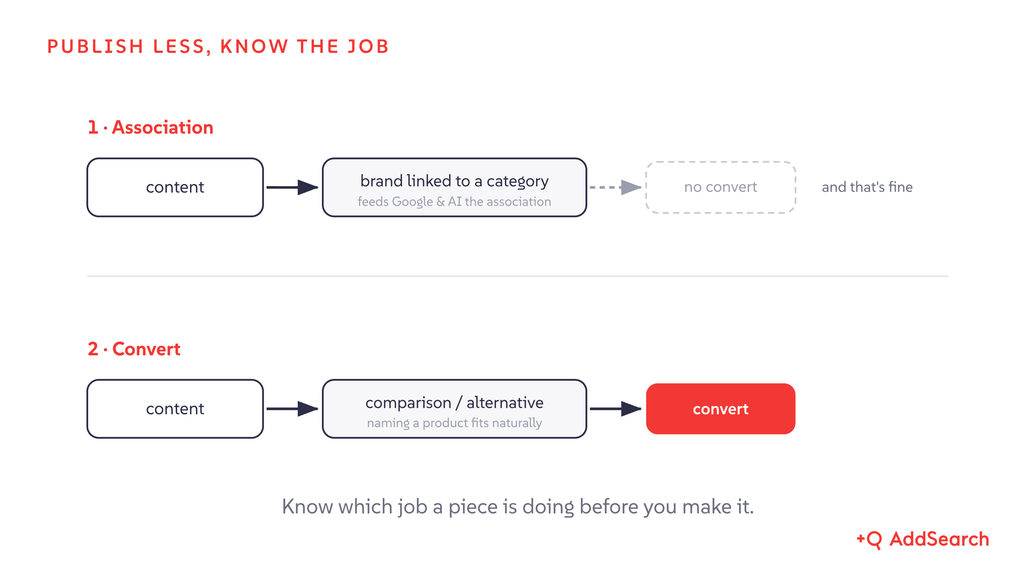
But before she makes anything, she knows which of two jobs it is doing.
| Type of content | Its job | Convert directly? |
|---|---|---|
| Association / authority content | Build the link between your brand and a category, the way certain brands became synonymous with a concept. Feeds Google and AI the association. | No, and that is fine |
| Bottom-of-funnel content | Help someone choose. Comparisons, alternatives, decision content. | Yes, this is where naming a product fits naturally |
Neither is better than the other. The point is to know going in which job a piece is doing, so you are not disappointed when the association piece does not convert. That was never its role.
Becoming a source AI cites, without going flat
This is the part every team worried about AI slop wants to get right. How do you become a source AI references, without flattening your writing into machine-optimized copy?
The reassuring part
Raisa pointed to a Princeton study that tested changes to content and measured what made it more likely to appear in AI-generated answers.
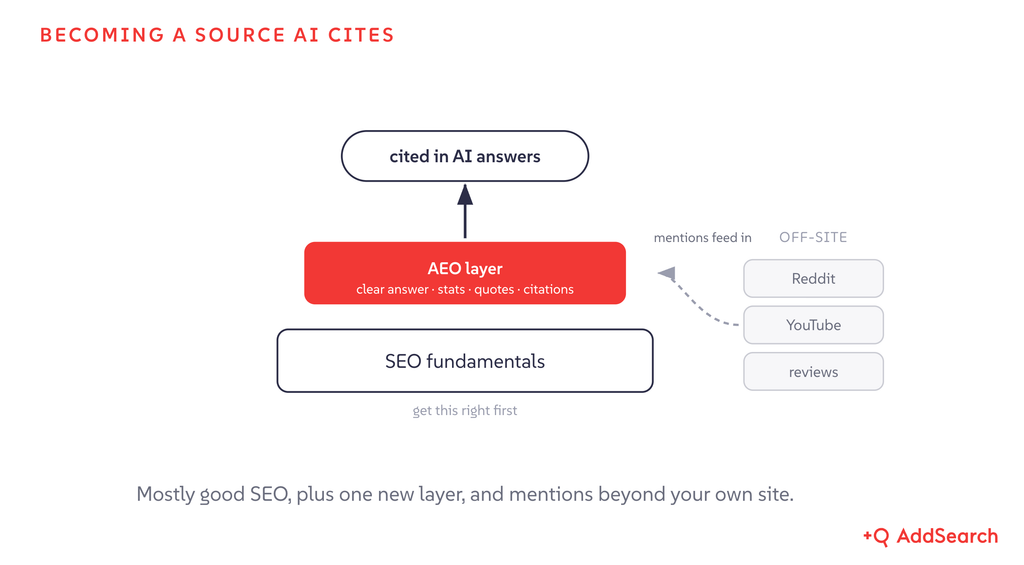
- Adding statistics, quotes, and clear source citations improved the odds of being cited, by roughly 30 to 40 percent in her recollection.
- None of that is new. It is the same good practice, backing up claims with real sources, that predates AI.
Her rule of thumb: winning in AI search, what people call AEO, is mostly solid SEO with a new name. Get the SEO fundamentals right first, then add the extra optimization for AI. Focusing on AEO while skipping the SEO signals underneath does not work.
The real tension
Writing purely to be extracted by a machine pushes you toward flat, templated copy. That is the opposite of what gets cited, because generic content is what gets blended into an answer with no credit to anyone.
“You can still find a good balance between AI friendly and human friendly. That’s part of the job AI still cannot replace, which is making that human judgment.”
If you strip out everything that sounds like a real person, you might get quoted, but there is nothing left worth quoting.
The move most teams miss: get mentioned off your own site
AI does not only read your website. It crawls Reddit, YouTube, Quora, Substack, and LinkedIn too, places you do not control, where people are already talking about you.
That cuts both ways:
- If those third-party signals repeat the same thing about your brand, AI picks it up and stores it, even if it differs from what you say on your own site.
- So part of the work is making sure the way you are described out there matches how you want to be seen.
For a small team, this changes the math:
- Every post you publish only works while you keep publishing. Stop for a month and the momentum stops with you.
- A Reddit thread, a review, or a guest spot that recommends you keeps getting surfaced long after you have moved on.
As Raisa put it, she would rather spend an afternoon getting in front of the right community than write another post nobody was waiting for. Owning your domain still matters. It is just not enough on its own anymore.
The back catalogue: refresh, do not date-swap
Most teams are sitting on years of old content. Raisa treats that archive as one of the biggest and most overlooked opportunities a team has, especially when budget for new content is tight.
Freshness matters more now, not less. She cited an Ahrefs study finding that AI answers tend to favor newer content more than regular search does. An old page can quietly disappear from AI answers even if it ranked well on Google for months.
The trap
Changing the publish date without changing anything else does not work, and it can backfire. Google’s late-2025 update specifically went after pages that did this. The content itself has to change.
A real refresh means:
- New data replacing old data.
- Fixed mistakes and outdated claims, like stale pricing.
- Updated examples, and sometimes a different angle if things have moved.
- Even something as simple as rewriting the FAQs counts, as long as it is genuine.
The three-question audit
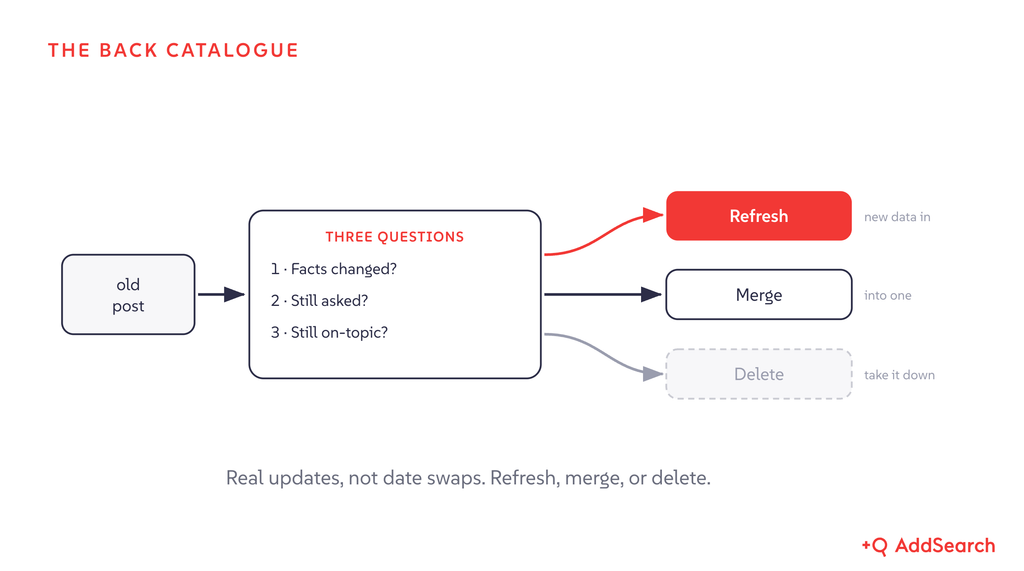
When Raisa audits old content, she runs each piece through three questions.
| Question | If yes | If no |
|---|---|---|
| Have the facts in it changed? | Refresh: swap in new data | Leave the facts as they are |
| Is anyone still asking this? | Keep it in play | Candidate for removal |
| Does it still connect to what you sell? | Worth maintaining | Candidate for removal |
How the answers combine:
- Facts changed, people still asking: refresh.
- Several pieces answering slightly different versions of the same question: consolidate into one stronger piece.
- Facts outdated, nobody asking, no link to the product: delete.
That last one is the step teams skip most. Deleting content you spent time and budget on feels wrong. But a page that answers a question nobody asks and connects to nothing you sell is not neutral. It is noise in the archive, and it can drag down how AI and search engines see the rest of your site.
One example from Raisa: a comparison piece that was two years stale, rebuilt with current pricing and a genuinely new angle, went on to outperform several brand-new posts from the same quarter. The old piece already had structural trust, links, history, familiarity, that a new post has to earn from zero.
Distinctly human is the same thing as citable
There is a temptation to treat “human” and “optimized for AI” as opposites. Raisa’s experience is that they are not.
What makes content feel human, a real opinion, lived experience, your own data, a snippet from your sales team, is also what a machine cannot copy. So writing for a person and writing something worth citing point the same direction.
Her practical split:
- AI can help with the drafting and the research.
- The human makes sure it is correct, and adds the experience and specifics that make it worth reading in the first place.
This shows up most in comparative content, the “which tool should I pick” and “which approach is better” questions. B2B buyers are tired of content that plays it safe and recommends nothing. A clear opinion, or a real account of having made the decision yourself, is more useful than a balanced list that helps no one choose.
Talking about value without overclaiming
When traffic is down but the business is fine, content leads still have to explain their worth to people who grew up on the traffic graph. Raisa says this is the conversation she has most often.
The reframe is the same one from the start: content did not stop working, the number people trusted stopped meaning what they think it means.
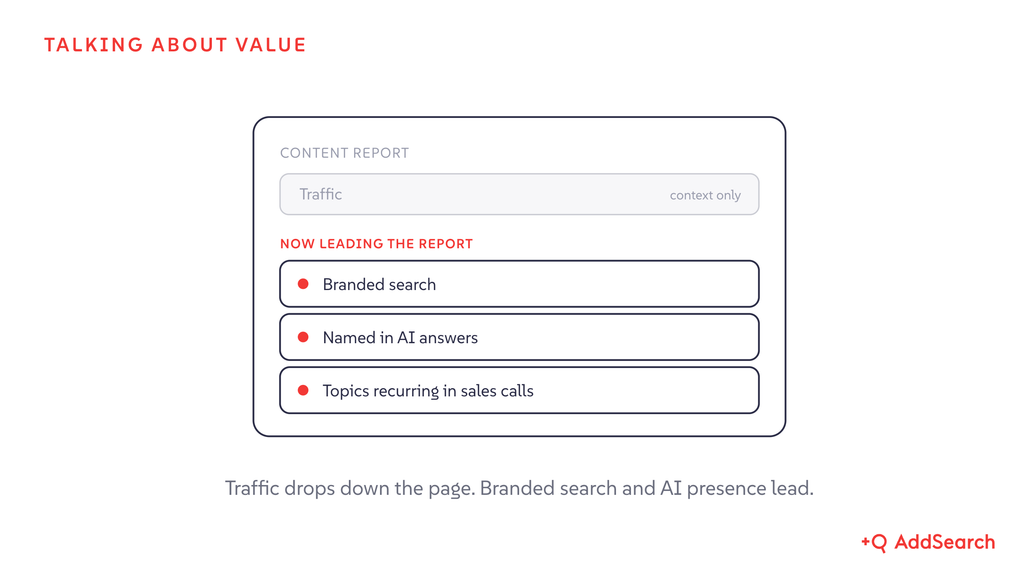
What Raisa watches instead
- Branded search. Are people searching for you by name? Strong branded search means the association has landed, people have heard of you from somewhere.
- How AI represents you. Are you named as the solution, or just pulled in as a source?
- Reviews and third-party perception. Check G2 and review sites against your own positioning. If there is a mismatch, that is your signal something needs fixing. If it matches, you are pointed the right way.
On attribution, show patterns, not false precision
You cannot honestly say one blog post closed a deal, because almost nothing closes on a single touch anymore.
So instead of forcing a number that is not really there, Raisa shows the pattern.
- If a topic keeps coming up in sales calls, the content is doing its job, even if no single page can be credited.
- Ask recently converted customers directly: how did you hear about us? That first-party answer often catches the touches your tracking missed.
At AddSearch we do exactly this with a “how did you hear about us” field at signup and meeting booking, then compare what users say against what our attribution reports claim. The gap between the two is usually the interesting part.
Keep one thing, let go of one thing
I closed by asking Raisa for one thing content teams should keep doing, and one thing to let go of.
Keep: be the source AI relies on. If AI is part of how you produce content, you have to know your brand, your product, and your ICP better than the model does, so you can feed it the right information and catch it when it is wrong.
Let go: the fixation on traffic. It was always a stand-in for something else, and right now it is a stand-in that is actively misleading you. The landscape may shift again in a year or two. Watch the whole journey and connect the dots instead of living and dying by one number.
What a good content team looks like in two years
Raisa’s bet:
- Smaller, with AI handling more of the production.
- Publishing less on the website, but each piece more unique and harder for AI to absorb.
- Paying far more attention to places beyond the domain: Reddit, YouTube, getting mentioned by other people.
The question shifts from “what should we publish next month” to “how do we get people talking about what we already have.” More distribution, less pure production. Owning the domain still matters. It is just the starting point now, not the whole game.
A note from us
At AddSearch, we spend a lot of time thinking about how people find and get answers from content, so this shift is close to home. This conversation is a reminder that the work still matters as much as it ever did. What is changing is how we prove it, and where we show up.
Thanks to Raisa Yogiaman for a genuinely useful conversation. You can find more from her at saas.group.
FAQs
What is the zero-click era?
It refers to searches that end without a click to any website, because the answer appears directly in the search results or in an AI assistant. Recent clickstream data puts the share of US Google searches ending without a click at around two in three.
Is SEO still worth it with AI search?
Yes. Getting cited by AI answers is mostly built on the same fundamentals as good SEO. The practical approach is to get the SEO signals right first, then add extra optimization for AI search, often called AEO.
What content still works when AI answers most questions?
Content that cannot be compressed into a one-line answer: proprietary data, customer stories, real experience, and clear opinions. A useful test is whether anyone else could have written the piece from public information alone.
How do you refresh old content without just changing the date?
Make real changes: update data, fix outdated facts and pricing, refresh examples, or add a new angle. Date-only changes do not count and can backfire after Google’s late-2025 update targeting them.
What should content teams measure instead of traffic?
Branded search, how AI represents your brand, third-party perception on review sites, and patterns like topics recurring in sales calls. Traffic stays as context, not the headline.
