



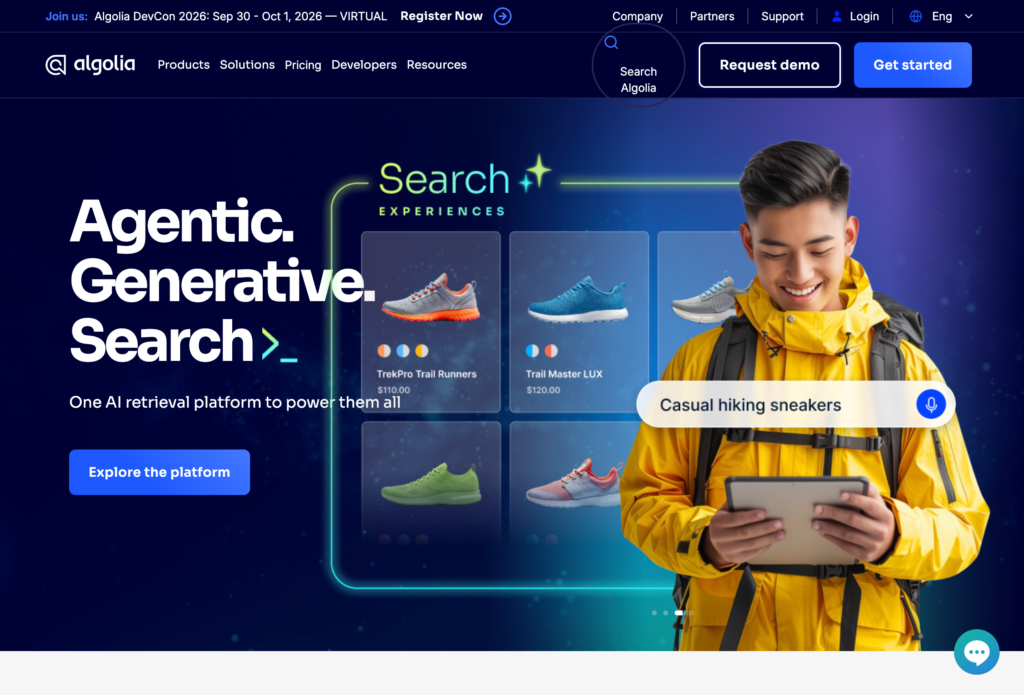
Algolia is a hosted, API-first search platform used by thousands of websites and apps to power product search, autocomplete, and content discovery. It is one of the most recognized names in the search-as-a-service space, known for fast, developer-friendly implementation.
That reputation is well earned for the use case Algolia was built around: developers building search into apps and e-commerce catalogs. But a growing number of organizations outside that use case are looking for something different, and for good reason.
Algolia’s own pricing page lists four plans:
- Build: free, with 10,000 search requests and 1 million records included per month. Meant for testing all features.
- Grow: self-serve, pay-as-you-go, no annual commitment. Includes 10,000 search requests per month, then $0.50 per additional 1,000 requests, plus $0.40 per additional 1,000 records beyond the included 100,000.
- Grow Plus: same usage allowances as Grow, but adds AI capabilities like AI Synonyms, AI Ranking, and Advanced Personalization. The added AI pushes the rate up to $1.75 per additional 1,000 search requests, more than three times the Grow rate.
- Elevate: an annual plan with volume-based discounts and custom request/record limits. Adds NeuralSearch (semantic search), AI Collections, Smart Groups, real-time personalization, and enterprise-level SLA and support.
That structure means costs on the self-serve tiers can rise as traffic and AI usage grow, since the AI-enabled Grow Plus tier costs more than three times as much per additional request compared to standard Grow. For the full enterprise AI feature set on Elevate, exact pricing requires a conversation with Algolia’s sales team.
Beyond pricing structure, Algolia is also built primarily around product catalogs and e-commerce-style discovery. Organizations with content-heavy websites, universities, government agencies, and financial services firms often find the platform requires significant developer time to configure for non-product content.
This article looks at 7 top Algolia alternatives: what each one does well, where it falls short, and which type of organization it tends to fit best.
1. AddSearch
AddSearch is an AI search and conversational content discovery platform. It brings together keyword search, direct AI-generated answers, and context-aware conversational search into one unified experience, rather than asking organizations to stitch together separate tools for each.
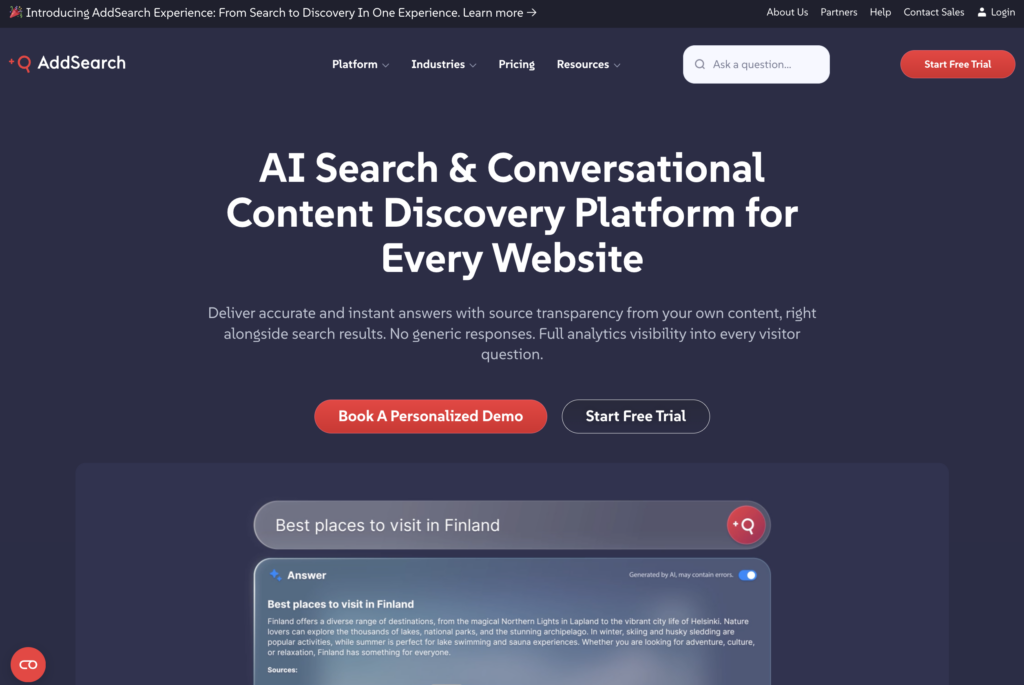
The platform is built for websites of any size that want visitors to find what they need quickly, whether that means a fast keyword result, a direct answer to a specific question, or a guided conversation that helps someone explore a topic. Universities, government agencies, financial services firms, associations, and corporate websites all use AddSearch today. The underlying capability, helping any website turn its content into answers people can actually use, works just as well for a small site as it does for a large one.
What makes AddSearch different from Algolia
The clearest difference is who each platform is built for. Algolia is a developer-first platform. Implementing it well, tuning relevance, configuring indices, building the right ranking rules, generally requires engineering resources. AddSearch is built for both developers and business teams. Developers get full documentation, libraries, and APIs to build and extend the experience exactly how they need. Business users, marketing teams, and content teams can manage and adjust search and discovery independently, without waiting on a developer for every change.
Algolia offers a conversational answer product called Ask AI, which delivers cited, multi-turn answers generated from indexed content, along with a separate Generative Experiences framework for building broader generative AI features, such as shopping assistants. The key difference is in who has to build and maintain it. Ask AI requires you to bring and manage your own LLM provider and API key, and it is positioned primarily for documentation and support content. Generative Experiences is a developer toolkit, APIs and UX libraries you build on top of, not a managed, ready-to-use product.
AddSearch AI offerings work differently: it is included as a managed capability with no separate LLM setup required, and it is built for content-heavy websites broadly, not just developer documentation.
On pricing specifically: Algolia’s self-serve tiers are usage-based, and the AI-enabled tier (Grow Plus) costs more per request than standard search, while full enterprise AI (Elevate) requires a custom quote with no published figure.
AddSearch’s pricing is published directly:
Keyword Search plans start at $119 per month on an annual plan. AI Answers starts from $8,400 per year, and custom pricing is available for AI Conversations and AddSearch Experience.
How the AddSearch’s unified experience looks in practice
From keyword search to conversational discovery, it all comes together in one unified experience.
- Fast, accurate keyword search with typo tolerance and relevant filtering
- Direct answers to specific questions, generated from the organization’s own indexed content, with source citations
- Context-aware conversations that remember what a visitor has already asked and let them dig deeper naturally
A visitor can naturally move between these. Someone might start by typing a keyword, get a direct answer along with the search results, and then ask a follow-up question that turns into a short conversation, all within the same search experience.
Other things worth knowing
- Answers are grounded only in the organization’s own indexed content. AddSearch does not pull information from external sources.
- Your data is not used to train any AI model.
- AddSearch is SOC 2 Type II certified.
- WCAG 2.1 is supported.
- Standard setup is typically completed in a few days.
- A 14-day free trial is available using the organization’s own website content.
Best for: For organizations seeking an enterprise-grade AI search and content discovery platform that delivers exceptional speed, precision, and reliability without the heavy burden of ongoing developer maintenance, AddSearch is engineered for exactly that.
Start a free trial now: https://app.addsearch.com/signup/user
2. Elasticsearch
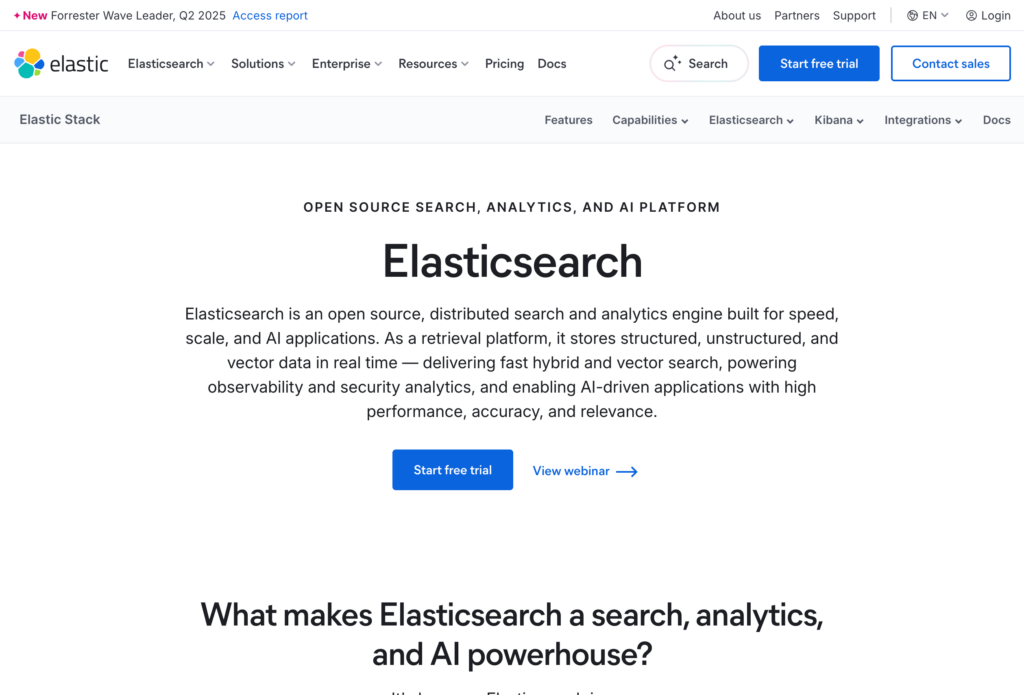
Elasticsearch is an open-source search and analytics engine built on Apache Lucene. It is one of the most widely deployed search technologies in the world, used for everything from website search to log analytics and observability. It is infrastructure, not a finished product, so most of what it does well depends on the team building on top of it.
In 2026, Elastic has continued to expand its AI capabilities, including multimodal search through the Elastic Inference Service and tooling aimed at AI agent workflows. These are genuinely useful additions for engineering teams with the resources to use them, though they do not change the fundamental nature of the platform: it remains something you build and operate, not something you configure through a business-friendly dashboard.
Elasticsearch limitations to consider
- No business-facing dashboard for non-technical teams to manage search independently
- No AI Answers or conversational search as a managed, out-of-the-box product
- Requires meaningful engineering expertise to configure, scale, and maintain
- Significant ongoing operational overhead
Elasticsearch Pricing:
Self-hosted Elasticsearch is free and open-source, though you carry the full operational cost. Elastic also publishes three managed paths with real figures:
- Elastic Cloud Hosted: starts at $99 per month for the Standard tier (based on a 120GB, 2-zone production configuration), scaling up to $184 per month for the Enterprise tier, which adds Agent Builder, AI Playground, and semantic reranking.
- Elasticsearch Serverless: metered by usage across compute, storage, and AI inference tokens. Elastic’s own published examples show a small development environment running around $24 to $27 per month, and a moderate production environment (20GB of data, 8 hours of daily search activity) running around $190 to $210 per month.
Best for: Organizations with engineering teams who need full infrastructure control and are prepared to build their own search experience on top of it.
3. Typesense
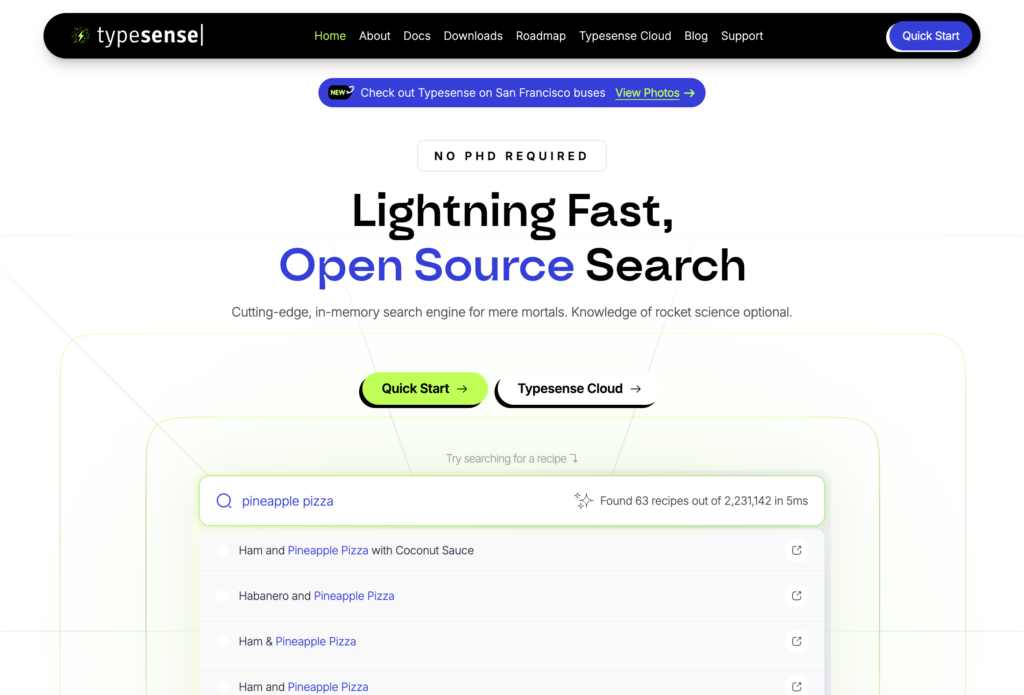
Typesense is an open-source search engine, written in C++, built around speed and developer experience. It is often positioned as a fast, self-hostable alternative to Algolia, with sub-50ms search performance and built-in typo tolerance.
In 2026, Typesense added built-in retrieval-augmented generation (RAG) support and automatic embedding generation, which lets developers build AI-powered search features without standing up a separate embedding pipeline. This is a meaningful capability if your team wants to build a custom AI search experience from scratch.
Typesense limitations to consider
- It is a developer tool. There is no business-facing dashboard for non-technical teams to manage or adjust search.
- Any AI Answers-style or conversational experience would need to be built by your developers; it is not a managed feature.
- Pricing is resource-based rather than a simple flat tier, which means estimating cost requires understanding your memory, CPU, and traffic needs in advance.
Typesense Pricing:
Self-hosting is free. Typesense Cloud uses an hourly, resource-based calculator rather than a flat starting price. Cost depends on:
- RAM and CPU
- High availability setting
- Storage type
- Data center location
For an accurate figure, use Typesense’s own pricing calculator directly for your specific use case.
Best for: Developer-led teams who want a fast, self-hostable search engine they are comfortable configuring and maintaining themselves.
4. Coveo
Coveo is an enterprise AI search and personalization platform. Its core strength is federated search, bringing together content from a CRM, CMS, knowledge base, support portal, and website into a single search experience. It has deep, established integrations with Salesforce, Sitecore, ServiceNow, and SAP.
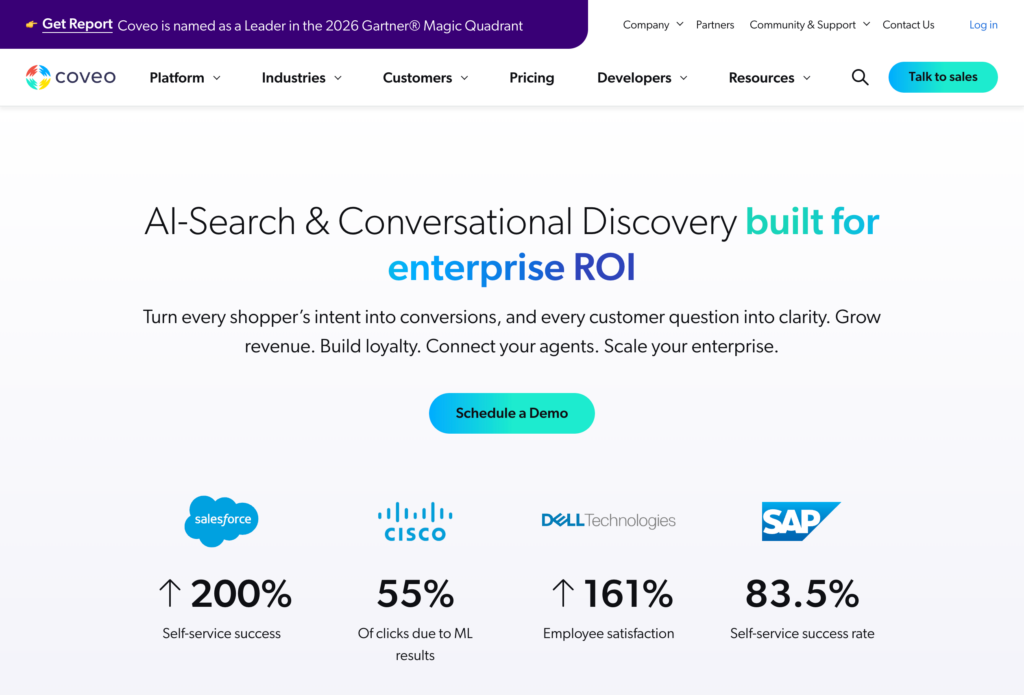
Coveo’s own pricing page, structured around two offerings, confirms how its packaging works. The first offering, Service, Website, and Workplace, covers enterprise knowledge experiences for customers, agents, and employees, priced on entitlement-based licensing for Service and Website use cases plus seat-based pricing for Workplace.
The second offering, Commerce, covers product discovery for B2B and B2C shoppers, with scalable, modular pricing built around a feature-rich base package plus add-ons. Across both offerings, each pricing unit includes 100,000 queries per month as a baseline. Generative AI and agentic capabilities, including Conversational Search, Generative Answering, and Coveo’s Conversational Product Discovery for commerce, are explicitly listed as “Add-on Available” rather than included in the base package.
Coveo limitations to consider
- Generative AI and conversational capabilities are explicitly add-ons on both the knowledge and commerce sides, not included in the base package.
- Implementation typically takes months and benefits from a dedicated internal search team.
- Buyers consistently describe the consumption-based, query-volume pricing model as difficult to forecast at scale.
Coveo Pricing:
Coveo for Salesforce pricing starts at $100K per year.
Coveo’s pricing for its ‘Service/Website/Workplace’ and ‘Commerce’ offerings is not public. Both are structured around a 100,000-query-per-month base unit with usage-based scaling. Cost depends on:
- Which offering you choose: Service/Website/Workplace or Commerce
- Query volume beyond the included base unit
- Add-ons like Conversational Search, Generative Answering, or Conversational Product Discovery
For an accurate figure, contact Coveo’s sales team directly through their pricing page.
Best for: Large enterprises with complex, multi-source content ecosystems and the budget and team to support a longer implementation.
5. Doofinder
Doofinder is a search and product discovery platform built specifically for e-commerce. It integrates with platforms like Shopify, WooCommerce, Magento, BigCommerce, and PrestaShop.
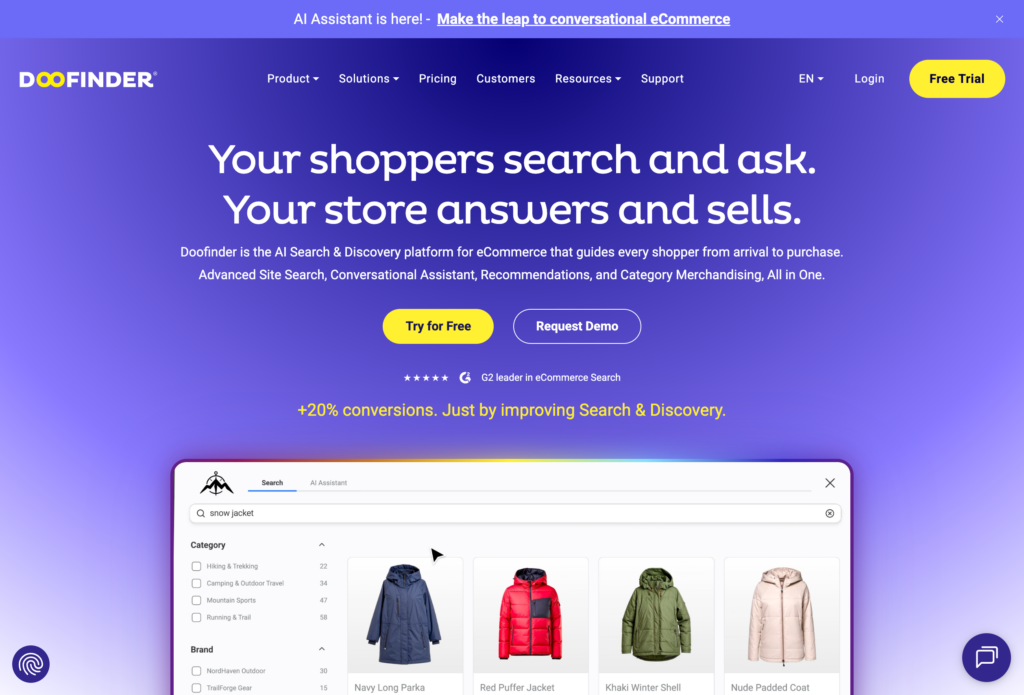
In 2026, Doofinder restructured its plans so that Search, Recommendations, and Quiz Maker are now included across all three main tiers. Separately, an AI Assistant, a conversational layer aimed at guiding shoppers toward products, is available as an add-on on the Pro, Advanced, and Enterprise plans, with pricing available on request.
This is a retail-first product. If your organization runs a content-heavy, information-driven website rather than a product catalog, Doofinder’s feature set is not built around your use case.
Doofinder limitations to consider
- The platform is built exclusively for e-commerce product discovery, not content-driven websites.
- There is no AI Answers-style capability grounded in general website content; the AI Assistant is a paid add-on focused on product discovery, not included by default.
- Pricing complaints appear in public reviews, including a documented case from March 2026 describing a substantial unexpected price increase on an existing account.
Doofinder Pricing:
Doofinder’s own pricing page lists three main plans. The rates below reflect annual billing:
- Basic: $44/month billed annually, up to 10,000 requests/month for each of Search, Recommendations, and Quiz Maker
- Pro: $134/month billed annually, up to 150,000 requests/month
- Advanced: $314/month billed annually, up to 400,000 requests/month
- Enterprise: custom pricing
The AI Assistant add-on is priced separately and requires contacting Doofinder directly for a quote.
Best for: Online retailers who need plug-and-play product search, recommendations, and merchandising tools.
6. Meilisearch
Meilisearch is an open-source search engine written in Rust, built for developer simplicity and speed. It is fully free to self-host under the MIT license, with no feature gating on the open-source version. Meilisearch is used by organizations including Hugging Face and Louis Vuitton.
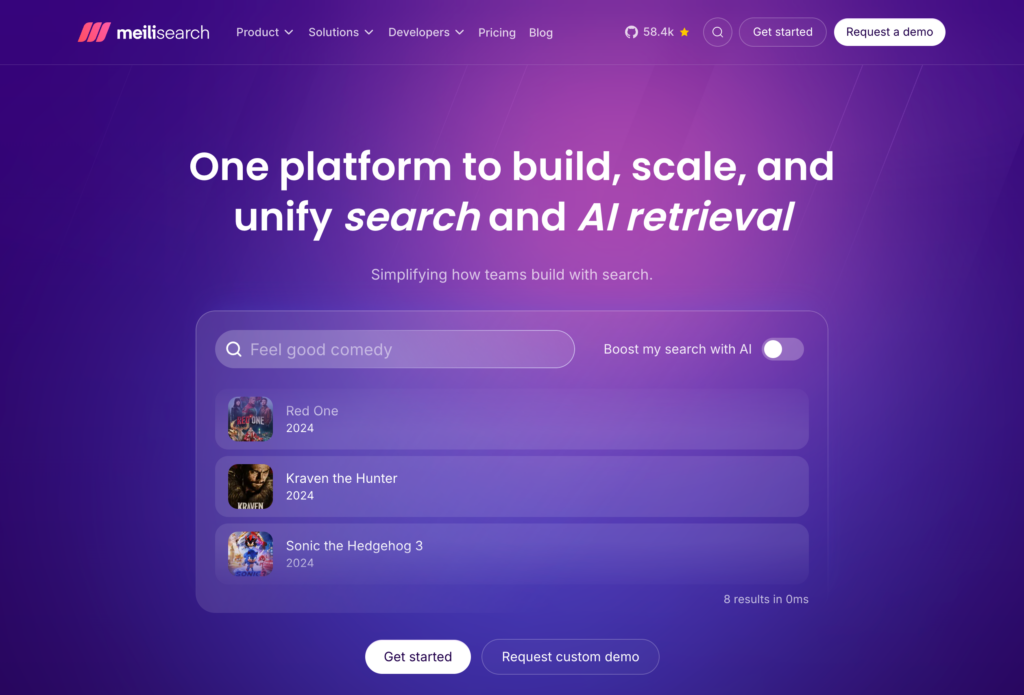
Meilisearch has outlined a 2026 roadmap that includes serverless indexes, its own AI gateway, and a more capable chat-style engine, suggesting the platform intends to expand beyond pure keyword and vector search over time. As it stands today, it remains a developer-oriented tool rather than a business-managed platform.
Meilisearch limitations to consider
- No business-facing dashboard. Non-technical teams cannot independently manage search configuration.
- No managed AI Answers or conversational search product currently available.
- Support on the open-source tier is community-based rather than dedicated.
Meilisearch Pricing:
Self-hosting is free. Meilisearch Cloud starts at $20/month. Their built-in cost estimator gives two examples:
- Usage-based: $30/month for a base configuration (100,000 documents, 50,000 searches)
- Resource-based: $23/month for a smaller instance
Enterprise: custom pricing, adds SSO, SOC 2 compliance, a dedicated Slack support channel, and an uptime SLA of up to 99.999%.
Best for: Developer teams who want a fast, open-source search engine and are comfortable managing their own infrastructure or a lightweight managed cloud plan.
7. Bloomreach
Bloomreach is a commerce experience platform combining AI-powered product discovery, marketing automation, a headless CMS, and a customer data platform.
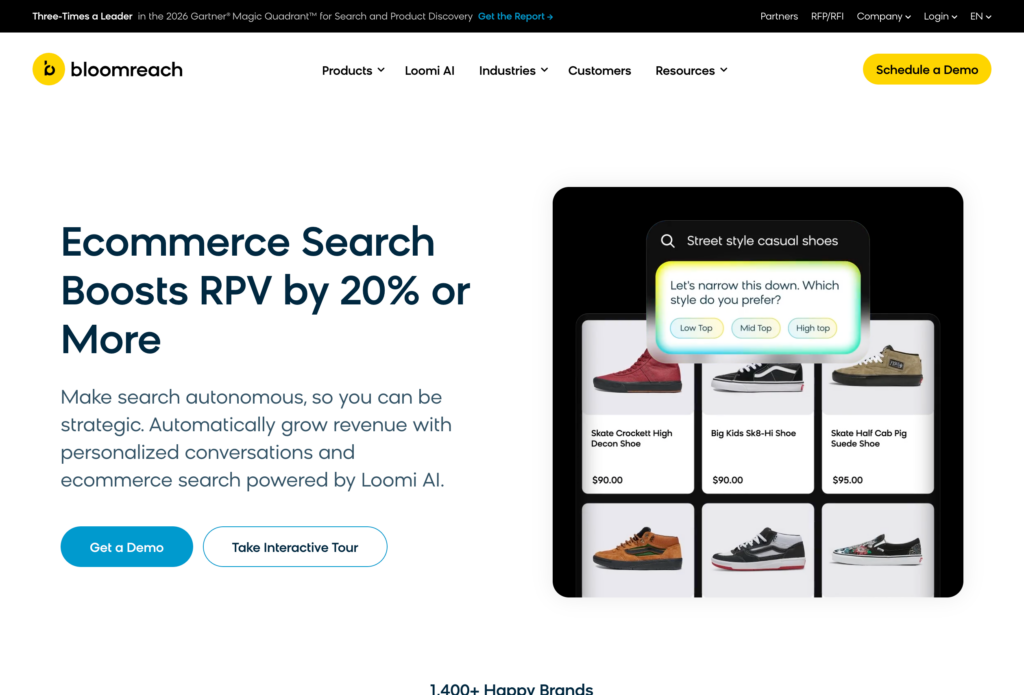
Its current product lineup includes Marketing Automation (email, mobile messaging, web and app personalization, ad optimization), Search (product discovery, categories, recommendations), the Loomi Conversational Agent (an on-site shopping assistant), and the Loomi Marketing Agent (autonomous campaign creation).
Loomi, Bloomreach’s AI layer, is built into every product by default; more advanced AI capabilities are available as premium add-ons.
Bloomreach is built specifically for enterprise retail. If your organization is not running a high-volume product catalog or a marketing program with the channel complexity Bloomreach is designed for, the platform’s capabilities are not built with your use case in mind.
Bloomreach limitations to consider
- Built around two size metrics, monthly unique visitors and billable profiles, which means pricing scales with audience size regardless of how simple your actual use case is.
- No AI Answers capability for general information or content-based questions; Loomi’s conversational capability is a product-discovery shopping agent, not a content Q&A tool.
- Bloomreach publishes no numerical pricing anywhere on its site. Every plan requires a custom quote based on your traffic and database size.
- For the Search product specifically, Bloomreach’s own FAQ states implementation typically takes around six weeks.
Bloomreach Pricing:
Bloomreach does not publish any dollar figures publicly on its own pricing page, for any product. Getting a direct quote requires sharing:
- Your monthly unique visitor count
- Your customer database size
- Which products you’re interested in
An advisor then responds with a ballpark estimate, typically within a business day. There is no free tier.
One confirmed data point comes from Bloomreach’s own “Loomi AI” listing on the Shopify App Store, which does publish dollar figures for two specific packages:
- Email Marketing: $22,500/year
- Ecommerce Search (includes Product Search, Conversational Shopping Agent, Merchandising & Categories, and Product Recommendations): $45,000/year
These figures apply specifically to Shopify merchants installing this listing and may not reflect pricing for non-Shopify deployments or other Bloomreach products.
Best for: Large enterprise retailers managing high-volume product catalogs and complex omnichannel commerce operations.
How These Algolia Alternatives Compare
| What matters | Algolia | AddSearch | Elasticsearch | Typesense | Coveo | Doofinder | Meilisearch | Bloomreach |
| Built for content-heavy and general-purpose sites | Yes, but e-commerce and app search as primary focus. | Yes | Partial (infra only) | Partial (infra only) | Yes, with high complexity | No, e-commerce only | Partial (infra only) | No, e-commerce only |
| Direct, content-grounded AI answers | Yes, via Ask AI (requires bringing your own LLM) | Yes | No | No, would need custom build | Yes, as a paid add-on | No | No | No |
| Conversational search that remembers context | Yes, via Ask AI | Yes | No | No, would need custom build | Partial, via add-on | Partial, product-focused assistant | No | Partial, product-focused (Loomi Conversational Agent) |
| Manageable without developer resources | No | Yes | No | No | Partially, with training | Yes | No | Partially, with training |
| Publicly confirmed starting price | Partially (Grow/Grow Plus rates published; Elevate is not) | Yes, $119/mo for Keyword Search, $8,400 for AI Answers | Yes, from $99/month (Cloud) | No flat figure published | No amount published on their own site; Coveo for Salesforce starting from $100K | Yes, from $44/month | Yes, from $20/month | No dollar figures published on Bloomreach’s own site; Shopify listing shows $22,500 to $45,000/year |
| Typical setup time | Days (self-serve); longer for Elevate | Days | Weeks to months | Weeks | Months | Days to weeks | Days to weeks | Months |
| Works alongside an existing search provider | N/A (this is the existing provider in this comparison) | Yes | N/A | N/A | Possible, with integration work | No | N/A | No |
Final Thoughts
For organizations seeking an enterprise-grade AI search and content discovery platform that delivers exceptional speed, precision, and reliability without the heavy burden of ongoing developer maintenance, AddSearch is engineered for exactly that.
It seamlessly unifies advanced keyword search, direct AI-generated answers, and context-aware conversations into a single secure experience: grounded strictly in your own data and backed by robust enterprise security. Unlike traditional legacy implementations that drag on for months, AddSearch deploys in days and integrates smoothly with your existing infrastructure. You get a sophisticated, highly scalable search architecture with transparent, predictable pricing and a significantly lower total cost of ownership.
You can start a 14-day free trial using your own website content, or book a short walkthrough with our team to see how it would work on your site.
Start your 14-day free trial: https://app.addsearch.com/signup/user
Book a demo: https://www.addsearch.com/addsearch-experience-demo/
