



Have you ever found yourself typing a complex question into a website’s search bar, only to be met with a list of semi-relevant links rather than the direct answer you were seeking? You’re not alone. While traditional search has served us well for decades, the gap between how humans naturally ask questions and how search engines process queries has remained a persistent challenge—until now.
The Evolution of Search Technology
From Keywords to Conversations
Traditional search has always operated on a relatively simple principle: match keywords in a query to keywords in content. Although the search vendors developed their solutions beyond simple keyword match with additional features based on user behaviors and content ranking, the experience has not always been complete.

Humans needed to learn “how to search” to match the software’s logic rather than how they would communicate. When you need to ask for help about the location of your coffee mug, the person next to you at the office, you do not shout “coffee mug” at people, right?
We ask questions like “How do I return an item I purchased last week?” rather than “return policy e-commerce procedure.” We seek contextual understanding, not just keyword matching. This fundamental disconnect between human communication and search functionality has created friction in the user experience for years.
The Limitations of Traditional Search
Traditional search engines face several challenges:
- They struggle with natural language questions
- They often return document links rather than direct answers
- They lack contextual understanding of user intent
- They require users to know the correct terminology
- They make users sift through results to find relevant information
These limitations force users to adapt to technology, rather than technology adapting to users—a backwards approach in today’s user-centric digital landscape.
What is Conversational AI Search?
Conversational AI Search is an advanced approach to information retrieval that enables users to interact with search systems using natural language, just as they would in a human conversation.
Rather than simply matching keywords, these systems understand context, interpret intent, and deliver direct, comprehensive answers to questions.
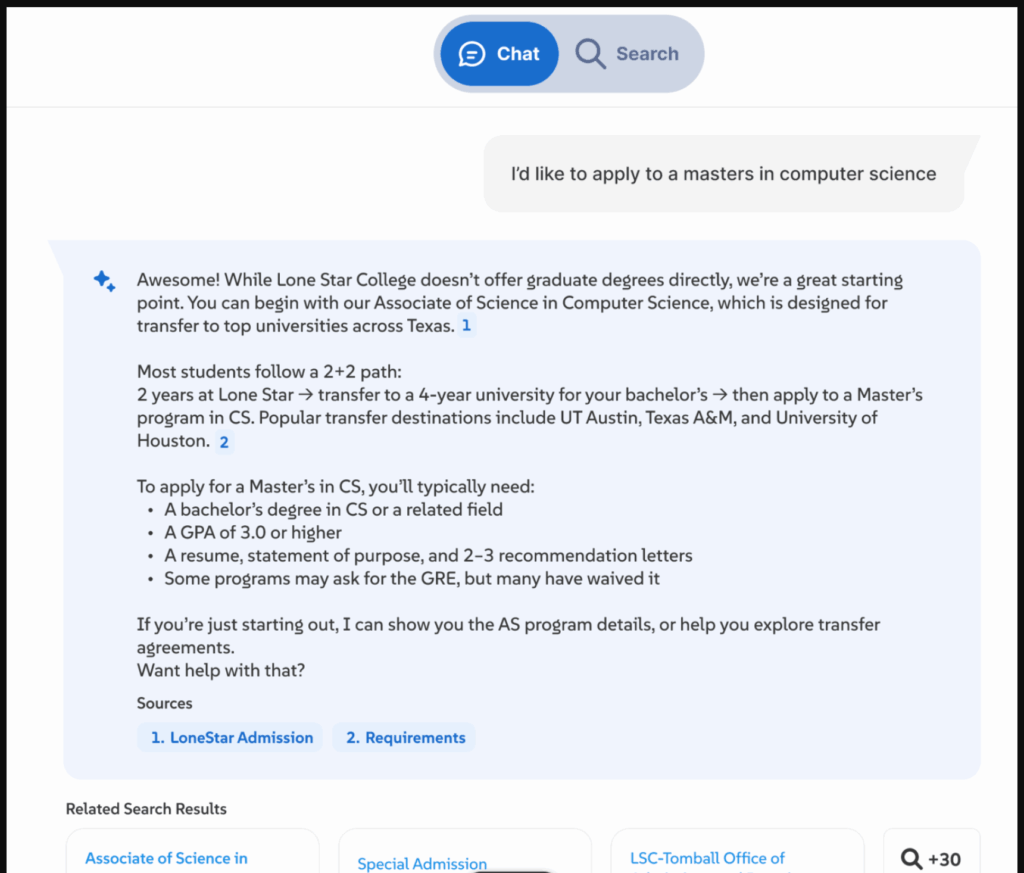
At its core, Conversational AI Search combines several cutting-edge technologies:
- Natural Language Processing (NLP) to understand the meaning behind queries
- Machine Learning to continuously improve response accuracy
- Knowledge Graphs to connect related concepts and information
- Neural Networks to understand context and nuance
- Information Retrieval Systems to locate relevant content
How Conversational AI Search Works
When a user enters a query, the system doesn’t just look for matching words—it works to understand what the user is actually asking. It analyzes the semantic meaning of the query, identifies entities and relationships within it, and determines the true intent behind the question.
Once it understands the query, the system doesn’t just point to relevant documents—it extracts and synthesizes information from across your content to craft a direct, comprehensive answer. It’s the difference between saying “here’s where you might find that information” and “here’s the specific information you need.”
The Benefits of Implementing Conversational AI Search
1. Enhancing User Experience
The primary advantage of Conversational AI Search is its ability to deliver a more intuitive, frictionless experience. Users can ask questions in their own words and receive immediate, relevant answers—no advanced search techniques required.
This approach significantly reduces the cognitive load on users, eliminating the need to:
- Translate their question into search-friendly keywords
- Navigate through multiple pages to find information
- Piece together answers from various sources
2. Business Advantages
For businesses, implementing Conversational AI Search delivers measurable benefits:
- Reduced support costs: When users can find answers themselves, support tickets decrease
- Increased conversion rates: Removing friction from the information discovery process leads to more completed transactions
- Extended time on site: Engaging, helpful answers encourage deeper exploration
- Valuable user insights: Natural language queries reveal what customers really want to know
- Competitive differentiation: Advanced search experiences set your digital properties apart
Real-World Applications of Conversational AI Search
1. E-Commerce and Retail
In retail environments, Conversational AI Search transforms the product discovery experience. Rather than forcing users to browse through categories or know exact product names, they can ask naturally:
“What running shoes would work best for someone with flat feet?”
“Do you have waterproof jackets that pack into their own pocket?”
The system understands these queries and can provide targeted recommendations that match the specific criteria, significantly improving conversion rates and customer satisfaction.
2. Financial Services
Financial institutions manage vast amounts of complex information. Conversational AI Search helps customers navigate this complexity with queries like:
“What documents do I need to apply for a mortgage?”
“How do I dispute a charge on my credit card?”
Instead of directing users to lengthy policy documents, the system extracts and presents the precise information needed, improving self-service rates and reducing support costs.
3. Healthcare and Pharmaceutical
In healthcare, accurate information delivery is critical. Conversational AI Search helps patients find reliable information with questions like:
“What are the side effects of this medication?”
“How should I prepare for my upcoming procedure?”
The system can deliver authoritative answers from trusted content, ensuring patients receive accurate information while reducing the burden on healthcare providers.
How AddSearch Delivers Advanced Conversational AI Search
AI Answers: Beyond Traditional Search
At AddSearch, we’ve developed AI Answers to bridge the gap between how users naturally ask questions and how search technology traditionally works. Our solution doesn’t just match keywords—it understands questions, processes context, and synthesizes information to deliver clear, direct responses.
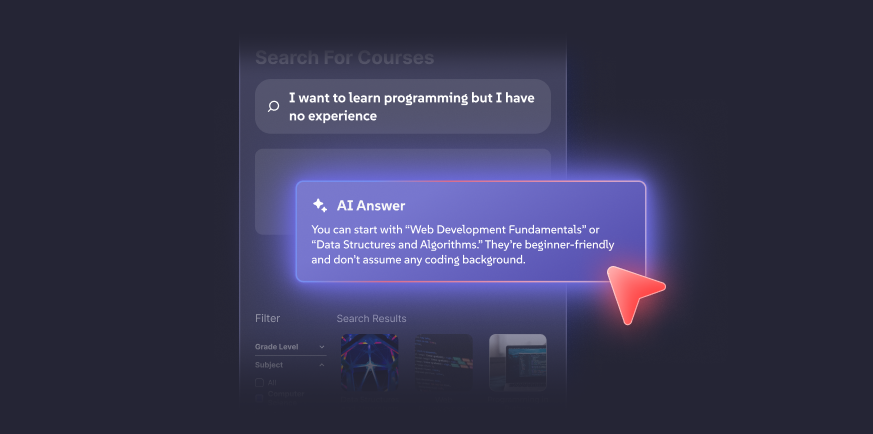
Unlike basic chatbots or keyword-based search engines, AI Answers:
- Understands the nuance and intent behind natural language questions
- Pulls information from across your trusted content sources
- Synthesizes comprehensive answers rather than just linking to pages
- Provides citations to build user confidence in responses
- Continuously improves based on user interactions
Seamless Integration with Existing Content
One of the most powerful aspects of AddSearch’s Conversational AI Search is that it leverages your existing content. There’s no need to create separate answer databases or FAQ repositories. The system intelligently extracts and combines information from your website, knowledge base, product documentation, and other authorized sources.
This approach ensures consistency between your published content and the answers provided, while maximizing the return on your content investment.
The Future of Conversational AI Search
Evolving Capabilities
Conversational AI Search continues to evolve rapidly. As the underlying technologies advance, we’re seeing emerging capabilities:
- Multimodal understanding: Processing and responding with text, images, and other media
- Personalized responses: Tailoring answers based on user history and preferences
- Proactive suggestions: Anticipating follow-up questions and information needs
- Conversational memory: Maintaining context across multiple interactions
Preparing for an AI-First Search Experience
As these technologies become more sophisticated, user expectations are evolving as well. Forward-thinking businesses are already planning for a future where conversational interactions become the primary way users engage with digital properties.
Organizations that implement Conversational AI Search today aren’t just improving their current user experience—they’re building the foundation for the next generation of digital interactions.
Getting Started with Conversational AI Search
Assessing Your Readiness
Implementing Conversational AI Search doesn’t have to be complicated, but it does require thoughtful preparation. Key considerations include:
- The quality and coverage of your existing content
- The types of questions your users typically ask
- The technical capabilities of your current website or application
- Your goals for user experience improvement
Taking the Next Step
Ready to transform how users interact with your website? AddSearch makes implementing advanced Conversational AI Search straightforward:
- We analyze your content and common user queries
- Our team configures AI Answers to your specific needs
- You review and approve the implementation
- We continuously optimize performance based on real user interactions
Experience the Future of Search Today
The gap between how humans naturally communicate and how search has traditionally worked is finally closing. With Conversational AI Search, your users can ask questions in their own words and receive direct, helpful answers—transforming their experience and delivering measurable business results.
That’s why AddSearch is preparing to launch AI Conversations, bringing intelligent, natural interactions tailored to your content.
Join our waiting list today and be among the first to unlock this new experience. 🚀
