



For years, plenty of teams solved on-site search the quick way. They dropped in Google Programmable Search Engine, formerly Google Custom Search, and moved on. It was free to start, it used Google’s index, and it took minutes to embed.
That shortcut is now running into two walls at once.
The free version still shows third-party ads on your own search results and carries Google branding you have to pay to remove. And the Custom Search JSON API, the programmatic route many sites rely on, is now closed to new customers, with existing customers given until January 1, 2027 to move off it. Google is pointing everyone toward Vertex AI Search instead.
So whether you are being pushed off by the shutdown or you are simply tired of ads sitting on top of your results, this is a good moment to look at what else is out there.
One thing to be clear about up front: this article is about search on your own website, the search box your visitors use to find pages, articles, documents, and answers. It is not about replacing Google.com for general web searching. If you run a content-heavy site in higher education, government, financial services, associations, or healthcare, these are the alternatives worth your time.
What Google Programmable Search Engine Is Built For
Google Programmable Search Engine lets you create a search experience for one site or a group of sites, powered by Google’s core search technology. It is quick to set up and, for a simple use case, it works.
What Google Programmable Search Engine does well
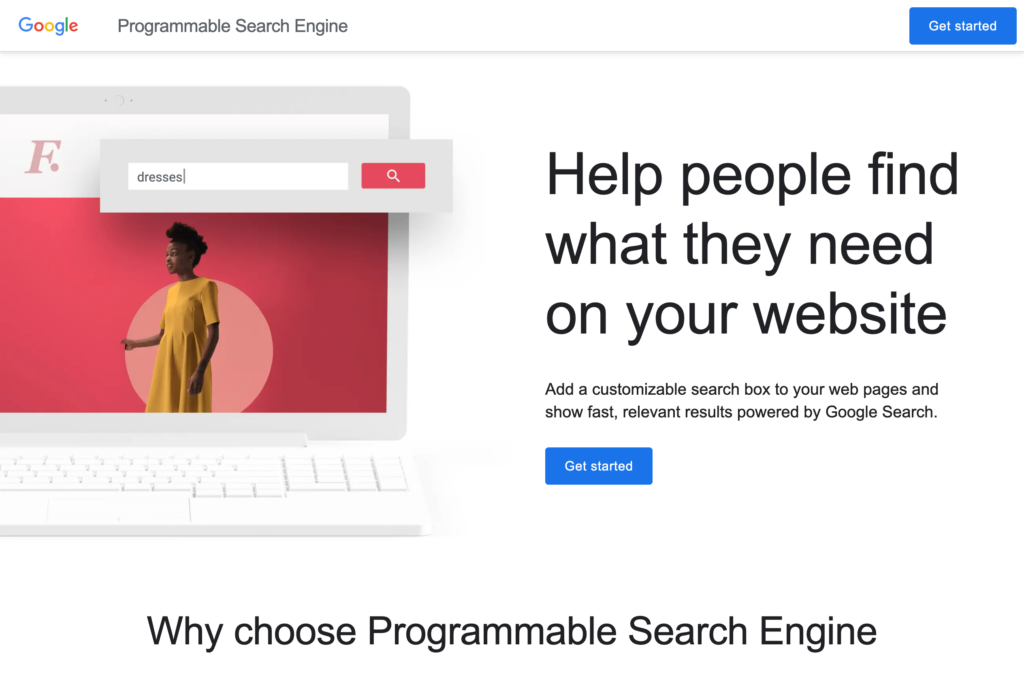
The appeal has always been speed and familiarity. You get Google-quality relevance, a search box you can embed with a snippet of JavaScript, and support for both web pages and images. For a small blog or a quick internal project, that is often enough to get going without a budget conversation.
How Google Programmable Search Engine offerings and pricing work
Where it gets complicated is the pricing structure. Google splits Programmable Search Engine into four offerings, and the key thing to understand is that an ad-free, fully your-own-branding experience is not the free path.
Note: The Custom Search JSON API is closed to new customers. Existing Custom Search JSON API customers have until January 1, 2027 to transition to an alternative solution.
Here is how Google’s own documentation lays out the four offerings:
| Standard Search Element | Non-profit Search Element | Paid Search Element | Custom Search JSON API | |
| Cost | Free | Free | $5 per 1,000 queries | $5 per 1,000 queries |
| Ads | Yes | No | No | No |
| Google branding | Optional | Yes | Optional | No |
| Daily query limit | No daily limit | No daily limit | No daily limit | 10,000 queries per day |
| Implementation | Client-side JavaScript | Client-side JavaScript | Client-side JavaScript | Client-side or server-side JSON API |
| Availability | Everyone | Non-profits only | Everyone | Everyone |
The free Standard element shows ads on your results and only makes Google branding optional. The free Non-profit element removes the ads but requires Google branding, and it is limited to non-profits.
To go ad-free otherwise, you move to the Paid element or the Custom Search JSON API, both billed at $5 per 1,000 queries, and the JSON API is hard-capped at 10,000 queries per day.
In short, the moment you want a clean, branded, ad-free search experience, Google’s free tool stops being free.
Why Google Custom Search is a shrinking option in 2026
The bigger issue is direction. Google’s Custom Search JSON API is closed to new customers, and Google’s own documentation gives existing customers until January 1, 2027 to transition. Google recommends moving to Vertex AI Search, which it describes as suitable for searching up to 50 domains, and routes anyone needing full web search to a request form. A related endpoint, the Site Restricted JSON API, already stopped serving traffic in January 2025.
On top of that, Programmable Search Engine returns a list of links. There are no direct AI answers drawn from your own content, and no conversational content discovery. In 2026, that is a real gap for sites whose visitors now expect a straight answer, not a page of blue links they still have to dig through.
The alternatives below fall into two groups: managed platforms that handle search and content discovery for you, and developer or cloud infrastructure you build and run yourself.
1. AddSearch
AddSearch is a site search and conversational content discovery platform built for websites of any size. It is one platform on a single index, and every capability is available from day one: fast keyword site search, AI answers drawn directly from your own content, and conversational content discovery that holds context across a multi-turn exchange. You choose how much of it to switch on and where.
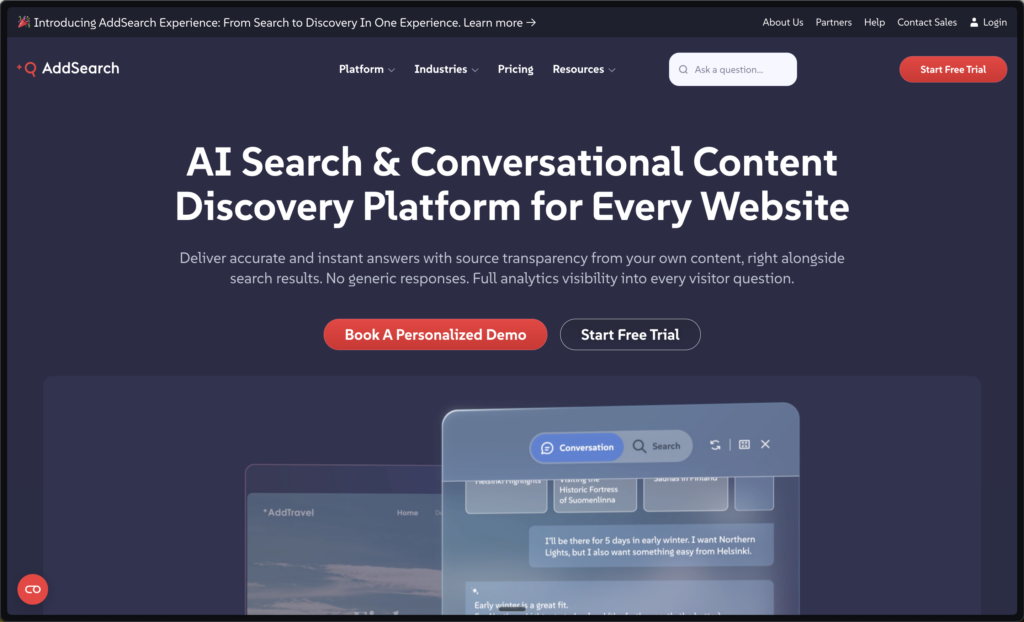
Against the Google Programmable Search Engine, the contrast is straightforward. AddSearch is ad-free and completely on-brand by default. Along with a list of links, it can return a direct answer grounded in your indexed content, with source citations on every response, and it tells visitors plainly when it cannot find an answer rather than guessing. You control ranking, appearance, and exactly which parts of your site are indexed, there is no daily query ceiling to design around, and it is SOC 2 Type II certified with WCAG 2.2 support.
The AddSearch setup is typically a few days, and the AddSearch team prepares a demo on your own content before you commit.
AddSearch limitations to consider
- It is a paid platform. There is a 14-day free trial, but no free-forever tier, so it is a step up in cost from a free tool like Google’s Standard element.
- Answers are currently text and markdown-based. Rich media inside answers, and images or graphs inside indexed documents, are on the roadmap.
AddSearch pricing
- Keyword site search: Core from $119/month billed annually ($155 monthly), Growth from $299/month, Advanced from $599/month, Enterprise custom
- AI answers: from $8,400/year
- AI Conversations and AddSearch Experience: custom quote
- 14-day free trial with your own website content
Best for: Content-heavy websites of any size that want ad-free, branded search plus AI answers and conversational content discovery on one platform, without needing a developer to manage it.
2. Site Search 360
Site Search 360 built its business on exactly this migration. When Google retired the older Google Site Search product, Site Search 360 positioned itself as the ad-free, customizable replacement, and it still leads with that comparison today. It is a managed, drop-in site search you add with a line of JavaScript, with control over layout, filtering, and result grouping.
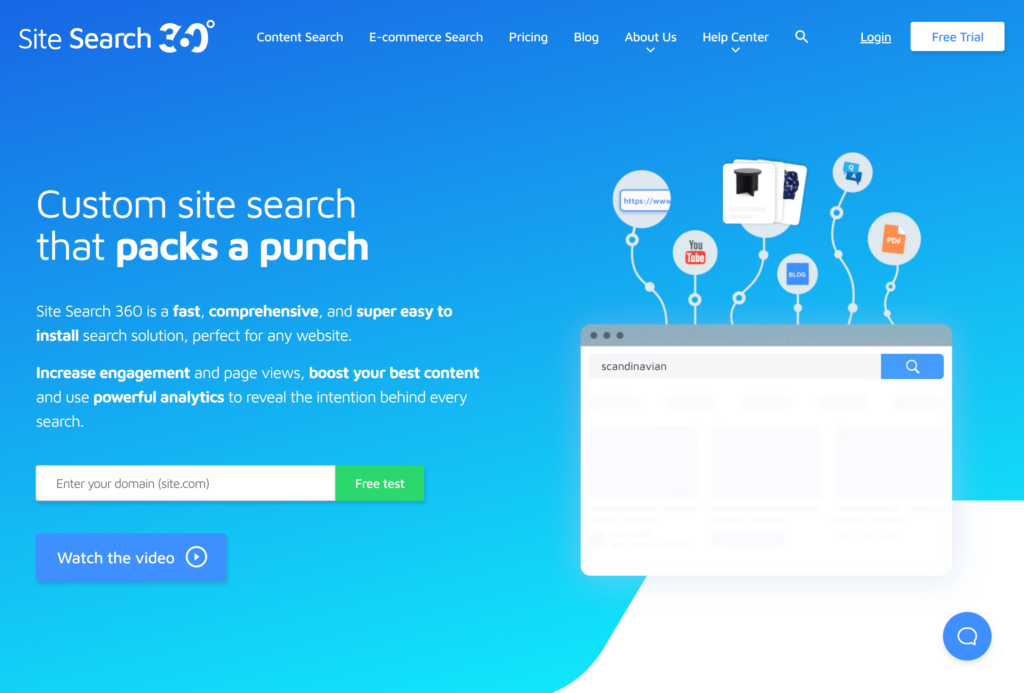
For a team coming off the free Google box mainly to escape ads and Google branding, it is one of the most direct swaps on this list.
Site Search 360 limitations to consider
- It is positioned around search and result presentation. It does not offer the same depth of AI answers grounded in your content or multi-turn conversational content discovery as a full platform.
- Heavier customization beyond the standard options is quoted separately on a per-hour basis.
- Query overages are billed per query, so high-traffic sites need to watch quota.
Site Search 360 pricing
- Free tier available
- Paid plans from around $9/month, up to roughly $119/month for the self-serve Batman plan, with custom quotes above that
- 10% discount on annual plans paid upfront, and a 10% discount for educational organizations
Best for: Smaller content sites that mainly want a fast, ad-free, customizable replacement for Google’s search box without moving to a full content discovery platform.
3. Cludo
Cludo is a site search and AI platform aimed squarely at public-sector and other content-heavy organizations, with a strong presence in government and higher education. It pairs managed site search with AI features and puts a lot of emphasis on analytics and hands-on support, which suits teams that want help shaping search rather than a pure self-serve tool.
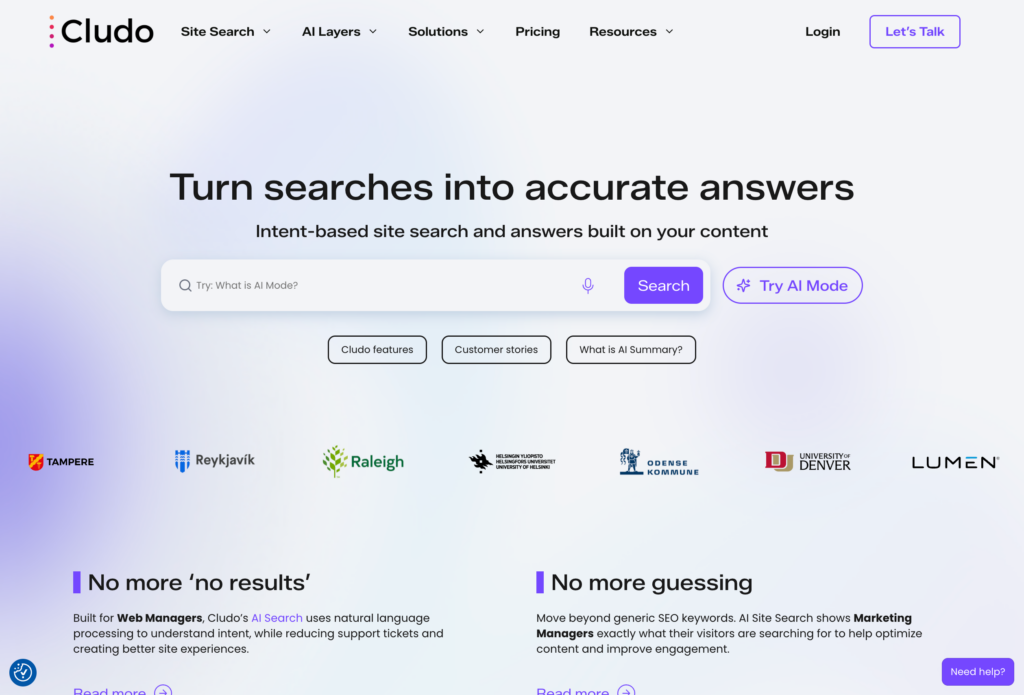
It is a closer comparison to AddSearch than most, since both come at this from the content-discovery angle rather than developer infrastructure.
Cludo limitations to consider
- It does not publish pricing, so evaluation starts with a sales conversation and an annual commitment rather than a quick self-serve trial.
- Its AI capabilities are positioned as add-ons to a search core, so the naming and packaging can take some untangling.
- The model is geared toward managed, supported deployments, which is a strength for some teams and heavier than others need.
Cludo pricing
- No public pricing. Custom annual quotes through sales.
Best for: Public-sector and other content-heavy organizations that want a managed, analytics-led search partner and are comfortable with a sales-led, annual-contract model.
4. SearchStax
SearchStax offers managed site search built on Apache Solr, with a marketer-friendly layer on top for analytics and real-time tuning. It removes the burden of running Solr yourself while keeping the power of that engine underneath, which appeals to teams that want Solr’s capabilities without the operations overhead.

It is a solid managed option for larger sites, particularly where a marketing team wants visibility into search behavior and the ability to adjust results without engineering tickets.
SearchStax limitations to consider
- The Site Search entry point is priced well above the other managed tools here, so it is aimed at larger deployments.
- Its strength is search and analytics. Direct AI answers grounded in your content and conversational content discovery are not its core focus in the way they are for a dedicated platform.
- Some reviewers note the configuration can feel complex for non-technical users.
SearchStax pricing
- Site Search Essential from $799/month, with full details through sales
- Managed Search (raw Solr infrastructure) from around $37/month per node if you only need hosted Solr
- Nonprofit discounts available; SOC 2 and HIPAA certified
Best for: Larger content sites and marketing teams that want managed Solr-based search with strong analytics and are ready for an enterprise price point.
5. Vertex AI Search
Vertex AI Search is worth understanding precisely because it is Google’s own recommended successor to the Custom Search JSON API. It is part of Google Cloud, and it can index your content and return AI-generated answers grounded in that content, which is a genuine step up from a link list.
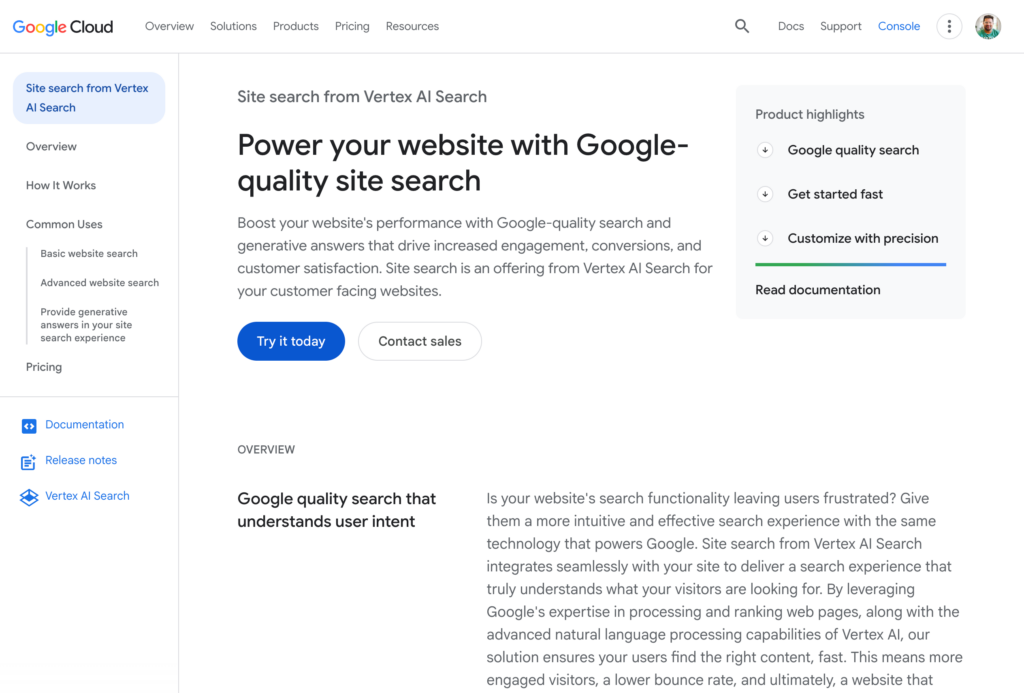
If you are migrating off the JSON API specifically because Google told you to, this is the path Google is steering you down. The catch is that it is a Google Cloud product, priced and operated like one.
Vertex AI Search limitations to consider
- Pricing is usage-based across several meters. You can pay for search queries, index storage, and, for generative answers, the underlying Gemini model tokens, which makes the monthly bill hard to predict before you are already running it.
- It requires a Google Cloud setup and engineering familiarity with the platform. It is not a paste-in-a-snippet tool for a marketing team.
- It is scoped to a defined set of domains, and full web search sits behind a separate request process.
Vertex AI Search pricing
- Usage-based on Google Cloud, roughly $1.50 per 1,000 queries at the standard tier up to $4 to $6 per 1,000 for advanced queries
- 10,000 free queries per month
- Additional costs for index storage and, for generative answers, Gemini token usage
Best for: Teams already invested in Google Cloud with engineering resources, who want Google’s own AI search stack and can manage usage-based, multi-meter billing.
6. Algolia
Algolia is one of the most widely used hosted search APIs, known for fast, developer-friendly search you build into your site or app. It has a generous free tier for getting started and has been adding AI-powered search features to its higher plans.
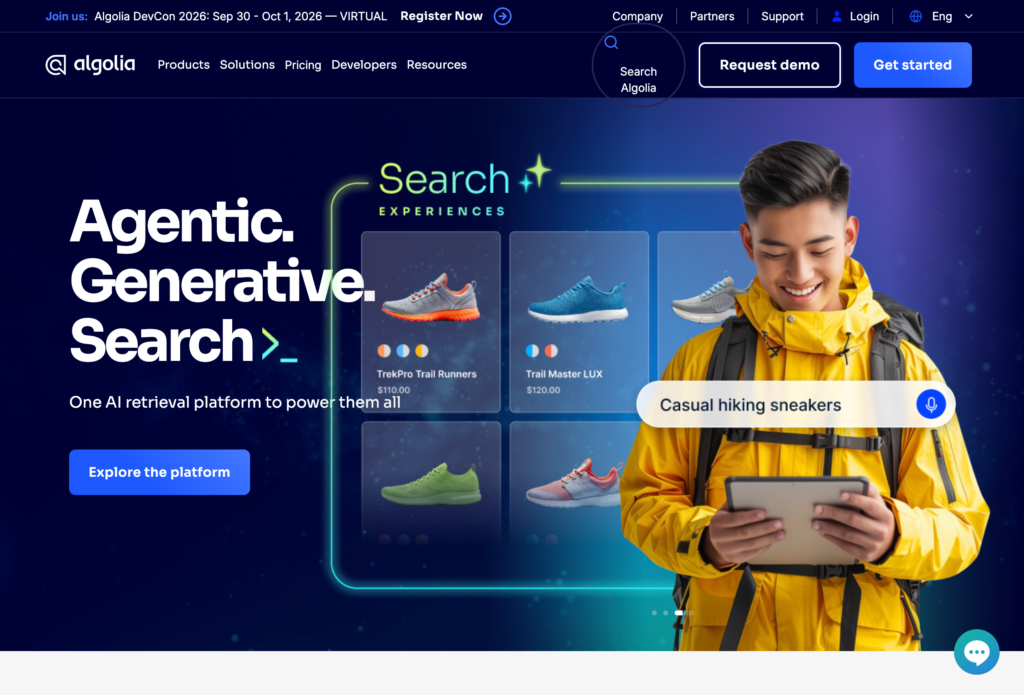
It is a strong choice when you have developers who want fine-grained control over the search experience and are happy to build and maintain the front end themselves.
Algolia limitations to consider
- It is an API-first, developer-oriented tool. Delivering a finished search experience takes engineering work rather than a managed setup.
- Usage-based pricing on the paid tiers can climb quickly as search volume and record counts grow, and its AI features sit on a higher-priced tier.
- Answers grounded in your content and conversational content discovery are not delivered as a managed, out-of-the-box experience the way they are on a dedicated platform.
Algolia pricing
- Build: free, 10,000 search requests per month
- Grow: usage-based, around $0.50 per 1,000 search requests beyond the included amount and $0.40 per 1,000 records
- Grow Plus: adds AI features at a higher per-request rate (around $1.75 per 1,000 requests)
- Premium and Elevate: enterprise tiers with custom annual pricing
Best for: Product and engineering teams that want a fast, flexible hosted search API and have the developer resources to build and maintain the experience.
7. Elasticsearch
Elasticsearch, from Elastic, is the powerhouse of open-source search. If you want maximum control and are willing to run the infrastructure, the open-source engine is free to self-host, and Elastic Cloud offers a managed version. It handles very large and complex datasets and is a common backbone for search across big organizations.
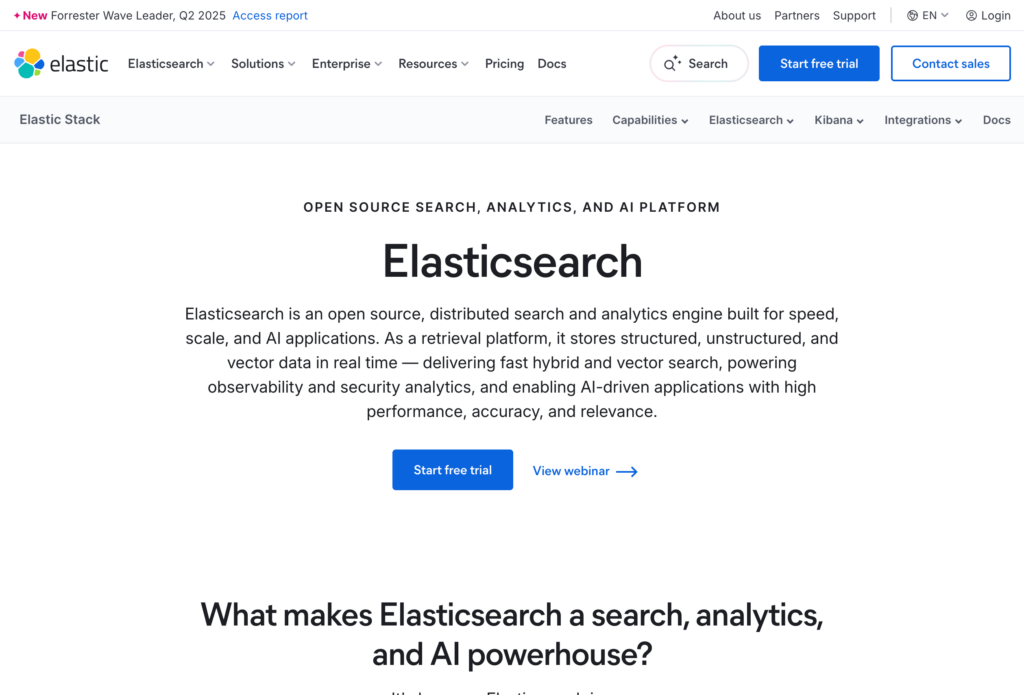
That power comes with responsibility. Elasticsearch gives you the engine, but relevance tuning, the search UI, and ongoing operations are on you or your team.
Elasticsearch limitations to consider
- Self-hosting is free at the license level, but you carry the full cost of infrastructure, tuning, and engineering time.
- It is not a finished site search experience. Turning it into one, with a polished UI, AI answers, and conversational content discovery, is a build project.
- Managed cloud costs scale with provisioned resources and can grow substantially for production workloads.
Elasticsearch pricing
- Open-source, self-managed: free license, you pay for your own infrastructure and engineering
- Elastic Cloud Hosted: from around $95/month at the entry tier, scaling with provisioned resources
- Serverless option: consumption-based
Best for: Engineering-led teams with large or complex datasets that want maximum control and are prepared to build and operate the search experience themselves.
8. Meilisearch
Meilisearch is a fast, lightweight open-source search engine with a clean developer experience. It is free to self-host under an open-source license, and Meilisearch Cloud offers managed hosting with simple, predictable pricing rather than the resource-based complexity of heavier engines.
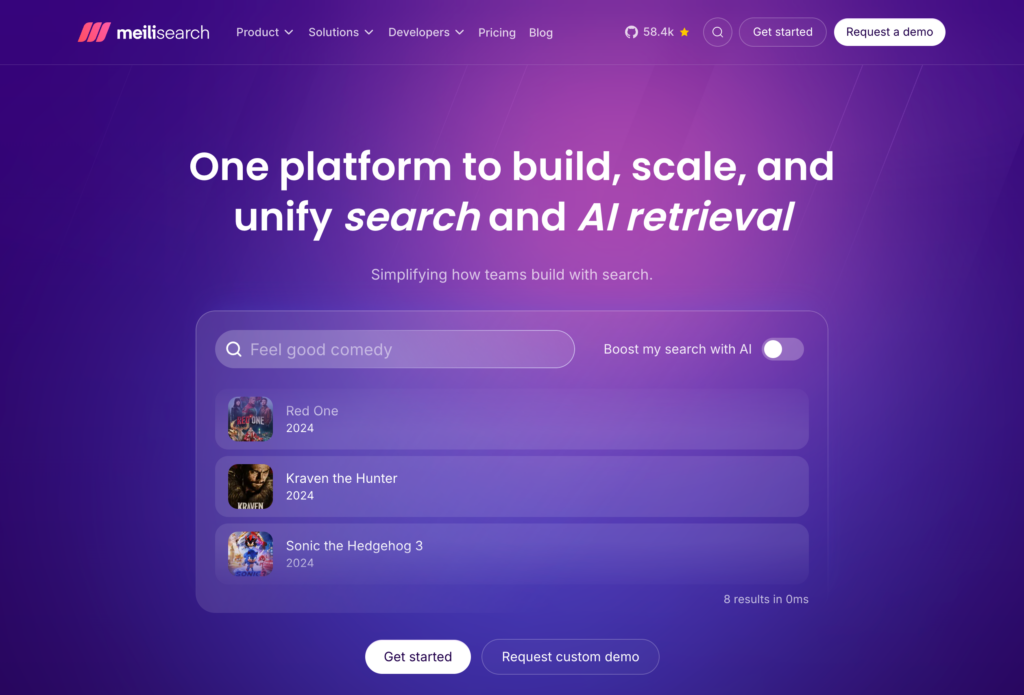
It is a favorite for developers who want something quicker to stand up than Elasticsearch, with typo tolerance, filtering, and hybrid keyword-plus-vector search out of the box.
Meilisearch limitations to consider
- Like the other developer tools here, it gives you a search engine, not a managed, finished site search and content discovery experience.
- Delivering AI answers and conversational content discovery to visitors would require building that layer yourself.
- Non-technical teams will need developer support to deploy and maintain it.
Meilisearch pricing
- Open-source, self-hosted: free
- Meilisearch Cloud Build: $30/month, 50,000 searches and 100,000 documents
- Meilisearch Cloud Pro: $300/month
- Enterprise: custom pricing
Best for: Developers who want a fast, affordable, open-source search engine that is quicker to deploy than Elasticsearch.
Comparison table
| Google Programmable Search Engine | AddSearch | Site Search 360 | Cludo | SearchStax | Vertex AI Search | Algolia | Elasticsearch | Meilisearch | |
| Built for content-heavy, general-purpose websites | Partial | Yes | Yes | Yes | Yes | Partial | Partial | Partial | Partial |
| Ad-free with your own branding by default | No | Yes | Yes | Yes | Yes | Yes | Yes | Yes | Yes |
| Direct AI answers grounded in your content, with citations | No | Yes | Limited | Yes | Limited | Yes | Limited | Build it yourself | Build it yourself |
| Conversational content discovery that remembers context | No | Yes | No | Yes | No | Yes | No | Build it yourself | Build it yourself |
| Control over ranking, appearance, and indexing | Limited | Yes | Yes | Yes | Yes | Yes | Yes | Yes | Yes |
| Manageable without developer resources | Partial | Yes | Yes | Yes | Partial | No | No | No | No |
| No daily query cap | No (JSON API 10k/day) | Yes | Overage-based | Yes | Yes | Usage-based | Usage-based | Yes | Yes |
| Actively developed and open to new customers | JSON API closing Jan 1, 2027 | Yes | Yes | Yes | Yes | Yes | Yes | Yes | Yes |
| Publicly confirmed starting price | Free with ads, or $5 / 1,000 queries ad-free | Starting from $119/month | Free, paid from ~$9/month | Custom quote | From $799/month | Usage-based, ~$1.50 / 1,000 queries | Free tier, then usage-based | Free self-hosted, cloud from ~$95/month | Free self-hosted, cloud from $30/month |
| Typical setup | Snippet, minutes | A few days, done with you | Snippet | Managed onboarding | Managed onboarding | Google Cloud build | Developer build | Developer build | Developer build |
Final Thoughts
The right replacement depends on what pushed you to look in the first place.
If you mainly want to get ads and Google branding off your results with the least disruption, a managed drop-in like Site Search 360 is a clean swap. If you are an engineering-led team that wants to own the stack, Algolia, Elasticsearch, or Meilisearch give you control, and Vertex AI Search is the path Google itself will point you to, provided you are ready for Google Cloud and usage-based billing.
But if the deeper reason is that a list of links no longer meets what your visitors expect, and you want ad-free, branded search plus direct answers grounded in your own content and conversational content discovery on one platform, without a developer babysitting it, that is where AddSearch fits. And with Google’s JSON API closing on January 1, 2027, this is not a decision that rewards waiting.
See AddSearch running on your own content. Book a personalized demo.
Prefer to explore first? Try the AddSearch Experience demo.
