



Association members expect answers the moment they need them. When a certification requirement, a technical standard, or a renewal policy sits buried in a PDF or three menus deep, members give up and email staff instead. Many stop looking altogether when answers are hard to find. That pressure is why more professional associations are rethinking how members search and discover content on their websites and portals.
Betty AI is one of the tools built for this moment. It is an AI knowledge platform made specifically for associations, and it has signed up a large roster of professional, trade, and standards-setting groups. But it is not the only option, and it is not the right fit for every association.
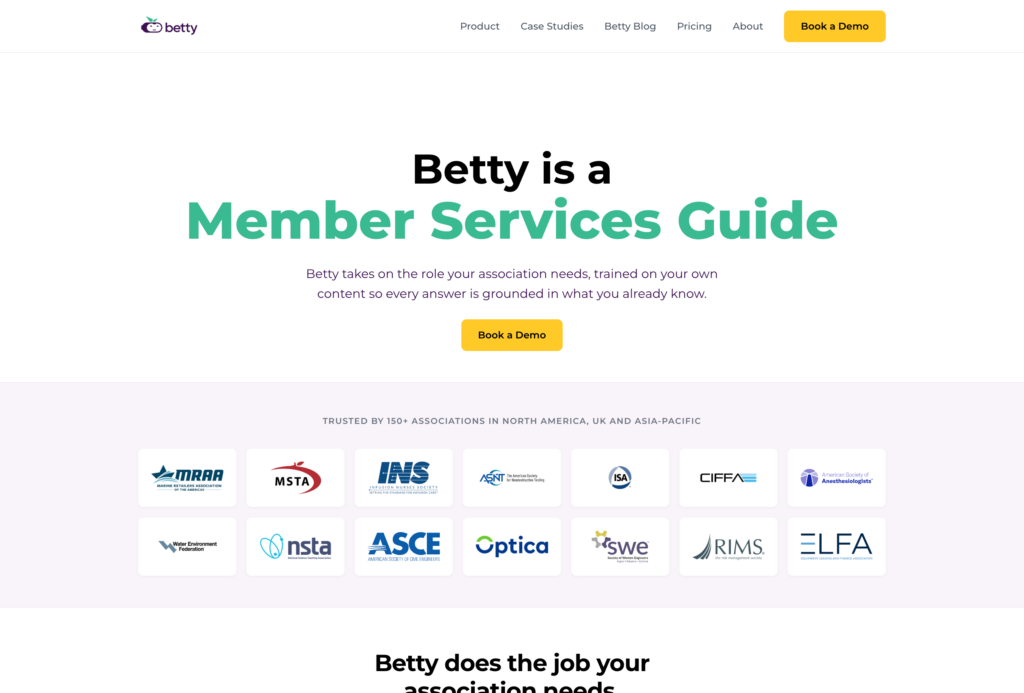
Betty AI replaces the search bar with a single conversational interface. Some associations want exactly that. Others want members to keep a full search experience alongside conversational answers. Others need pricing tied to usage rather than revenue, or want to serve a whole public website rather than only a member knowledge base.
What Betty AI Is Built For
Betty AI is a conversational AI knowledge platform built only for associations. It trains on your vetted content, including articles, PDFs, standards, and webinars, and answers member questions in plain language with source citations on every response. Each assistant is white-labeled with its own name, personality, and brand. Betty AI positions itself against menus and keyword search and puts a single conversational interface in their place.
How Betty AI Pricing Works
Betty AI uses revenue-based pricing, so an association pays based on its annual revenue rather than usage or per seat. There are two plans, both on a 12-month minimum, with setup and onboarding included.
- Knowledge Assistant runs from $11,000/year for associations under $1M in revenue, up to $180,000/year at $50M+ in revenue. It includes two instances (public or member, plus internal), the Betty:INSIGHTS reporting portal, and widget deployment.
- Knowledge+ runs from $13,200/year up to $216,000/year. It adds up to four instances, job onboarding templates, and, notably, the advanced Search and Directory options plus API access.
Why Some Associations Look for an Alternative
- Conversational only on the base plan. Search is a Knowledge+ feature. On the entry plan, members who want to scan a list of results do not get that experience.
- Cost scales with revenue, not usage. A large, well-funded association pays a premium even if query volume is modest.
- Longer onboarding. Betty AI reports most deployments going live in 12 to 16 weeks.
- API access is gated. Developer access sits on the Knowledge+ tier only.
This article compares 7 alternatives to Betty AI for associations. We look at each tool across two things members actually do: ask a question and get a direct answer, and search and browse to find the right page or resource.
1. AddSearch
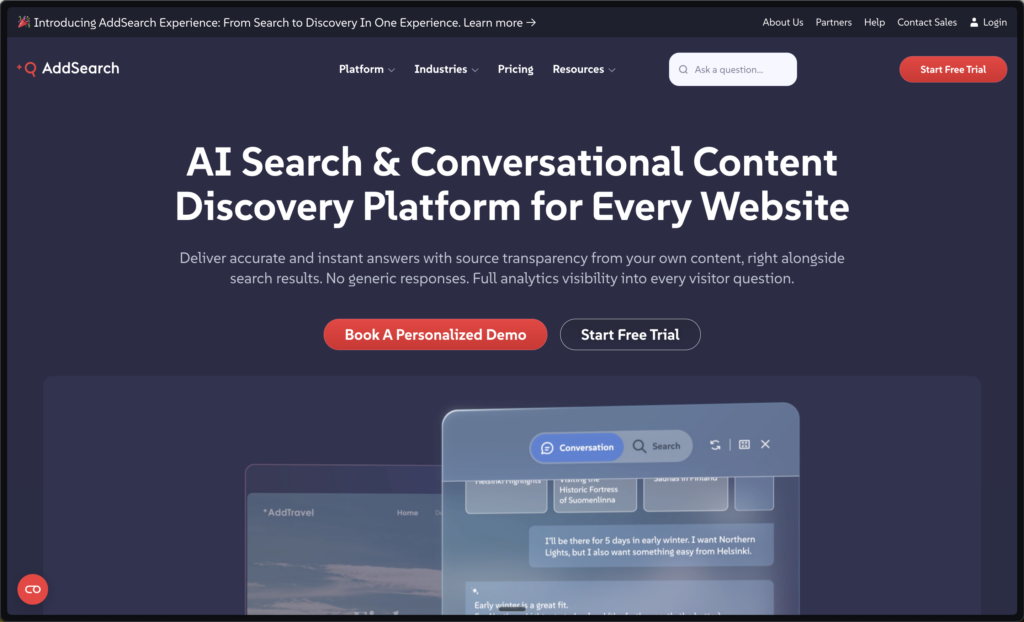
AddSearch is a search and content discovery platform for the AI era. It puts keyword search, direct AI answers with source citations, and context-aware conversational search on one platform, all grounded strictly in your own content. Every capability is available from day one, and you decide how much of it to deploy and where. It works for associations of any size, deploys in days, runs alongside whatever search you already have, and publishes its starting price up front.
What Makes AddSearch Different
- One platform, deployed your way. Keyword search, AI answers, and conversational discovery are all available from the start. Run them as a single interface, as a split view with keyword results and the conversational answer side by side, or in a custom layout. You can keep one part of your site on keyword search and give another part full conversational search.
- Answers grounded in your content. AI answers and conversational discovery respond only from your own website content, with source citations on every response. Your content is never used to train shared AI models.
- Works with any site and any provider. AddSearch serves associations of any size, and its AI capabilities can run alongside an existing search setup rather than forcing a rip and replace.
- Built for staff and developers. Non-technical staff can manage and tune results without code, and developers get APIs, libraries, and documentation to build custom experiences.
- Accessible and secure. AddSearch supports WCAG 2.2 accessibility and is SOC 2 Type II certified, with customer data kept out of any AI model training.
Limitations of AddSearch
- AddSearch is not association-only, so it does not ship with association-specific job templates such as certification or exam prep out of the box. You configure those experiences yourself.
- It is a platform your team runs, rather than a fully managed, done-for-you service, so an association that wants a vendor to build and maintain everything end to end may prefer a managed option.
AddSearch Pricing
AddSearch publishes pricing for its two most-adopted tiers, so you can see real numbers before talking to sales. Keyword Search and AI Answers have publicly available pricing, with Keyword Search starting at $119/mo (billed annually) and AI Answers starting at $8,400/year. AI Conversations and the full AddSearch Experience platform are custom-quoted based on scale and available on request.
AddSearch’s pricing is based on usage rather than your association’s revenue, so costs stay predictable as you grow, and a 14-day free trial is available.
Best for: associations of any size that want keyword search, AI answers, and conversational search on one platform, with predictable pricing and control over how much of it runs where.
2. FUSESearch
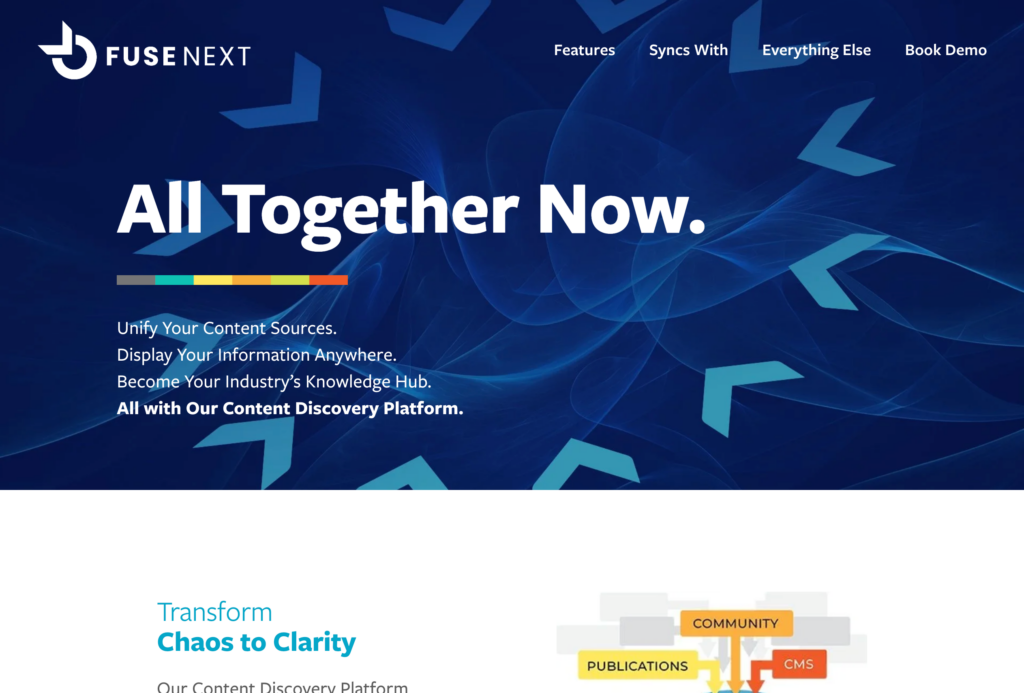
FUSESearch is a content discovery platform built for associations. It runs AI-driven federated search across the systems associations actually use, including the website, the learning management system, and publications, and adds a conversational layer on top.
Limitations of FUSESearch
- Federated search across many systems can add technical complexity to the initial setup.
- It is best suited to associations with content spread across multiple platforms. A smaller single-site association may not need the breadth.
FUSESearch Pricing
FUSESearch does not publish standard pricing. Cost is quote-based and depends on the systems you connect and your content volume. Contact their sales team for a quote.
Best for: associations with content scattered across a website, an LMS, and publication archives that want one search across all of it.
3. Onyx Point AI
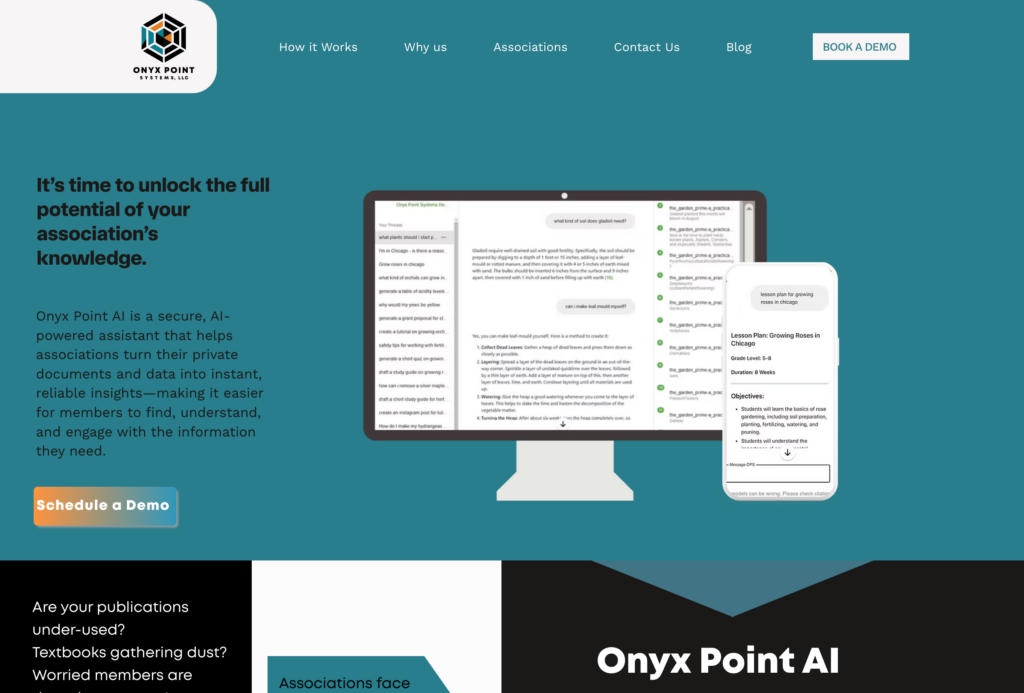
Onyx Point AI is an association-specific AI knowledge platform focused on secure, private search and discovery of proprietary content. It connects to your association management system through single sign-on, so membership status governs who can access which content, and it cites its sources on every answer. Note that this is a separate product from the open-source enterprise search tool also called Onyx AI.
Limitations of Onyx Point AI
- It focuses on knowledge search and discovery, not the broader member community, marketing, or event tooling that some associations also want.
- Its effectiveness depends on having a well-organized, substantial content library to draw from.
Onyx Point AI Pricing
Onyx Point AI does not publish standard pricing. The company positions itself as a cost-effective option for associations of all sizes, with implementation in weeks rather than months. Cost is quote-based.
Best for: associations whose main need is helping members find answers inside a large library of journals, standards, and technical documents, gated by membership.
4. Higher Logic Thrive
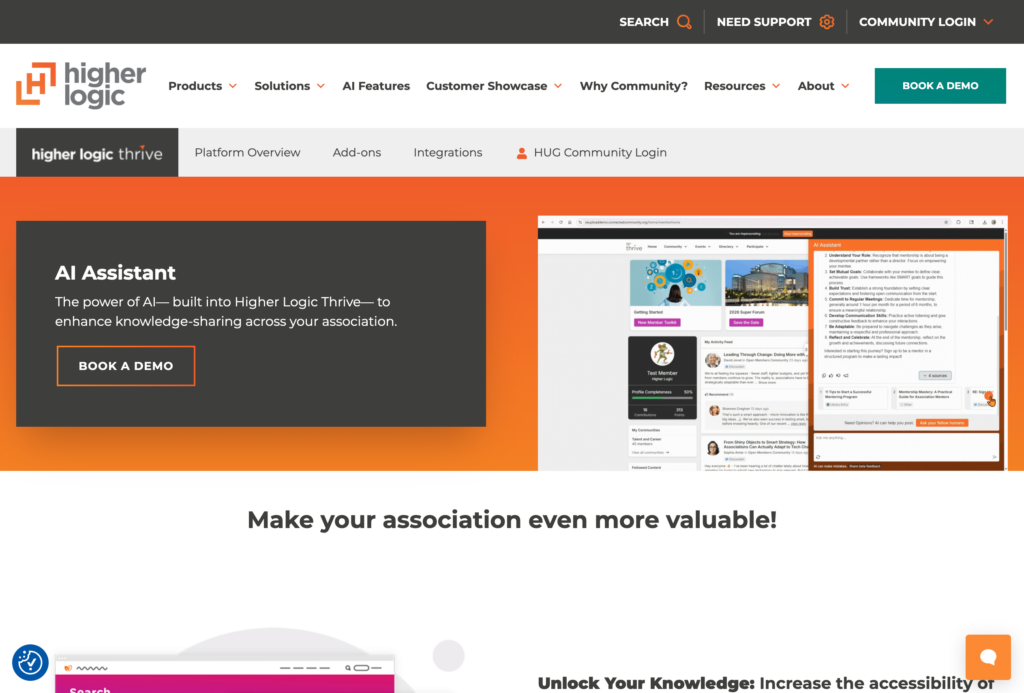
Higher Logic Thrive is a member engagement platform built for associations, combining online community, marketing, events, and learning. Its AI Assistant searches community content and drafts a post to ask other members when it cannot find an answer. It fits associations that want member search inside a broader engagement suite rather than a standalone search platform.
Limitations of Higher Logic Thrive
- Search sits inside a community platform, so it is oriented around member-generated discussions and libraries rather than your full public website.
- The breadth of modules brings a learning curve, and several capabilities are paid add-ons.
Higher Logic Thrive Pricing
Higher Logic Thrive does not publish standard pricing. Cost is quote-based, typically includes a setup fee, and scales with the modules you add.
Best for: associations that want an all-in-one member community and marketing platform, with AI-assisted search across that community as one part of it.
5. Coveo
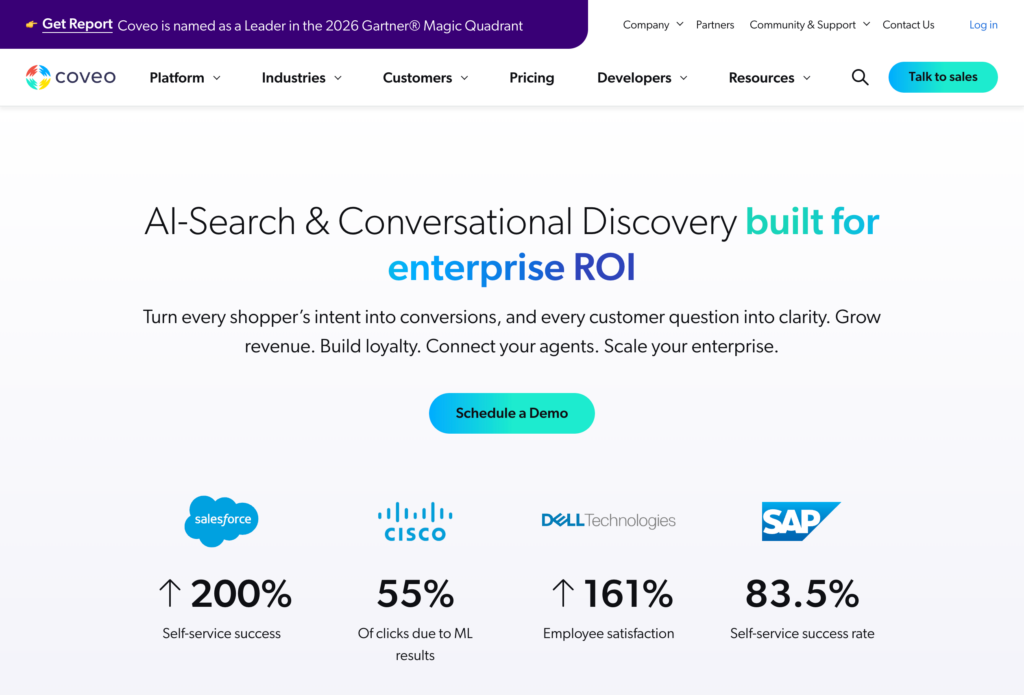
Coveo is an enterprise AI search and relevance platform. It runs federated search across many systems, including CRM, knowledge bases, content management, and support portals, with machine-learning relevance and generative answers. For a large association with complex, multi-system content and a technical team, Coveo is capable, though it is heavier and more expensive than most association-specific tools.
Limitations of Coveo
- Implementation is involved and usually needs developer time. Deployments can run for months.
- Consumption-based pricing makes costs hard to predict at scale.
Coveo Pricing
Coveo does not publish standard pricing. It uses consumption-based, quote-only pricing built around units of 100,000 queries per month. Coveo for Salesforce starts at $100,000 per year. Pricing for the Service/Website/Workplace and Commerce offerings is not published. For an accurate figure, contact Coveo’s sales team directly.
Best for: large associations with content spread across many enterprise systems and the technical resources to configure and maintain an enterprise search platform.
6. Algolia
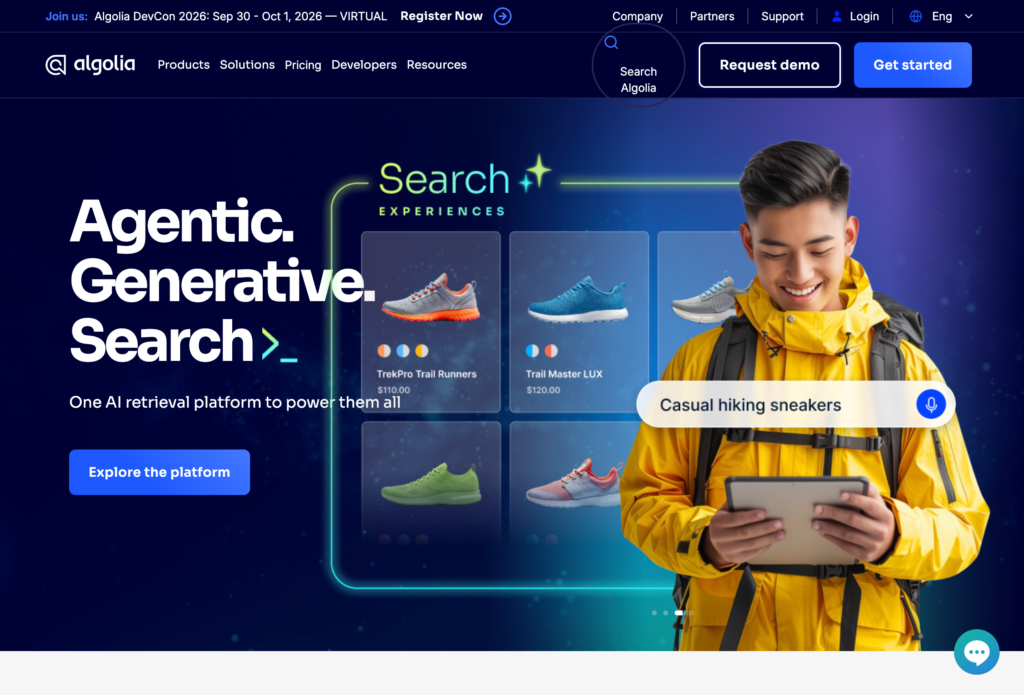
Algolia is a developer-first search platform known for fast, hosted keyword search and, on its higher tiers, AI features such as semantic ranking and personalization. It gives engineering teams fine-grained control through APIs and libraries. An association with in-house developers who want to build a custom search experience may find it a strong fit. One without developers will find it harder to run.
Limitations of Algolia
- It is built for developers, so getting the most from it assumes engineering resources.
- AI capabilities sit behind higher tiers, and usage-based billing can be hard to forecast as traffic grows.
Algolia Pricing
Algolia has a free Build tier for development. The Grow plan is usage-based with no base fee and covers keyword search, with overages around $0.50 per 1,000 search requests and $0.40 per 1,000 records. Grow Plus adds AI features, with search overages at $1.75 per 1,000 requests. Premium and Elevate are custom annual contracts. These figures are from Algolia’s official pricing page.
Best for: associations with a developer team that wants API-first control over a custom search build.
7. Cludo
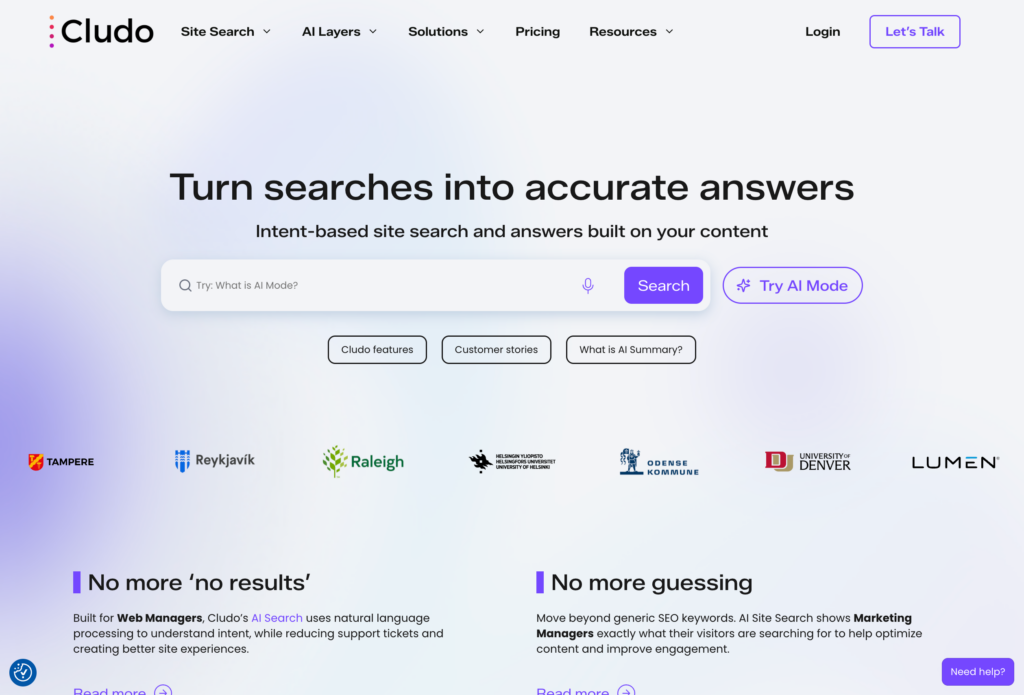
Cludo is an AI-powered site search and answer platform for content-rich websites, with a strong base in higher education and the public sector. It offers AI Search, AI Summary, and conversational AI, plus a no-code Experience Builder, and runs on any website without developer dependency. It is a practical option for associations that want managed site search with AI answers.
Limitations of Cludo
- Search quality depends on how well content is organized, so teams with very large, loosely structured sites may need to tune results.
- Feature depth is oriented to site search rather than the wider member lifecycle.
Cludo Pricing
Cludo does not publish standard pricing. Cludo splits its offering into three parts. AI Search and Enterprise Search are both quote-only, so the starting cost is not published. The AI capabilities sit in a separate line item: AI Layers start from $8,000 USD annually, per layer.
Best for: content-heavy associations and public-sector-style sites that want managed AI site search without a developer.
Betty AI Alternatives Compared
| Feature | Betty AI | AddSearch | FUSESearch | Onyx Point AI | Higher Logic Thrive | Coveo | Algolia | Cludo |
| Type | Conversational AI knowledge platform | Search and content discovery platform | Federated search and content discovery | AI knowledge search and discovery | Member engagement suite | Enterprise AI search | Developer-first search | AI site search and answers |
| Built for associations | Yes, associations only | Yes, and any content-heavy site | Yes | Yes | Yes | No, enterprise across industries | No | Serves higher ed and public sector |
| Keyword + conversational on one platform | Search on Knowledge+ plan only | Yes, all from day one | Yes | Conversational-first | Community search plus AI assistant | Yes | Keyword; AI on higher tiers | Yes |
| Publicly confirmed starting price | $11,000/year (Knowledge Assistant) for revenue <$1M. It goes upto $180,000/year for $50M+ revenue. | Keyword Search from $119/mo (billed annually); AI Answers from $8,400/yr | Not public | Not public | Not public | Not public. Coveo for Salesforce starts at $100,000 per year. | Free tier, then usage-based | Not public. AI Layers start from $8,000 USD annually, per layer. |
| Predictable pricing (not revenue-based) | No, revenue-based | Yes, usage-based | Quote-based | Quote-based | Quote-based, setup fee | No, consumption-based | Partly, usage-based | Quote-based |
| Source citations | Yes | Yes | Yes | Yes | Answers from community content | Yes | Depends on configuration | Yes |
| Developer access | Knowledge+ only | Yes, APIs and libraries | Not publicly stated | Not publicly stated | Yes, API | Yes | Yes, API-first | No developer dependency |
Pricing and capabilities are confirmed from official sources where published. “Not public” means the vendor.
Final Thoughts
The right choice comes down to what your members need and how you want to pay for it.
If you want keyword search, AI answers, and conversational discovery on one platform and one index, with a standard starting rate and then usage and service-based pricing, and control over how much of it runs where, AddSearch gives you all of that from day one, on a website of any size.
If you want a fully managed, association-only conversational assistant and are comfortable with revenue-based pricing, Betty AI is purpose-built for that. The rest fit narrower needs, from federated search across many systems to enterprise-scale deployments and developer-led builds.
See how AddSearch Experience works with your association’s content.
You can also explore the AddSearch Experience demo to see keyword search, AI answers, and conversational search on one platform.
