



AI assistants have changed how people look for information. Visitors now expect a website to understand their question and answer it, not hand them a page of links. So how do you make an AI-ready website without rushing into something you cannot trust?
In a recent AddSearch webinar, CEO Helena Rebane spoke with Dave Rodriguez, Managing Director of Development at Hanson Inc., an AddSearch partner. Dave walked through a real public sector project and shared a clear message: great AI answers depend on a strong search foundation. Here is what organizations and agencies can take away from the conversation.
From results to answers: what visitors expect now
The old model was simple. A visitor typed a keyword and scanned a list of blue links. That model no longer feels good enough.
As Dave explained, tools like ChatGPT and Claude have reset the baseline. People are less willing to click through several pages when an assistant can summarize what they need. They bring that expectation to your website too.
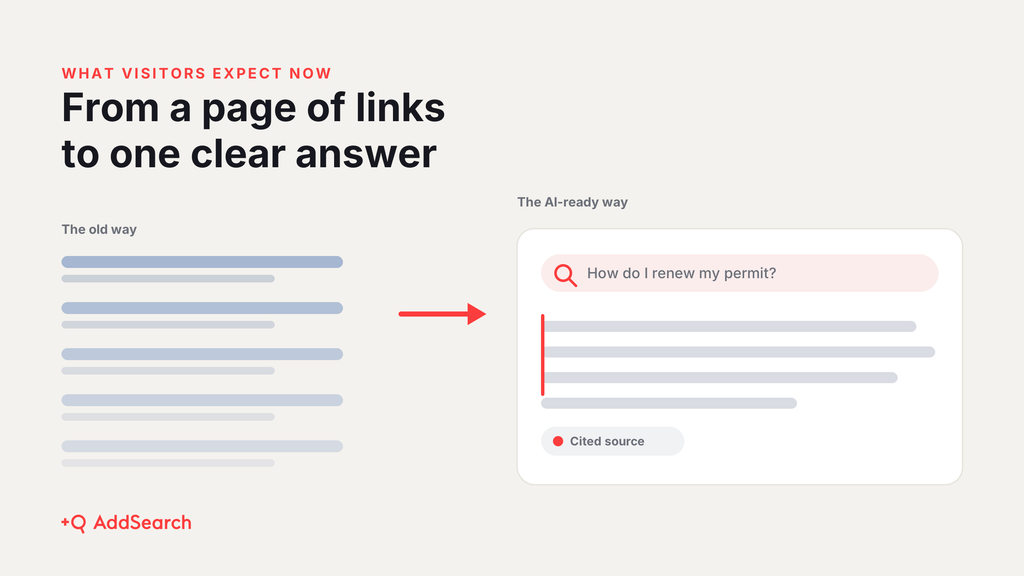
“If you think about the way that you’re using the web in general, you’re less likely to click through a bunch of links and read several pages if an AI agent or assistant can summarize that information and give you what you need.”
– Dave Rodriguez, Managing Director of Development, Hanson Inc.
Today, visitors want to:
- Ask questions in natural language, the way they would ask a person
- Get results that match their intent, not only their exact words
- Find the answer quickly, often as a short, direct response
This also changes what a website is for. Your content is not only brand voice. It is a source of knowledge. Well-written explainers and how-to guides still earn clicks, because they help people understand a process or a service in depth.
The foundation comes first: a public sector example
Hanson recently worked with a large public sector agency that serves several million residents. The site had deep, layered content. Different audiences arrived with different goals, and each person’s path to the right page could be long.
Hanson started where it always does: with the audiences. Who comes to the site? What are they trying to do? Only then did the team look at search.
The project needed robust crawling to collect the content. It also needed an index the team could actively manage, so it could add structure and control relevance. The goal was search that understands intent, not search that only matches keywords. Hanson used AddSearch’s keyword search as that flexible foundation, organizing and tailoring the index to the agency’s needs.
“We were able to use AddSearch’s keyword search to provide a really flexible foundation for that, and again allow us to organize and tailor the index just the way we need.”
– Dave Rodriguez, Hanson Inc.
More content is not always better
It is tempting to index everything. But a bigger index is not automatically a better one.
The agency’s site held general pages written by many teams over the years. It also held documents and press releases, some archived for a decade or more. Documents and press releases are often dense with keywords. As a result, they can compete with the very pages you want visitors to land on.
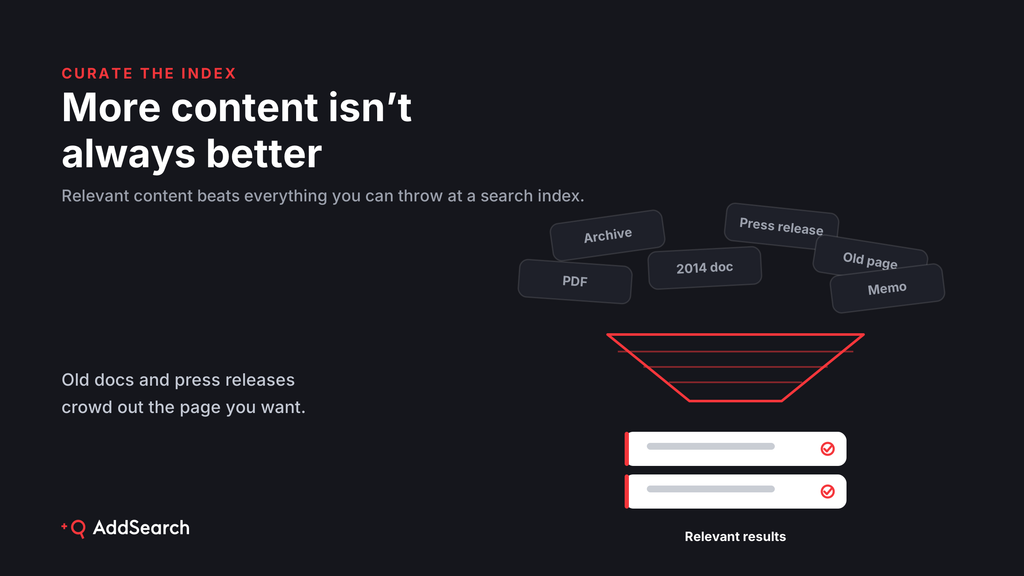
Without index management, a search for a common topic might surface a ten-year-old document instead of the current service page. Dave put it this way:
“More content isn’t always better. Relevant content can often be much more valuable than just throwing everything you have at a search index.”
– Dave Rodriguez, Hanson Inc.
To solve this, Hanson used AddSearch’s site area rules extensively. These rules let the team match only certain URL patterns, prioritize content from the current year, and segment content into categories. The result was a cleaner, more relevant set of results.
Keeping results current and relevant
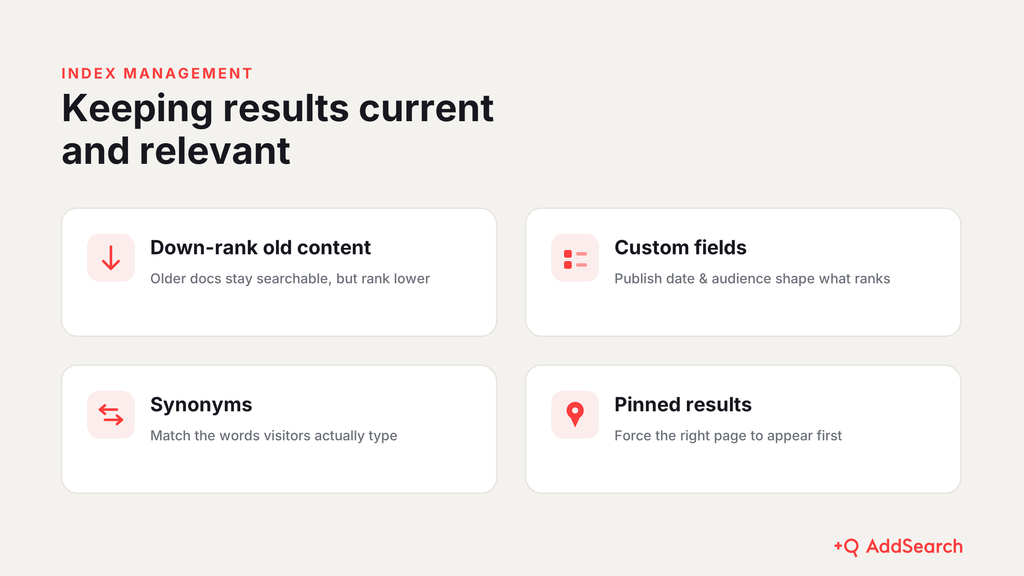
News, regulations, and documents go out of date. Many organizations do not realize how much control they have over this behind the scenes. Hanson relied on four index management tools:
“A lot of organizations have jargon, terms that they use internally, but they don’t necessarily match the words that the public knows or that their customers know.”
– Dave Rodriguez, Hanson Inc.
- Automatic down-ranking of older content. Older press releases and documents stay searchable, because they may still help someone. They simply rank lower than current content.
- Custom fields. Many CMSs let teams add metadata to content. AddSearch can index those fields and apply rules to them, so values like publish date and audience influence what ranks higher or lower.
- Synonyms. Organizations often use internal jargon that the public does not. Synonyms connect the words visitors actually type to the terms on the site.
- Pinned results. For the most important questions, pinned results make sure the right page appears first.
Hanson worked with the agency to set up synonyms and pinned results for every alternate wording the team discovered. Together, these tools turn a crawled index into a curated one.
Where AI adds value once the basics are in place
Why spend so much time on keyword search in a conversation about AI? Because AI answers are only as good as the content underneath them. A well-structured, well-governed index is the same foundation an AI answer layer draws on. The work Hanson did is what makes the next step possible.
Once content is organized, indexed, and governed by clear rules, AI can shift the experience from finding links to gaining knowledge. It can:
- Summarize information from your own content, with cited sources
- Support a conversation, so visitors can ask follow-up questions
- Encourage deeper exploration, so visitors leave having completed their task
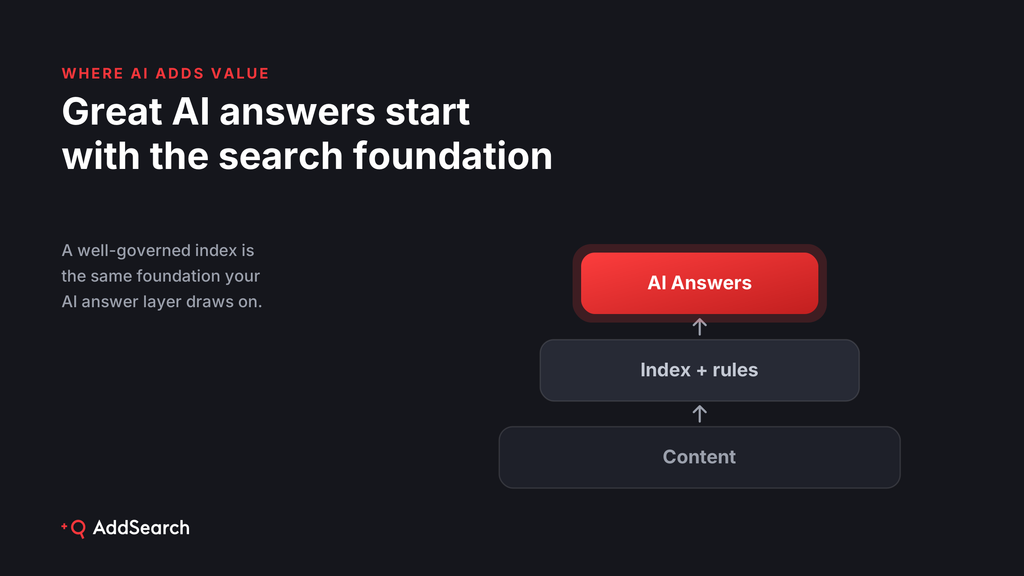
“Once you have your content organized, indexed, and all the rules set up, the opportunity of AI is to really shift that search experience from just finding links to gaining knowledge.”
– Dave Rodriguez, Hanson Inc.
Dave also highlighted analytics and feedback as key. Monitoring what people search for, and whether they find it, shows you where content is missing or hard to find. Building an AI-ready website is an ongoing process, not a one-time launch.
Is your organization ready for AI?
According to Dave, readiness comes down to two things.
The first is the state of your content. Do you have content you believe in, that is relevant and meets real user needs? The second is your tolerance for risk. In some industries, a conversational AI experience is an immediate win. In regulated industries, the cost of a wrong answer is higher, so organizations naturally move more carefully.
“The advice that I would give to anybody considering an AI search is be ready to test and tweak until you’re comfortable with the results.”
– Dave Rodriguez, Hanson Inc.
Whatever your starting point, plan to test and tune until you are comfortable with the results. Hanson’s process for adding AI to site search starts with three question lists:
- On-topic questions the AI should answer well. Your subject matter experts can supply these.
- Off-topic questions the AI should not answer.
- Red-team questions that need guardrails to redirect the visitor.
The goal is an AI that serves your audience and nothing else. The more people who test it, give feedback, and review that feedback, the better tuned it becomes.
Where to start if you feel pressure to “do something with AI”
Many public sector and content-rich organizations feel pressure to act on AI quickly. Dave’s advice was practical:
“Start with analytics would be my advice. Use your analytics, use real user feedback if you can get it, to understand what content you have and what’s missing.”
– Dave Rodriguez, Hanson Inc.
- Study how search is used today. Look at popular search terms and, just as important, terms that return no useful results. Together they map what you have and what is missing.
- Audit the reliability of your content. Any search, keyword or AI, uses everything you give it unless you configure it otherwise. Can you say every page and document is current, consistent, and vetted?
- Limit scope if needed. If the answer is no, start with recent, vetted content. Then clean up and expand gradually.
- Keep measuring after launch. Track keywords, the pages search drives traffic to, click-through rates, and average click position. Keep closing gaps with your subject matter experts.
- Write to create knowledge. Assume each visitor is there to complete a task or learn something. If your CMS supports metadata, add as much as you can. It expands what you can do later.
“The truth of a search, whether it’s a basic search or an AI search, is that it will use everything you throw at it.”
– Dave Rodriguez, Hanson Inc.
Helena noted that this matches what AddSearch sees with its own customers. Many start small with AI Answers, a one-question, one-answer experience. They learn from the analytics, then build toward AI Conversations.
Does on-site AI still matter if visitors ask ChatGPT first?
This came up in the Q&A. If people get answers from AI Overviews or ChatGPT, why add AI to your own site?
Helena shared what AddSearch has observed in its user research and customer work. Visitors often start their research elsewhere. When they reach your website, they are further along in their journey. They already have the basics. What they want now is confirmation of what they learned and direct answers to the questions that remain.
“People don’t necessarily want the basic information anymore. They have the basic information. They want confirmation of what they have already learned, and then they want direct answers to the questions they still have.”
– Helena Rebane, CEO, AddSearch
Dave added that general AI tools do not know what you know about your audiences and their journeys. On-site search, whether a well-tuned structured search or a conversational AI experience, helps that visitor take the next step.
“Anyone using ChatGPT or Claude has access to a lot of good information, but they don’t necessarily have access to the specific knowledge about what you know about your audiences and their journeys.”
– Dave Rodriguez, Hanson Inc.
A higher education attendee asked whether this is the same as optimizing for Google and AI assistants. Dave clarified that these are two different processes:
- Generative Engine Optimization (GEO) is about how AI platforms find and send people to your site.
- On-site search and AI is about what happens once they arrive.
The two still reinforce each other. Helena explained that on-site AI search shows you how people actually describe their needs, in their own words. Those words often differ from your official terminology. You can use that insight to improve your visibility on Google, ChatGPT, and other AI platforms too.
Key takeaways for an AI-ready website
“Our advice is always start with content. Everything comes from understanding your audience, understanding their needs.”
– Dave Rodriguez, Hanson Inc.
- Start with content and audiences. Understand who visits and what they need before you configure anything.
- Make your data rich. Metadata classifies content by audience, need, and date, and it powers relevance rules.
- Curate the index. Relevant content beats all content. Use rules, down-ranking, synonyms, and pinned results.
- Let analytics lead. Searches with no results show you exactly what to create next.
- Add AI in steps. Begin with AI Answers, test with on-topic, off-topic, and red-team questions, then expand.
See AI search on your own content
AddSearch connects people to the exact information they need. Its conversational search layer goes beyond answers: it is designed to guide every visitor to the right next step, with conversions in mind. Every answer is grounded in your own content, with cited sources.
You can implement AddSearch yourself using ready-made UI solutions, UI libraries, and APIs, or work with AddSearch’s team or a partner agency like Hanson.
Want to see what AI search and discovery would look like on your website? Book a call and we will build it with your own content, so you can see how it answers your visitors’ real questions.
About Hanson Inc.
Hanson Inc. is an integrated marketing agency based in Ohio. The team creates great digital experiences supported by technology, and helps clients choose, vet, and integrate the right tools for their needs. As an AddSearch partner, Hanson helps organizations get their content, search, and AI foundations right, from audience research and content strategy to index design and AI testing.
Want to go deeper on preparing your site for AI-driven discovery? Read more through Hanson’s insights at https://hansoninc.com/blog
