


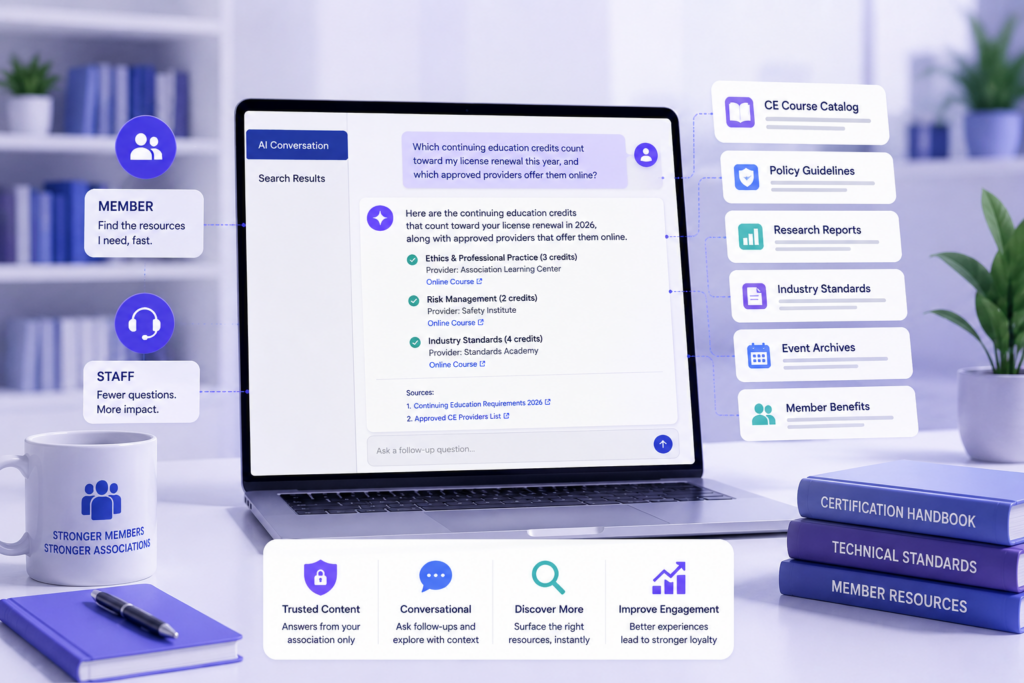
Most professional associations have spent years building their content libraries. Research reports, CE course catalogs, certification handbooks, technical standards, event archives, policy guidance. The resources are there. The investment has been made.
And yet, members still call headquarters asking where to find them.
A licensed professional searching for the continuing education credits required to renew their state license ends up clicking through five different pages before giving up. A structural engineer looking for the seismic design standard that applies to their current project, types three different queries into the search bar and gets back a pile of loosely related documents. A healthcare administrator trying to figure out what their membership tier actually includes sends an email to member services and waits two days for a reply.
The content exists. The problem is that members cannot find it.
This is the discoverability gap that sits at the center of most association website experiences today. And it is increasingly where AI search, specifically conversational AI search, is making the biggest difference.
The Real Problem Is Not Your Content. It Is Discoverability.
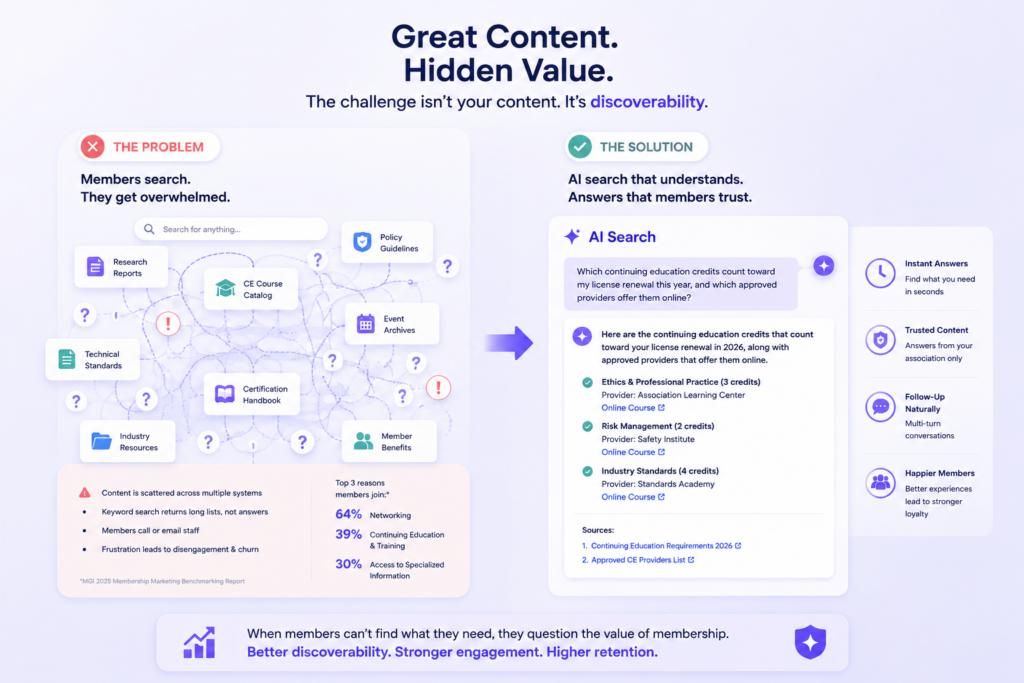
The resource library that your association has built over the years is genuinely valuable. The problem is not what is in it. The problem is that members experience it as a maze rather than a resource.
Every year, more content gets added. White papers from last year’s conference sit alongside white papers from six years ago. CE course listings accumulate. Policy updates layer on top of older guidance. The library grows, but the navigation structure does not keep pace. Members searching for something specific get back a long list of hits ranked by keyword relevance, not by what they actually need. They scan the first few results, do not find the right thing, and either call staff or give up.
The downstream cost of that experience is real. When members cannot locate the content they paid for, they start to question whether the membership is worth what they are paying. This is not a hypothetical risk. It is how renewal decisions get made quietly, long before the renewal date arrives.
Consider why members join in the first place. According to the MGI 2025 Membership Marketing Benchmarking Report, the top three reasons members join are networking with others in their profession (64%), continuing education and training (39%), and access to specialized or current information (30%). Two of those three are entirely dependent on content being findable. If a member cannot locate the CE courses or the specialized resources that made them join, the core membership promise has already failed.
The same report found that members who described their association experience as easy reported 93% five-year renewal intent, while those who struggled early were far less likely to renew. For associations where the website is the primary way members access their benefits, discoverability is not a UX problem. It is a retention problem.
Why Keyword Search Alone Is No Longer Enough
Keyword search was built for simple, short queries. It works well when a member types “annual conference” or “membership renewal form” and expects to see a list of pages that match those words.
It does not work well when a member types “What continuing education credits count toward my license renewal this year, and which approved providers offer them online?” That is not a keyword search. That is a question. And the gap between those two things is where most association search experiences break down.
There is also the federated content problem. Most associations run their content across multiple platforms at the same time. The main website holds general information and resources. An AMS (Association Management System) manages member records and certifications. An LMS (Learning Management System) hosts CE courses. An event platform handles conference registrations and session archives. A community forum holds discussions.
A member with a question does not know which platform has the answer. They go to the website, search, and hope. Traditional keyword search cannot reach across all of those systems in a meaningful way. Members get partial results or nothing useful, and the phone rings.
How Conversational AI Search Works on an Association Website
The shift from keyword search to conversational AI search is a shift from “find me pages that contain these words” to “answer my question.”
When a member types a question into a conversational AI search interface, the AI does not just match keywords. It reads the question, understands what the member is actually asking, searches the association’s indexed content for the most relevant answer, and returns a direct response. The answer includes citations: links back to the specific pages the AI used to generate the response, so the member can verify what they are reading and go deeper if they need to.
The multi-turn capability is where this becomes genuinely useful for associations. A member can ask “Which CE courses count toward my professional certification?” and get a direct answer. They can then follow up with “Which of those are available online?” and the AI holds the context of the first question. They can keep going: “Are any of them free for Professional members?” The conversation continues without the member having to restart or restate their context each time.
Everything the AI draws from comes strictly from the association’s indexed website content. It does not pull from external sources. It does not make things up. If the answer is not in the content, it says so clearly rather than guessing.
The Three AI-Powered Offerings from AddSearch That Association Websites Can Use
AddSearch offers three AI-powered products that association websites can use independently or together, depending on where they want to start.
AI Answers is designed for members who need a single, accurate answer quickly. It sits on top of the association’s existing search setup and delivers a direct response above the standard search results. A member asking about certification renewal deadlines, event registration details, or membership fee structures gets an immediate answer without having to click through to the right page. It works with whatever search provider the association already uses.
AI Conversations is designed for members who need to explore. It supports full multi-turn conversations where context carries across questions. A member researching CE options for their professional license can start broad, narrow down by topic, filter by format, and check availability, all within a single conversation. It is particularly well-suited to the kind of complex, layered queries that associations deal with regularly around certification pathways, standards navigation, and membership benefits comparisons.
AddSearch Experience is the unified platform that brings all three together. Keyword search, AI Answers, and AI Conversations work as a single integrated experience. A member can start with a keyword, see a direct AI-generated answer alongside the standard results, and then open a conversational window to dig deeper, all without leaving the search interface. For associations that want to offer the full range of search behaviors in one place, this is the starting point.
Five Ways Association Members Use Conversational AI Search Every Day
The value of conversational AI search on an association website becomes clearest when you look at the specific tasks members are trying to accomplish.
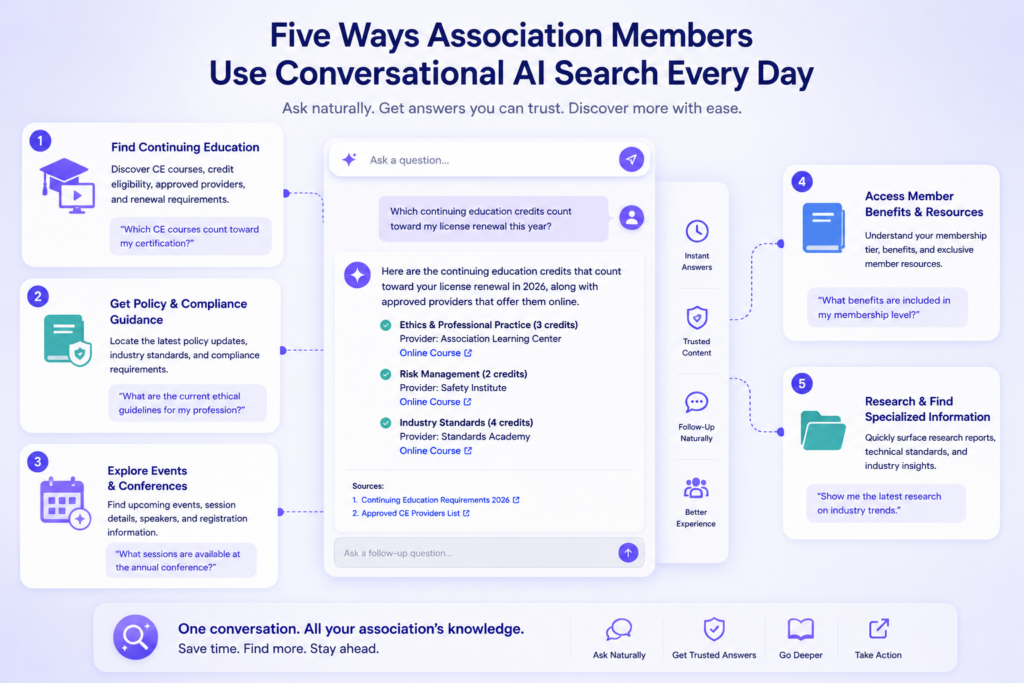
Certification and credentialing questions. A PE asking “What are the continuing education requirements to renew my engineering license in Texas?” gets a direct answer pulled from the association’s licensure guidance, with a link to the original source. No clicking through to the certification section, no scanning the full requirements page to find the specific renewal rules for their state.
Continuing education discovery. A member asking “What online courses count toward my ethics requirement this year?” gets a list of qualifying courses from the association’s own course catalog, without needing to know which category to browse or which filter to apply. The AI reads the question and surfaces what is relevant.
Standards and technical documents. A structural engineer looking for the section of a design standard that covers lateral load requirements for a specific building type can ask the question directly and get the relevant clause, not a list of the full document library. For associations that publish large volumes of technical guidance, this is one of the highest-value use cases.
Event and conference archives. Session recordings, speaker presentations, and post-conference materials are among the least discoverable assets on most association websites. A member asking “Were there any sessions on climate risk disclosure at last year’s conference?” can get a direct answer with links to the relevant recordings or materials, rather than navigating into a past events section and browsing.
Membership and benefits questions. “What is the difference between Professional and Associate membership?” and “How do I upgrade my membership tier?” are two of the most common questions association member services teams handle. Conversational AI search answers both directly from the association’s own membership pages, at any hour, without a support ticket.
What This Means for Association Staff, Operations, and Member Trust
The benefits for members are direct and visible. The benefits for association teams are just as significant, and worth understanding clearly before making a decision about implementation.
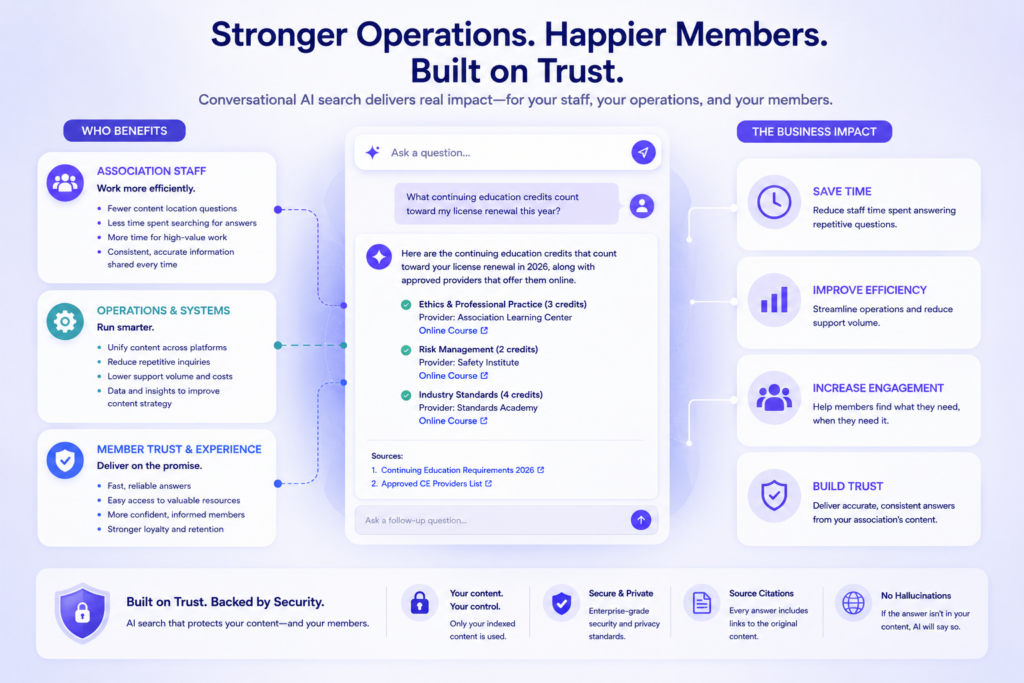
Reduced Support Volume
When members can self-serve answers to routine questions, the volume of inbound calls and helpdesk tickets goes down. The questions that staff currently spend time answering (“Where do I find my CE transcript?”, “What is the deadline to register for the conference?”, “Which membership level includes access to the full research library?”) get handled by the website instead. Staff capacity shifts toward the conversations that genuinely need a human.
The connection to renewal is direct. The MGI 2025 Membership Marketing Benchmarking Report found that 52% of association executives cite lack of engagement with the organization, specifically members not using their benefits, as the primary reason members do not renew. When members cannot find benefits on the website, they stop engaging. When they stop engaging, they do not renew. Reducing that friction is not just an operational improvement. It is a retention strategy.
Content Intelligence Through AI Analytics
Conversational AI search does something that traditional site search analytics cannot. Every question a member asks becomes a data point. The analytics dashboard shows which questions are being asked most frequently, which answers are landing well, and, critically, which questions are going unanswered because the content does not exist or is not indexed correctly.
For an association content team, this is a direct feed into editorial planning. If members are repeatedly asking about a topic that the website cannot answer well, that is a clear signal about where the next resource should go. Query volume, answer success rate, and follow-up question patterns all become visible. The search bar becomes a research tool.
Source Transparency That Members Can Trust
Every answer that AI search returns includes cited sources with clickable links to the original pages. Members can see exactly where the information came from and verify it themselves.
For professional associations, this is not a nice-to-have. It is a trust requirement. Members rely on association content for guidance that carries professional or regulatory weight. A licensed professional acting on information about renewal requirements needs to know that information is accurate and traceable. A healthcare administrator following clinical guidance needs to know where it came from. Transparent citations address that need directly. There are no black-box answers.
Full Control Over What the AI Answers From
The association controls exactly which content the AI uses. Outdated pages, draft documents, internal-only materials, and sections that are not ready for member-facing use can all be excluded. Only the content the association has approved for publishing gets used to generate answers.
This matters for associations that manage large content libraries where not every document is current or appropriate for all member audiences. It also matters for associations that need to ensure the AI does not surface information that conflicts with current policy or guidance. The AI speaks with the authority of the content the association has explicitly made available, and nothing else.
Accuracy as a Non-Negotiable
There is a reasonable concern about AI and accuracy. What if it gives a member wrong information about a certification requirement? What if it misrepresents a standard?
Conversational AI search that operates strictly from indexed content cannot fabricate information from outside that content. It does not pull from general knowledge or external sources. If a member asks a question that the website content does not cover, the AI says so. It does not guess. For associations that carry professional authority and publish content that members rely on for their work, this is the critical differentiator from general-purpose AI tools.
How AddSearch Experience Fits on Your Association Website
Adding conversational AI search to an association website does not require replacing existing systems or taking on a large implementation project.
The timing matters too. According to the MGI 2025 Membership Marketing Benchmarking Report, only 18% of associations are currently using AI in their membership marketing, with another 13% in the process of implementing it. The majority are still on the sidelines. Associations that move now have a real window to differentiate their member experience before AI search becomes the norm.
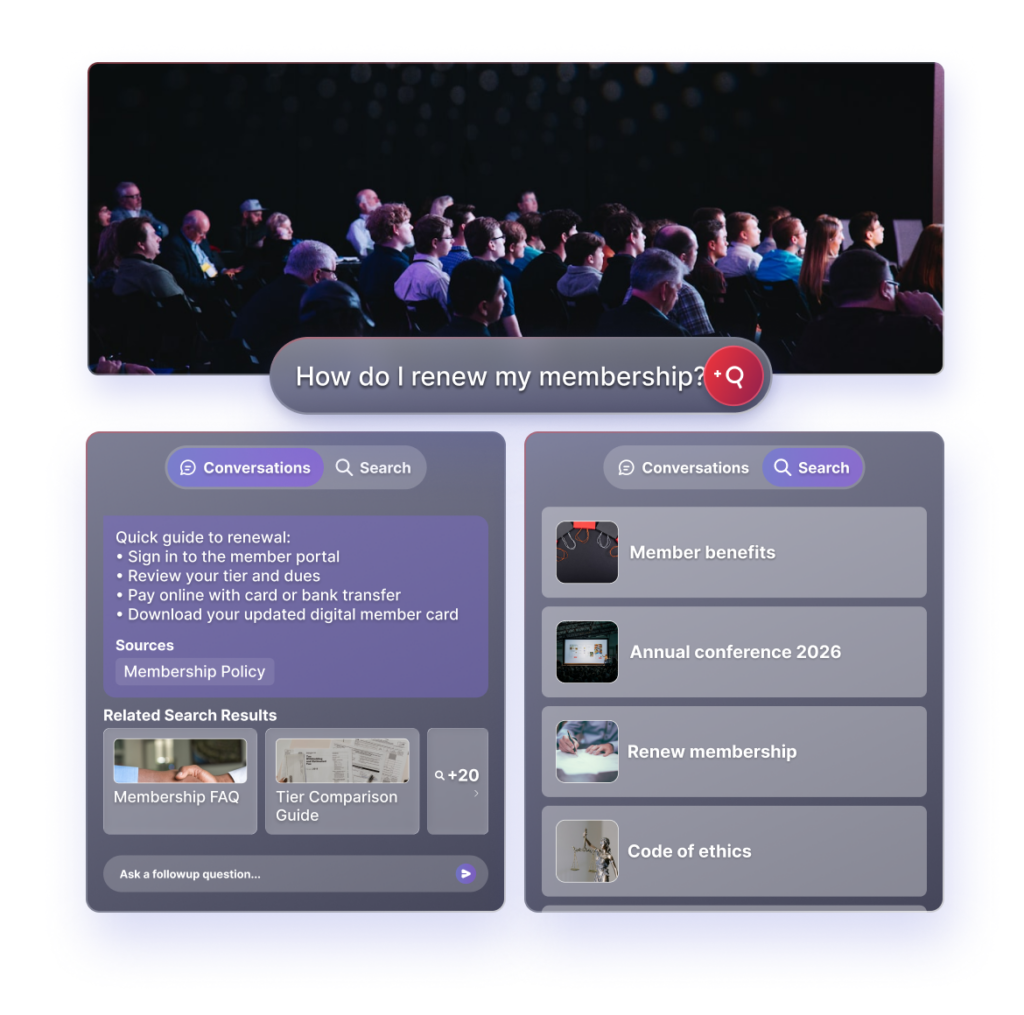
AddSearch works alongside whatever is already in place. The AMS, LMS, and existing site search all stay as they are. AddSearch indexes the association’s website content – both public and behind-the-login if needed, the team receives a code snippet to deploy, and the AI layer sits on top of the existing infrastructure. Keyword search, AI-generated answers, and conversational AI all work together from the same indexed content base. This is the hybrid search approach that combines keyword matching, vector search, and AI answer generation to improve accuracy and relevance across different query types.
Standard setup is completed in days. The association provides the content through the indexing process, and AddSearch handles configuration. There is no large engineering project required.
Two ways to get started:
Book a personalized demo using your own content. The AddSearch team sets up a working demo with the association’s actual website content before the call, so the conversation is about real use cases rather than hypothetical ones.
Start a free 14-day trial. Index the association’s site and see how the AI performs with the content that members are actually searching.
Frequently Asked Questions
Will conversational AI search surface member-only content to public visitors?
No. The AI only answers from the content that has been indexed and made available to it. Member-only content that sits behind a login or has been excluded from the index will not be surfaced to public visitors. The scope of what the AI can access is fully controlled by the association.
What happens when a member asks something the website does not cover?
The AI says it cannot find an answer in the available content, rather than generating a response from outside that content. This prevents incorrect or fabricated answers. The response can also include a prompt directing the member to contact the association directly, so no one hits a dead end, and the staff receives only the questions that genuinely need a human. It also surfaces a useful signal: if a question comes up repeatedly without a good answer, that is a gap in the content library worth addressing.
Can we control which sections of our website the AI draws answers from?
Yes. The association controls which pages and sections are included in the index. Specific site areas, content types, or individual pages can be excluded. This means the AI only answers from the content the association has approved for member-facing use.
How do we see what questions our members are actually asking?
The AddSearch analytics dashboard includes full conversation logs with questions, answers, source citations, and timestamps. Aggregate metrics show query volume, answer success rate, follow-up question patterns, and unanswered questions over time. The data is exportable for further analysis.
