



Halda is an AI-enabled enrollment platform built for higher education and K-12. It connects prospective student touchpoints, including web, email, SMS, voice, and WhatsApp, into one enrollment funnel, with tools like an AI Student Recruiter, AI Forms, and AI landing pages.
That breadth serves enrollment marketing teams well. But many institutions searching for Halda alternatives want something different: AI search and content discovery that serves every visitor on the website, not just prospective students inside a recruitment funnel. Others want a more established engagement platform with a longer track record. This article covers both.
What Halda Is Built For
Halda’s core strength is full-funnel enrollment marketing. It captures prospective student interest on the website through AI Forms and individualized content, then continues the conversation across email, SMS, and voice, all logged back to the CRM.
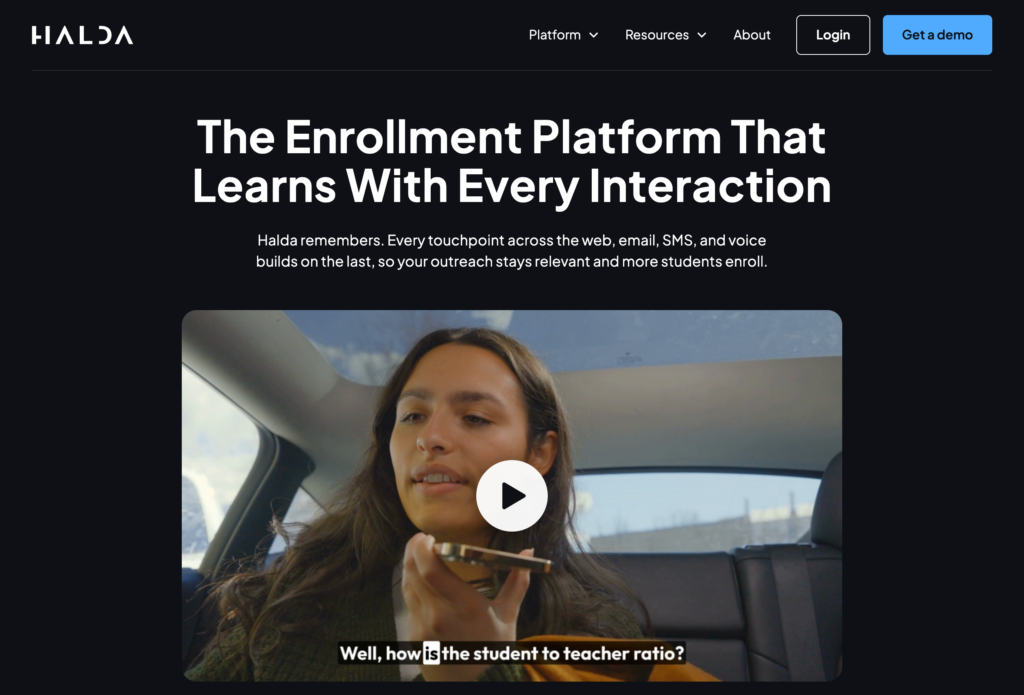
Halda also offers an AI Search that summarizes website content. But that search exists to feed the enrollment funnel. It is one feature inside a marketing suite, not a dedicated search product. A university website serves prospective students, current students, faculty, staff, and alumni. An enrollment platform is designed around only one of those audiences.
How Halda’s Pricing Works
Halda does not publish pricing. All plans are quote-based and structured around the platform bundle, so budgeting requires a conversation with their sales team.
This article looks at 5 Halda alternatives: what each one does well, where it falls short, and which type of institution it tends to fit best.
1. AddSearch
AddSearch is an AI search and conversational content discovery platform. It brings together keyword search, direct AI-generated answers, and context-aware conversational search into one unified experience, built to serve everyone who visits your website.
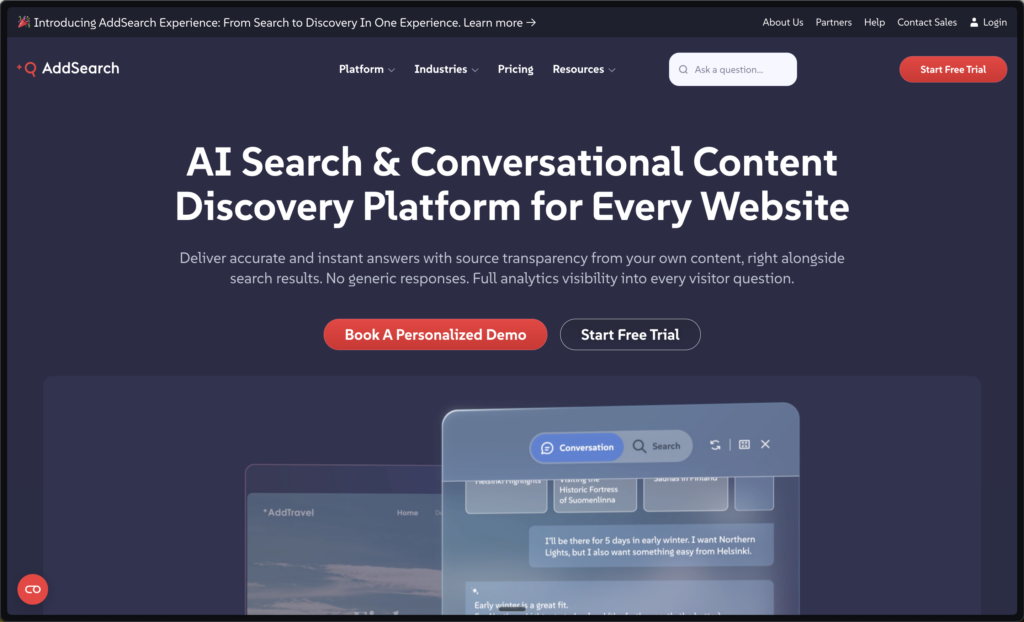
AddSearch is used by universities, colleges, government agencies, financial services firms, and associations. For higher education specifically, it helps prospective students find program pages, current students find deadlines and forms, and staff find policies, all through the same search experience.
Instead of sitting as a basic layer on a single page, AddSearch acts as a powerful federated search engine. It crawls and indexes content across multiple disparate domains, subdomains, and external databases via its API, bringing siloed information into one unified index.
What makes AddSearch different from Halda
The clearest difference is scope. Halda is an enrollment platform where search is one feature designed to convert prospects. AddSearch is a search and content discovery platform designed for the whole institution.
While AddSearch indexes your entire website and documents to power fast keyword searches, direct answers, and guided conversations, it doesn’t just stop at standard search results. For Higher Education, AddSearch provides specialized UI templates tailored to student use cases. Instead of wading through dense text, prospective students can easily interact with layouts designed specifically to let them find, filter, and compare different programs and courses side-by-side.
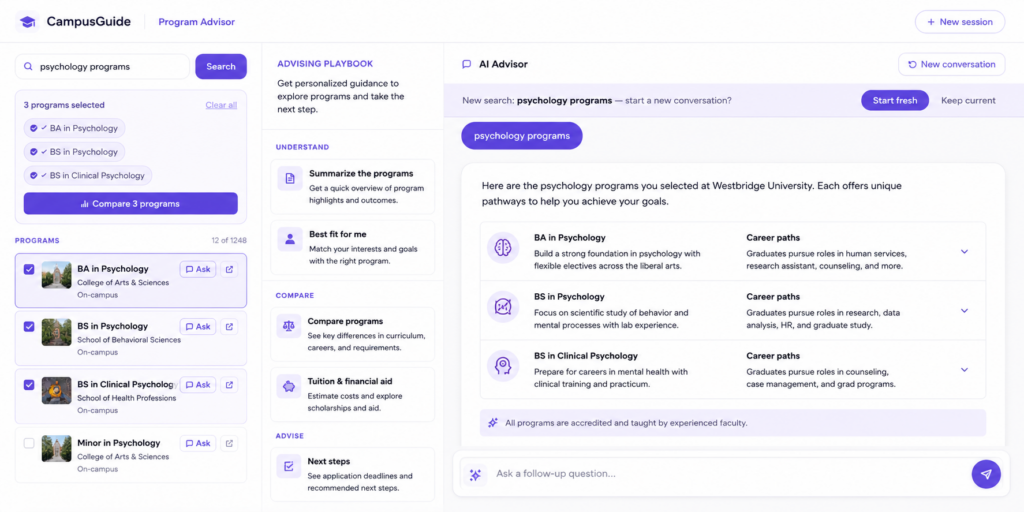
Setup is typically measured in days, not months. Marketing and content teams can manage and adjust search independently, without a dedicated technical team. Developers get full documentation, libraries, and APIs to extend the experience when needed.
AddSearch limitations to consider
- AddSearch is not an enrollment CRM. Institutions that also need email or SMS campaign tooling will pair it with their existing CRM rather than replace it.
- It focuses on website and document content. Outbound channels like SMS, voice, and email nurture, which Halda covers, are outside its scope.
AddSearch’s pricing is published directly:
Keyword Search plans start at $119 per month on an annual plan. AI Answers, which adds generated answers with citations, starts from $8,400 per year, and custom pricing is available for AI Conversations and AddSearch Experience.
How the AddSearch unified experience looks in practice
From keyword search to conversational discovery, it all comes together in one unified experience.
- Fast, accurate keyword search with typo tolerance and relevant filtering.
- Tailored Higher-Ed UI templates that make finding and comparing complex program and course details intuitive for students.
- Direct answers to specific questions, generated from the institution’s own indexed content, with source citations.
- Context-aware conversations that remember what a visitor has already asked and let them dig deeper naturally.
A prospective student might type “tuition for the nursing program” get a direct answer along with the search results, and then ask a follow-up about payment plans that turns into a short conversation, all within the same search experience.
Other things worth knowing about AddSearch
- Answers are grounded only in the institution’s own indexed content. AddSearch does not pull information from external sources.
- Your data is not used to train any AI model.
- AddSearch is SOC 2 Type II certified.
- WCAG 2.1 is supported.
- Standard setup is typically completed in a few days.
- A 14-day free trial is available using the institution’s own website content.
Best for: Institutions whose core problem is that visitors cannot find answers on the website. AddSearch turns your existing content into search, answers, and conversations without asking you to buy an entire enrollment suite.
Start a free trial now: https://app.addsearch.com/signup/user
2. Element451
Element451 is an AI-native CRM and student engagement platform built exclusively for higher education. It is the closest head-to-head match to Halda’s full value proposition, covering admissions, marketing campaigns, events, journeys, and student success in one system, with Bolt AI agents that handle inquiries and staff tasks around the clock.
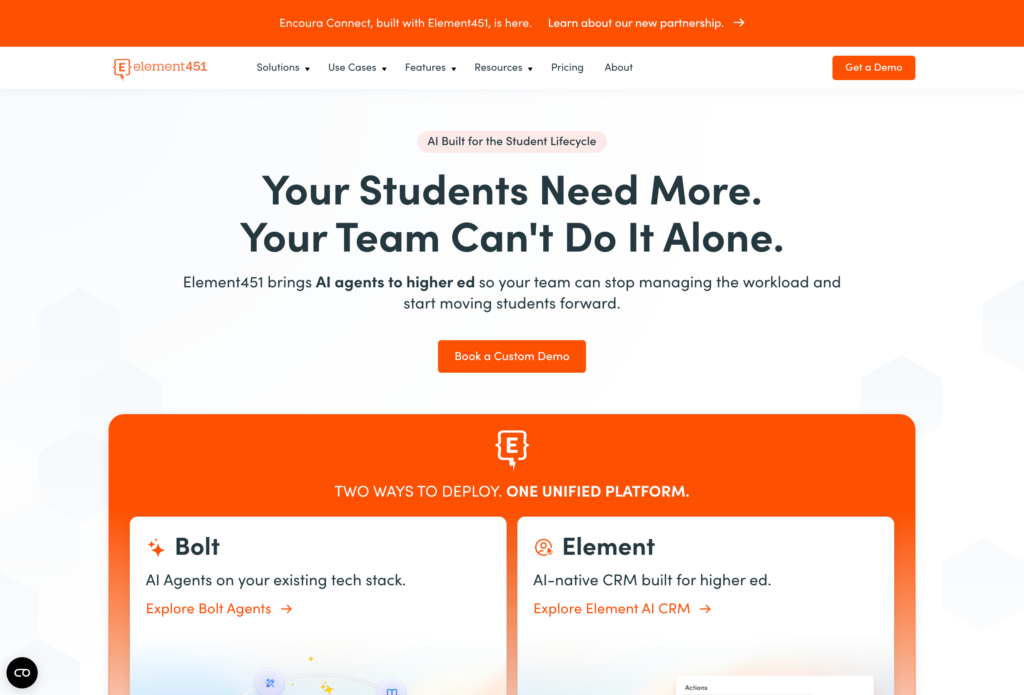
Where Halda is a newer entrant, Element451 has been serving higher ed since 2017 and secured a $175 million strategic investment from PSG in December 2024. For institutions weighing vendor stability alongside features, that scale matters.
Element451 limitations to consider
- It is a full CRM, not a search layer. Adopting it means consolidating your enrollment stack, which is a larger commitment than adding search to your website.
- Reviewers note a learning curve during setup, and data migration from a previous CRM takes planning.
- Like Halda, it is built around the prospective and enrolled student lifecycle, not institution-wide content discovery.
- Pricing is quote-only, based on institution size and support tier.
Element451 Pricing:
Element451 does not publish rates. Pricing is annual, organized into four packages (Admissions, Engagement, Marketing, Success) built on the shared Element Core, with special pricing for community colleges. Third-party listings report pricing starting around $20,000 per year. For an accurate figure, contact Element451 directly.
Best for: Institutions ready to consolidate enrollment marketing, admissions, and student engagement into one AI-driven CRM, with the budget and timeline that a platform decision requires.
3. Ivy & Ocelot (from Gravyty)
Ivy & Ocelot combines two of the most widely deployed conversational AI vendors in higher education. Ivy.ai and Ocelot merged under Gravyty and launched a unified platform in October 2025. Together, Gravyty serves 2,700+ education and nonprofit organizations.
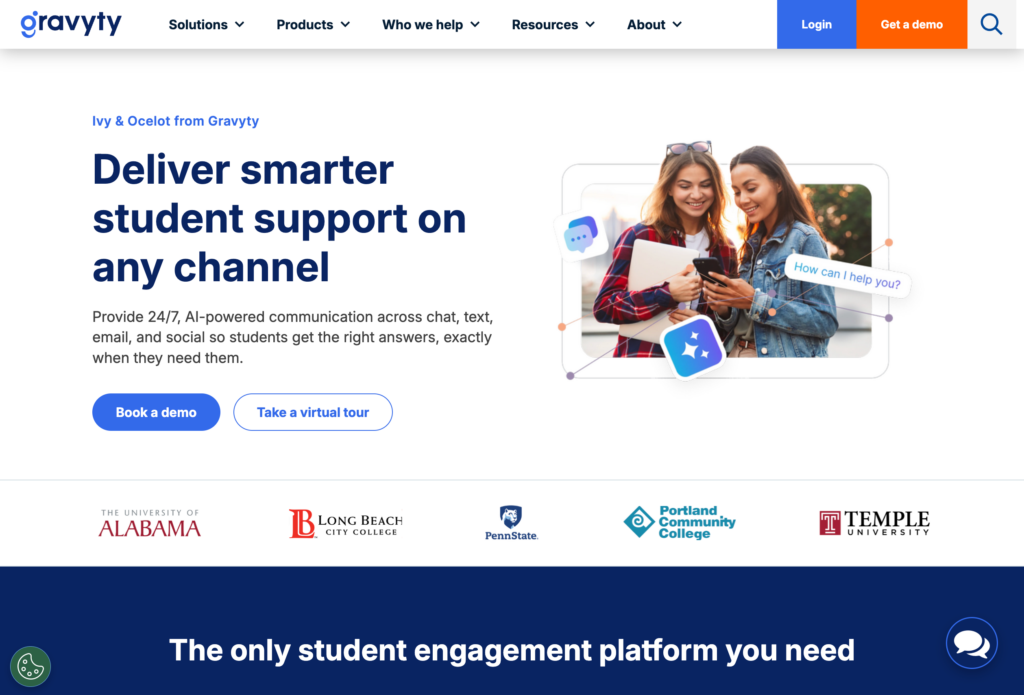
The platform provides higher-ed-trained AI assistants across web, SMS, email, voice, and social channels, with a deep library of financial aid, admissions, and student services content built from years of institutional deployments. It crawls your website daily to keep answers current and integrates with Slate, Ellucian, and Salesforce.
Ivy & Ocelot limitations to consider
- It is a conversational support tool, not a dedicated site search platform or an enrollment marketing CRM.
- The Ivy and Ocelot product lines are still being unified after the merger, so ask which capabilities come from which heritage product and how migration is handled.
- Pricing is quote-only, and third-party reports place annual contracts in the tens of thousands of dollars.
Ivy & Ocelot Pricing:
Gravyty does not publish pricing for Ivy & Ocelot. For an accurate figure, contact their sales team directly.
Best for: Institutions whose main pain is after-hours student question volume across financial aid, admissions, and student services, and who want a vendor with a long higher-ed track record.
4. Gecko
Gecko is a student engagement platform used by 150+ institutions. It combines conversational AI, live chat, SMS, event management, a student portal, and a cloud call center in one system, aimed squarely at lean admissions and recruitment teams.
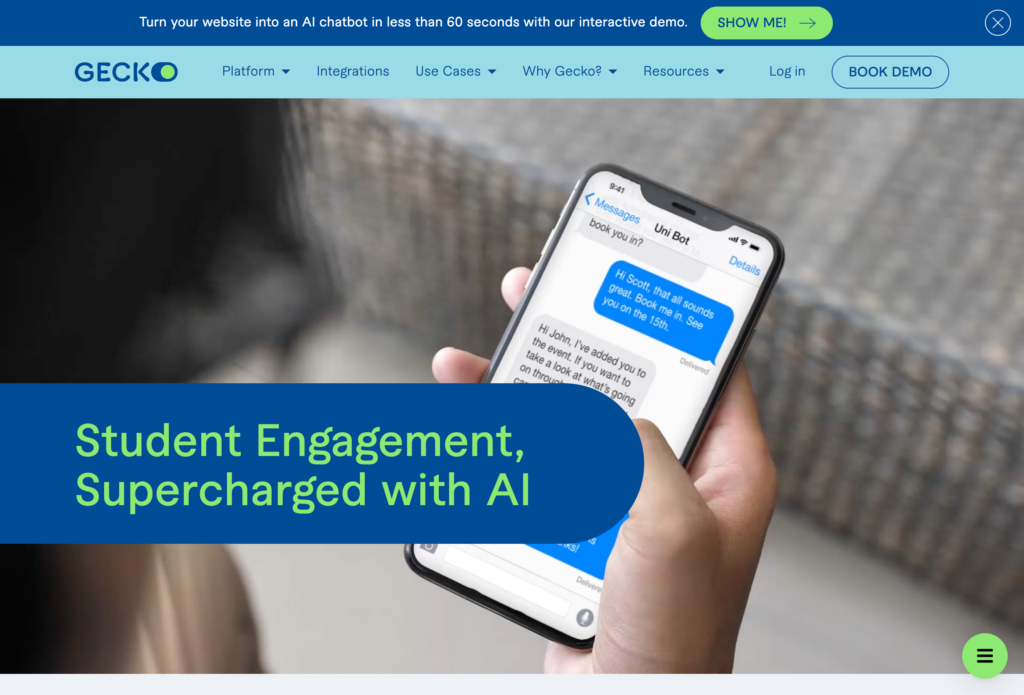
Gecko’s AI chatbot is pre-trained on institutional content and answers across web chat, WhatsApp, SMS, and Facebook Messenger, with multilingual support. Event registration and attendance tracking are built in, which sets it apart from pure conversational tools. Implementation is targeted at about a week.
Gecko limitations to consider
- It is an engagement and communications tool rather than a dedicated site search platform or a full marketing automation CRM.
- Independent review volume is thinner than for larger competitors, so ask for references at institutions similar to yours.
- Pricing is modular and quote-based, which makes budgeting harder up front.
Gecko Pricing:
Gecko does not publish pricing. Plans are custom-quoted based on institution size and usage. For an accurate figure, contact Gecko directly.
Best for: Lean admissions and marketing teams handling high inquiry and event volume who want engagement tools that feel bigger than their headcount.
5. Cludo
Cludo is a dedicated site search platform with an explicit higher education solution, making it the other search specialist on this list alongside AddSearch. It offers hybrid keyword and semantic search, AI-generated summaries above results, and conversational answers grounded in your indexed content.
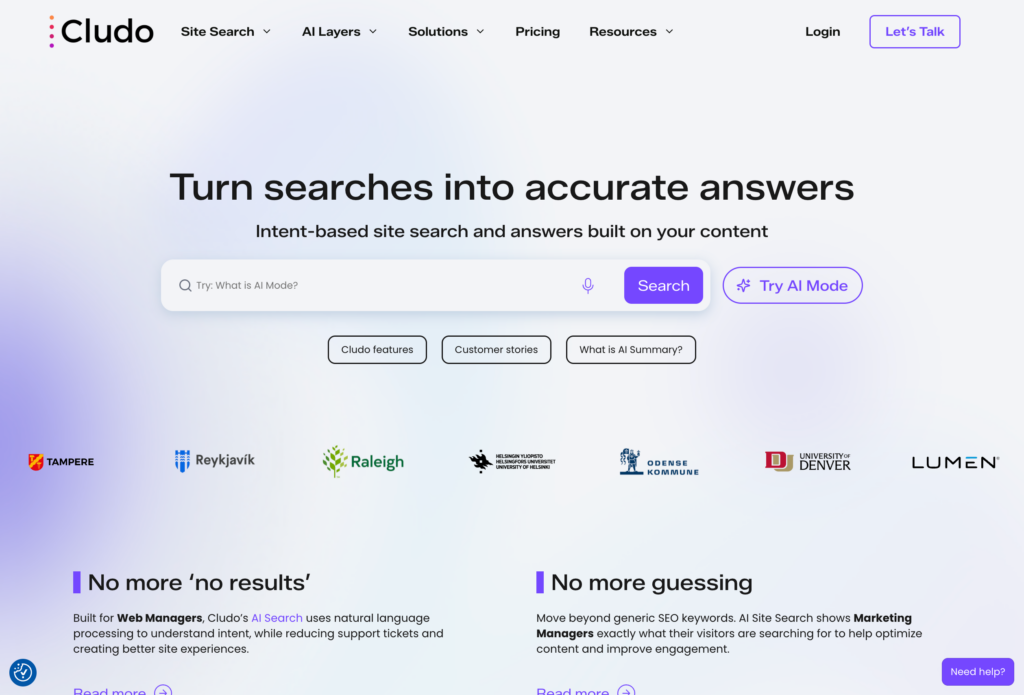
Cludo is used by universities including Boise State and the University of Bristol. It emphasizes accessibility, with WCAG 2.2 support, and provides analytics that help content teams spot gaps in what visitors are searching for.
Cludo limitations to consider
- Pricing is not published. Quotes are institution-specific, so comparing costs requires a sales conversation.
- Cludo is based in Denmark, and some North American teams note support response times across time zones.
- As with any search platform, evaluate AI answer quality on your own content. Run the same queries through each vendor and compare accuracy, citations, and how each handles questions your content does not answer.
Cludo Pricing:
Cludo does not publish pricing for its search plans. Their AI Layer plan starts from $8,000 annually per AI Layer. For an accurate figure, contact Cludo’s sales team directly.
Best for: Institutions comparing dedicated search specialists, particularly where accessibility compliance leads the requirements list.
6. Squiz Funnelback Search
Squiz Funnelback Search is an enterprise site search platform built on the search infrastructure, with deep roots in higher education and government. It can be purchased standalone without the full Squiz DXP, and it is designed for complex environments: millions of pages, multiple repositories, and fragmented content estates.
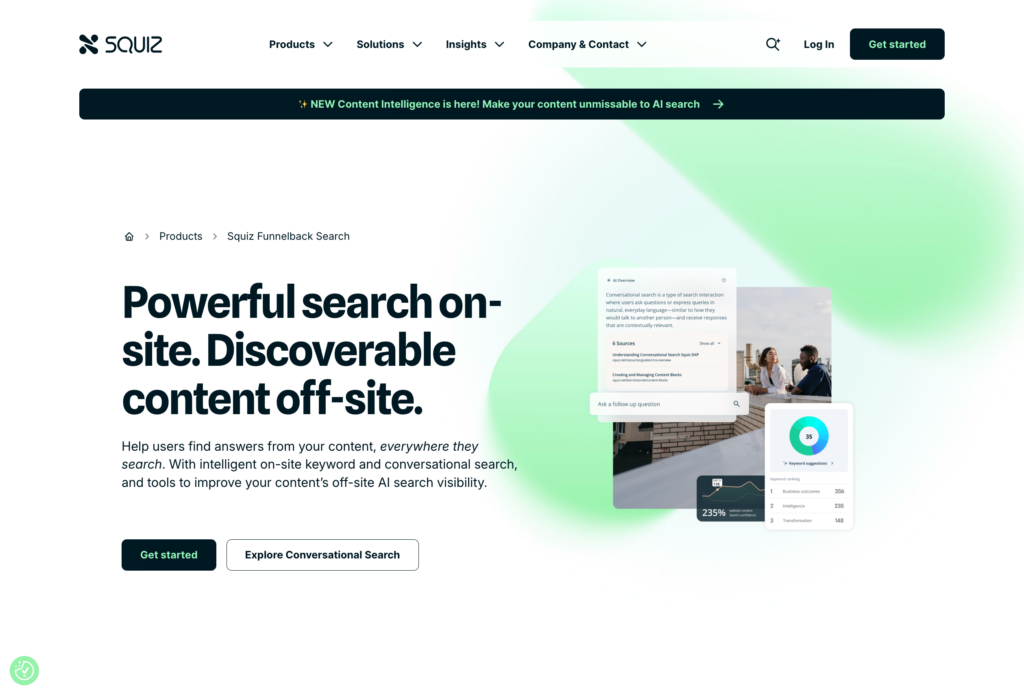
Funnelback offers both keyword search and conversational AI search grounded in your own content, plus Squiz Content Intelligence, a content health tool that audits AI readiness and WCAG 2.2 accessibility issues. Its ranking algorithm draws on 70+ signals refined over decades, and pre-built higher-ed templates are available.
Funnelback limitations to consider
Developer reliance is real. Both AddSearch and Funnelback offer federated search across multiple sites and data sources, but configuring and maintaining Funnelback layouts typically involves custom Freemarker template coding and ongoing technical work. Marketing teams rarely run it without engineering support.
Implementation is heavier. Setup timelines run longer than lightweight alternatives, and scoping usually involves professional services.
Pricing is quote-only, so budgeting requires a full sales cycle.
Squiz Funnelback Pricing:
Squiz does not publish pricing for Funnelback Search. Plans are custom-quoted based on scale and configuration. For an accurate figure, contact Squiz directly.
Best for: Large university systems with dedicated web engineering teams that want a battle-tested enterprise search backend and can absorb the technical overhead that comes with it.
How These Halda Alternatives Compare
| What matters | Halda | AddSearch | Element451 | Ivy & Ocelot | Gecko | Cludo | Squiz Funnelback |
| Built as a dedicated website search platform | No, search is one feature | Yes | No | No | No | Yes | Yes |
| Serves all website visitors, not just prospects | No | Yes | No | Partial | Partial | Yes | Yes |
| Direct, content-grounded AI answers with citations | Partial | Yes | Partial | Partial | Partial | Yes | Yes |
| Pre-built UI templates for course comparison and other Higher Ed usecases | No | Yes | No | No | No | No | No |
| Full-funnel enrollment marketing (email, SMS, voice) | Yes | No | Yes | Partial | Partial | No | No |
| Manageable without developer resources | Yes | Yes | Partially, with training | Partially, with training | Yes | Yes | No, developer support needed |
| Publicly confirmed starting price | No, quote-only | Yes, $119/mo for Keyword Search, $8,400/yr for AI Answers | No, quote-only | No, quote-only | No, quote-only | No, quote-only | No, quote-only |
| Predictable pricing | No, varies by bundle | Yes, flat plans with set annual rates | No, varies by size and usage | No, varies by contract | No, varies by usage | No, varies by scale | No, varies by scale and configuration |
| Typical setup time | About a week | Days | Weeks | Weeks | About a week | Weeks | Weeks to months |
Final Thoughts
The right Halda alternative depends on the job you are hiring it for. If you need to consolidate enrollment marketing into one CRM, Element451 is the strongest like-for-like choice. If the pain is after-hours student question volume, Ivy & Ocelot and Gecko are built for exactly that. And if you have the engineering resources for a traditional enterprise backend, Squiz Funnelback is proven at scale.
But if the core problem is that prospective students, current students, and staff cannot find answers on your website, a dedicated search and content discovery platform will serve you better than an enrollment suite where search is a side feature. AddSearch unifies keyword search, direct AI answers with source citations, and context-aware conversations into one experience, grounded strictly in your own content. It deploys in days, works alongside whatever CRM you already run, and is the only vendor on this list with published pricing.
You can start a 14-day free trial using your own website content, or book a short walkthrough with our team to see how it would work on your site.
Start your 14-day free trial: https://app.addsearch.com/signup/user
Book a demo: https://www.addsearch.com/addsearch-experience-demo/
