



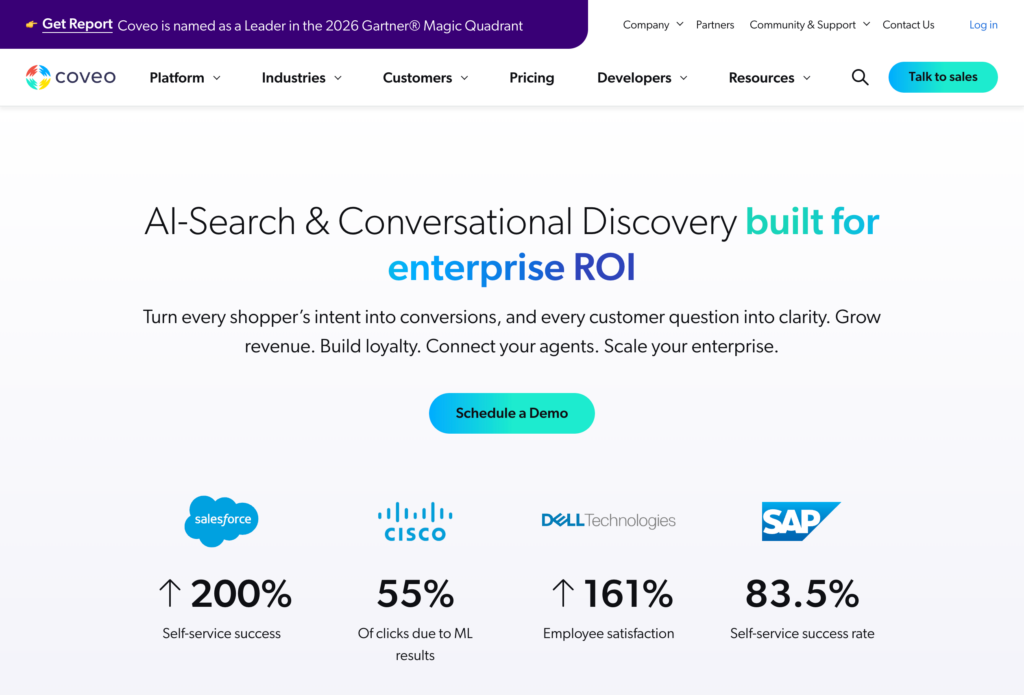
Coveo is an enterprise AI search and personalization platform used by large organizations to unify search across a CRM, CMS, knowledge base, support portal, and website. It’s one of the most established names in enterprise search, with deep, native integrations into Salesforce, Sitecore, ServiceNow, and SAP.
That reputation is well earned for the use case Coveo was built around: large enterprises that need to federate search across many internal systems and have the budget and team to support the implementation it takes to get there. But a growing number of organizations working with a narrower footprint want the payoff of good AI search without the six-figure floor and multi-month rollout.
What Coveo Is Built For
Coveo’s core strength is federated search: pulling together content from a CRM, CMS, knowledge base, support portal, and website into one search experience, backed by deep, established integrations with Salesforce, Sitecore, ServiceNow, and SAP. That breadth serves large, multi-system enterprises well, but it’s built for organizations with several internal systems to unify, not a single content-focused website.
How Coveo’s Pricing Works
Coveo’s own pricing page structures its offering around two paths:
- Service, Website, and Workplace offering covers enterprise knowledge experiences for customers, agents, and employees, priced on entitlement-based licensing plus seat-based pricing for Workplace.
- Commerce offering covers product discovery for B2B and B2C shoppers, with modular pricing built around a feature-rich base package plus add-ons.
Both are structured around a 100,000-query-per-month base unit, and generative AI and agentic capabilities, including Conversational Search, Generative Answering, and Conversational Product Discovery, are listed as “Add-on Available” rather than included in the base package. That means the generative AI capabilities most buyers actually want sit on top of an already substantial base price.
Coveo for Salesforce, one of the few products with a published pricing amount, starts at $100,000 per year.
Full Service, Website, Workplace, and Commerce pricing is not public and requires a conversation with Coveo’s sales team.
Why Coveo Takes Longer to Implement
Beyond pricing, Coveo is also built around implementations that typically take months and benefit from a dedicated internal search team. Organizations with a single content-heavy website, rather than a sprawling multi-system enterprise footprint, often find that scope hard to justify.
This article looks at 8 top Coveo alternatives: what each one does well, where it falls short, and which type of organization it tends to fit best.
1. AddSearch
AddSearch is an AI search and conversational content discovery platform. It brings together keyword search, direct AI-generated answers, and context-aware conversational search into one unified experience, rather than asking organizations to stitch together separate tools for each.
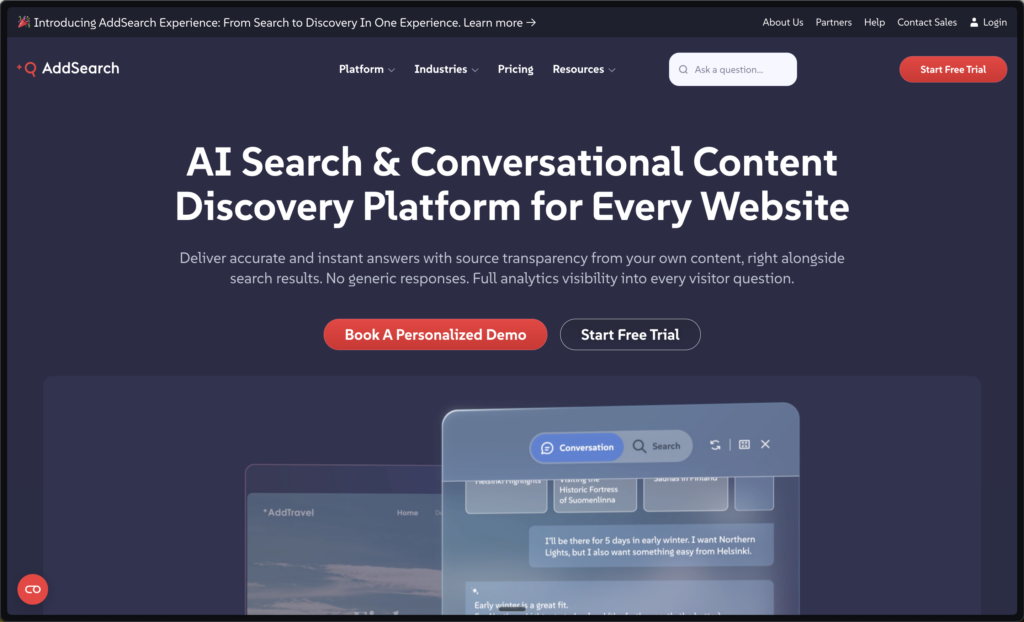
AddSearch is built for websites of any size that want visitors to find what they need quickly, whether that means a fast keyword result, a direct answer to a specific question, or a guided conversation that helps someone explore a topic. Universities, government agencies, financial services firms, associations, and corporate websites all use AddSearch today. The underlying capability, helping any website turn its content into answers people can actually use, works for websites of any size.
What makes AddSearch different from Coveo
The clearest difference is scope and approach. Coveo’s core strength is federated search: pulling together content from a CRM, CMS, knowledge base, support portal, and website through a library of pre-built connectors. That breadth is genuinely useful for large, multi-system enterprises, but it comes with real complexity. Implementations typically take months, generative AI capabilities sit behind Coveo’s pricing page as paid add-ons rather than being included in the base package, and buyers consistently describe the consumption-based, query-volume pricing model as difficult to forecast at scale.
AddSearch takes a faster, more flexible path to a similar outcome. Rather than relying on a catalog of ready-made connectors, it uses API-based indexing and authenticated crawling to pull in content from almost any source, including CRMs, intranets, and gated systems, without needing a dedicated connector built in advance. The primary focus is turning that content, most often a website and its documents, into fast keyword search, direct answers, and guided conversations. Setup is typically measured in days, not months. Answers come grounded in the organization’s own indexed content by default, with source citations on every response.
Developers get full documentation, libraries, and APIs to build and extend the experience exactly how they need. Business users, marketing teams, and content teams can manage and adjust search and discovery independently, without needing a dedicated internal search team to keep it running.
AddSearch’s pricing is published directly:
Keyword Search plans start at $119 per month on an annual plan. AI Answers starts from $8,400 per year, and custom pricing is available for AI Conversations and AddSearch Experience.
How the AddSearch’s unified experience looks in practice
From keyword search to conversational discovery, it all comes together in one unified experience.
- Fast, accurate keyword search with typo tolerance and relevant filtering
- Direct answers to specific questions, generated from the organization’s own indexed content, with source citations
- Context-aware conversations that remember what a visitor has already asked and let them dig deeper naturally
A visitor can naturally move between these. Someone might start by typing a keyword, get a direct answer along with the search results, and then ask a follow-up question that turns into a short conversation, all within the same search experience.
Other things worth knowing about AddSearch
- Answers are grounded only in the organization’s own indexed content. AddSearch does not pull information from external sources.
- Your data is not used to train any AI model.
- AddSearch is SOC 2 Type II certified.
- WCAG 2.1 is supported.
- Standard setup is typically completed in a few days.
- A 14-day free trial is available using the organization’s own website content.
Best for: For organizations seeking an enterprise-grade AI search and content discovery platform that delivers exceptional speed, precision, and reliability without the heavy burden of ongoing developer maintenance, AddSearch is engineered for exactly that.
Start a free trial now: https://app.addsearch.com/signup/user
2. Glean
Glean is a workplace AI platform built for federated search and generative answers across an organization’s internal systems. Its architecture is the closest match to Coveo’s core promise of any alternative on this list: permission-aware search across more than 100 native connectors, including Google Workspace, Microsoft 365, Slack, Jira, Confluence, Salesforce, and ServiceNow, combined with generative answers grounded in that connected content and a knowledge graph that personalizes results to each employee.
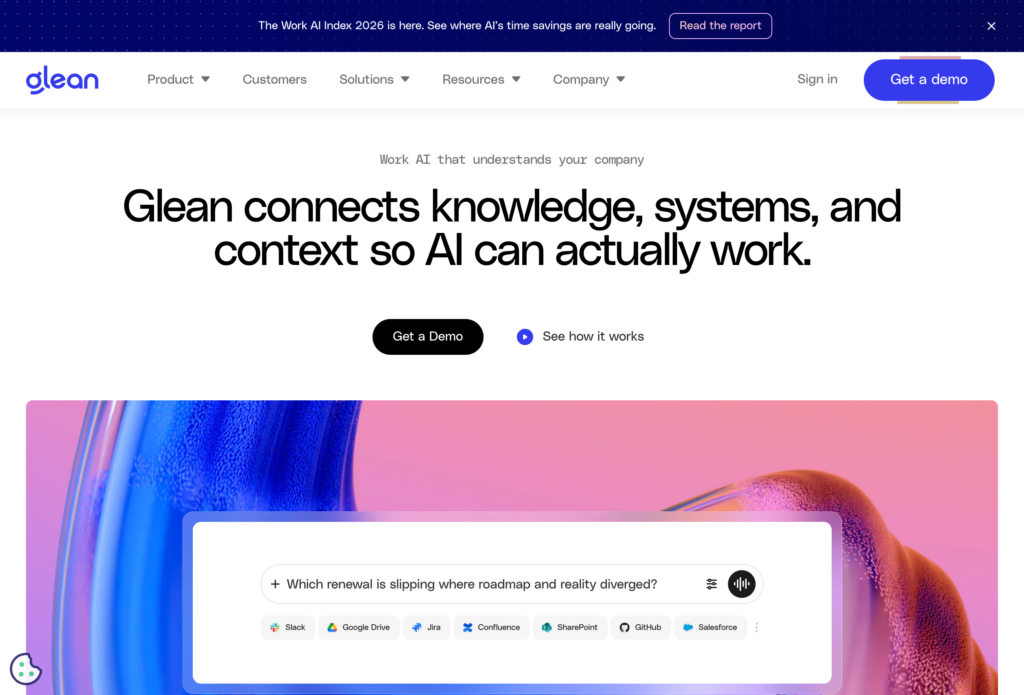
Where Coveo splits its platform across Service, Website, Workplace, and Commerce use cases, Glean is built specifically for internal workplace search and agentic workflows. It does not serve customer-facing commerce or public website search, which narrows its overlap with Coveo to the Workplace and Service side of Coveo’s offering.
Glean limitations to consider
- Cloud-only, with natural language processing optimized primarily for English, a constraint for organizations that need on-premise deployment or work heavily in other languages.
- Built for internal workplace and knowledge search, not customer-facing commerce or public website search, so it doesn’t cover Coveo’s Commerce use case at all.
- Pricing is quote-only and seat-based, with a high entry point and a reported minimum annual contract that typically requires 100 or more seats.
- Full infrastructure and administration overhead, including a dedicated admin, adds materially to total cost beyond the headline per-seat rate.
Glean Pricing:
Glean does not publish standard pricing. Based on third-party reporting:
- Enterprise Search license: approximately $50 to $75 or more per user, per month
- Minimum annual contract: approximately $50,000 to $60,000, typically requiring 100 or more seats
- A paid proof of concept, if requested, can run up to $70,000
For an accurate figure, contact Glean’s sales team directly.
Best for: Mid-market and large enterprises, generally 1,000 or more employees, that want turnkey, permission-aware search and generative answers across their internal software stack.
3. Algolia
Algolia is a developer-first, API-first search and retrieval platform used by more than 18,000 businesses to power product, app, and documentation search.
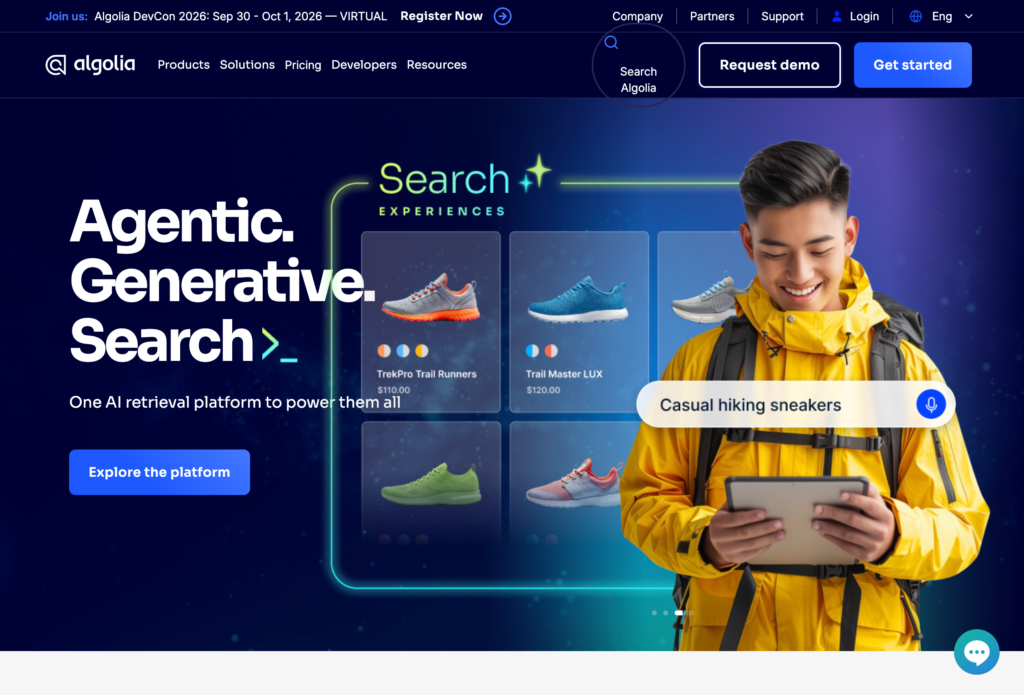
Where Coveo sells a managed, services-led enterprise relevance platform, Algolia sells fast, hosted search infrastructure that engineering teams assemble and tune themselves. Algolia has moved into generative and agentic territory recently with Ask AI, a generative, cited-answer layer for the search bar, along with DocSearch v4 and Agent Studio for building RAG agents.
Algolia limitations to consider
- No native federated search across CRM, CMS, knowledge base, or support systems, the way Coveo federates Salesforce, ServiceNow, and SAP. Algolia indexes content you push to it.
- Dual-metric billing, search requests plus records, can escalate unpredictably at scale.
- AI features require the Grow Plus tier, whose per-request rate is more than three times the standard Grow rate.
- Semantic search and real-time personalization are reserved for the custom-quoted Elevate tier.
Algolia Pricing:
- Build: free, 10,000 search requests and 1 million records per month
- Grow: pay-as-you-go, 10,000 search requests per month included, then $0.50 per additional 1,000 requests, plus $0.40 per additional 1,000 records beyond 100,000
- Grow Plus: same usage allowances as Grow, plus AI Synonyms, AI Ranking, and Advanced Personalization, at $1.75 per additional 1,000 search requests
- Elevate: custom annual pricing with NeuralSearch, AI Collections, Smart Groups, real-time personalization, and enterprise-level SLA
Best for: Product, engineering, and digital teams that need fast, developer-controlled search with an optional generative answer layer, and don’t need federated search across internal enterprise systems.
4. Elasticsearch
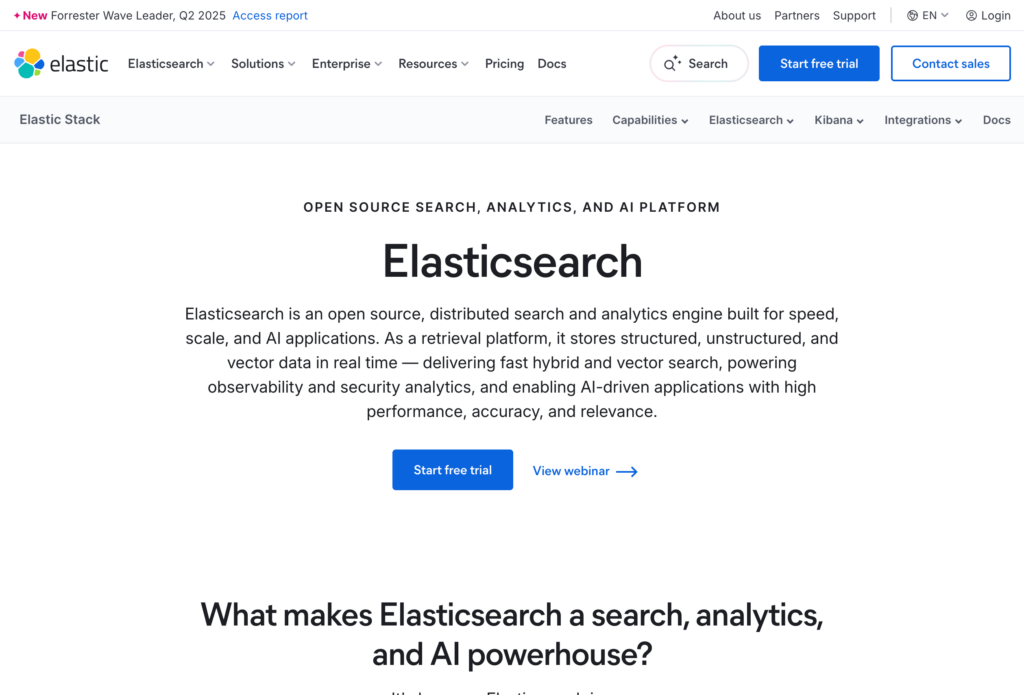
Elasticsearch is the open-source search and analytics engine underpinning a large share of the industry’s search infrastructure. Against Coveo, it sits at the opposite end of the build-versus-buy spectrum. Elasticsearch provides the building blocks, including a vector database, semantic search, and tools like AI Playground and Agent Builder for constructing RAG pipelines, but connectors, relevance tuning, permissions, and the answer layer are yours to build and maintain.
Elasticsearch limitations to consider
- Not a turnkey federated search product. Connecting CRM, CMS, knowledge base, and support content, and enforcing permissions per source, is an engineering project, not a configuration step.
- Managed AI answers and conversational search require building your own RAG pipeline.
- Meaningful ongoing engineering investment to configure, secure, and scale.
- Advanced features like machine learning anomaly detection, SSO, and cross-cluster replication sit behind higher paid tiers.
Elasticsearch Pricing:
Self-hosted Elasticsearch is free and open-source, though you carry the full operational cost. Managed options:
- Elastic Cloud Hosted: starts around $95 to $99 per month for a small production configuration, scaling to around $175 to $184 per month for the Enterprise tier
- Elasticsearch Serverless: metered by usage; small development environments run roughly $24 to $27 per month, and moderate production environments run roughly $190 to $210 per month
- Real-world production deployments commonly range from $1,500 to $8,000 per month, with larger deployments reaching well into five and six figures
Best for: Organizations with engineering teams who need full infrastructure control and are prepared to build federation, permissions, and AI answers themselves.
5. Bloomreach
Bloomreach is a commerce experience platform combining AI-powered product discovery, marketing automation, a headless CMS, and a customer data platform. It’s the closest match on this list to Coveo’s Commerce side, built specifically for enterprise retail rather than general content-heavy websites.
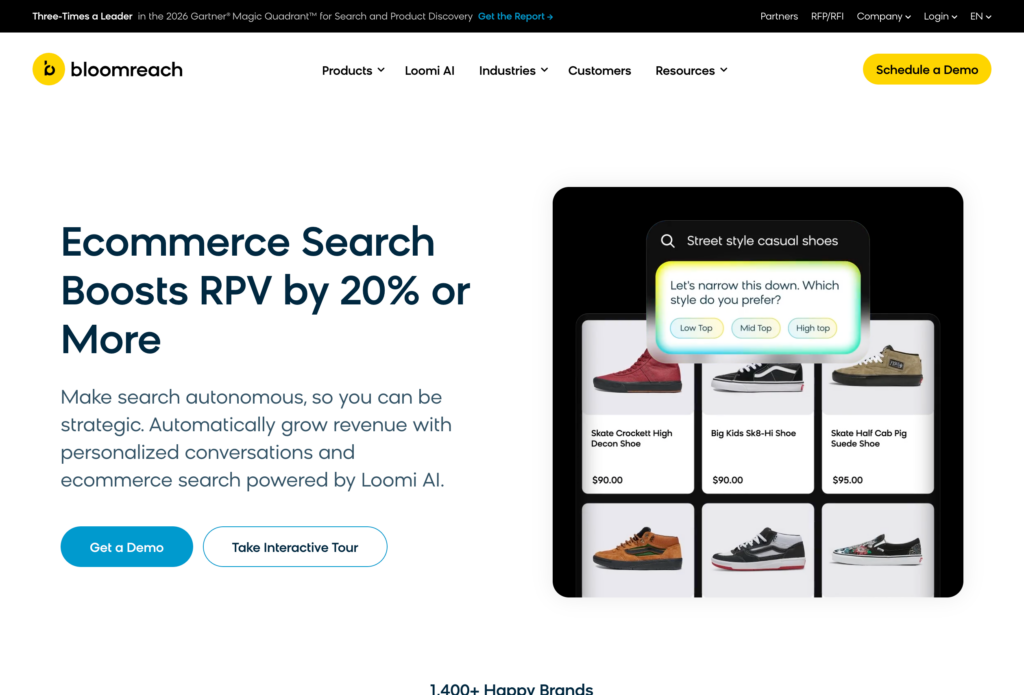
Its Loomi AI layer powers a conversational shopping agent and autonomous merchandising, and Bloomreach has been named a Leader three times in the 2026 Gartner Magic Quadrant for Search and Product Discovery. Where Coveo splits its platform across Service, Website, Workplace, and Commerce, Bloomreach’s unified data is customer and commerce data, not federated CRM or knowledge base content, so it doesn’t reach into internal workplace or support-portal search the way Coveo does.
Bloomreach limitations to consider
- Built for enterprise retail and product discovery, not internal workplace, support-portal, or federated knowledge search.
- No public pricing. Every plan is quote-only, and the platform is rarely a fit below roughly $50 million in revenue.
- Module-plus-usage pricing across Discovery, Content, and Engagement can be difficult to forecast at renewal.
- Enterprise-grade implementation timelines, with Discovery alone typically taking eight to twelve weeks.
Bloomreach Pricing:
Bloomreach publishes no dollar figures on its own pricing page. For an accurate figure, request a quote directly from Bloomreach.
Best for: Large enterprise retailers wanting an all-in-one commerce discovery, personalization, and marketing suite.
6. Yext
Yext is an enterprise platform built around a Knowledge Graph of structured business data, locations, people, products, and services, that powers on-site search and increasingly focuses on getting brands cited correctly in AI-generated answers from platforms like ChatGPT and Gemini.
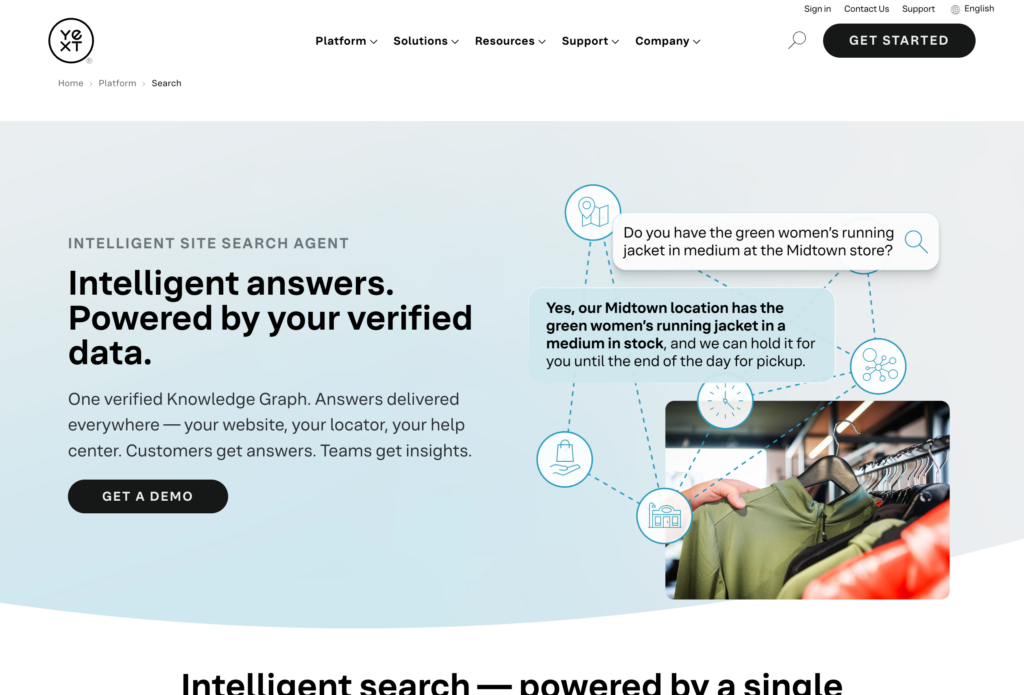
Yext’s search is built on that structured entity data, which makes it well suited to multi-location, consumer-facing brands such as retail chains, healthcare systems, and bank branches. It doesn’t federate content across a CRM, CMS, knowledge base, or support system the way Coveo does, and it isn’t built for general content-heavy websites in higher education, government, or associations.
Yext limitations to consider
- No federated search across enterprise systems like Salesforce, ServiceNow, or SAP.
- Built around structured entity data for multi-location, consumer-facing brands, not general content-heavy or knowledge-driven websites.
- Pricing is opaque and largely per-location. Real Search and Knowledge Graph deployments are custom-quoted.
- Enterprise deployments commonly land in the tens of thousands to hundreds of thousands of dollars per year.
Yext Pricing:
Yext does not publish standard enterprise pricing. For an accurate figure, contact Yext’s sales team directly.
Best for: Multi-location, consumer-facing brands that need structured business-data management, on-site search built on that data, and visibility in AI-generated answers.
7. Typesense
Typesense is an open-source search engine, written in C++, built around speed and developer experience. It’s often positioned as a fast, self-hostable alternative to Algolia, with sub-50ms search performance and built-in typo tolerance.
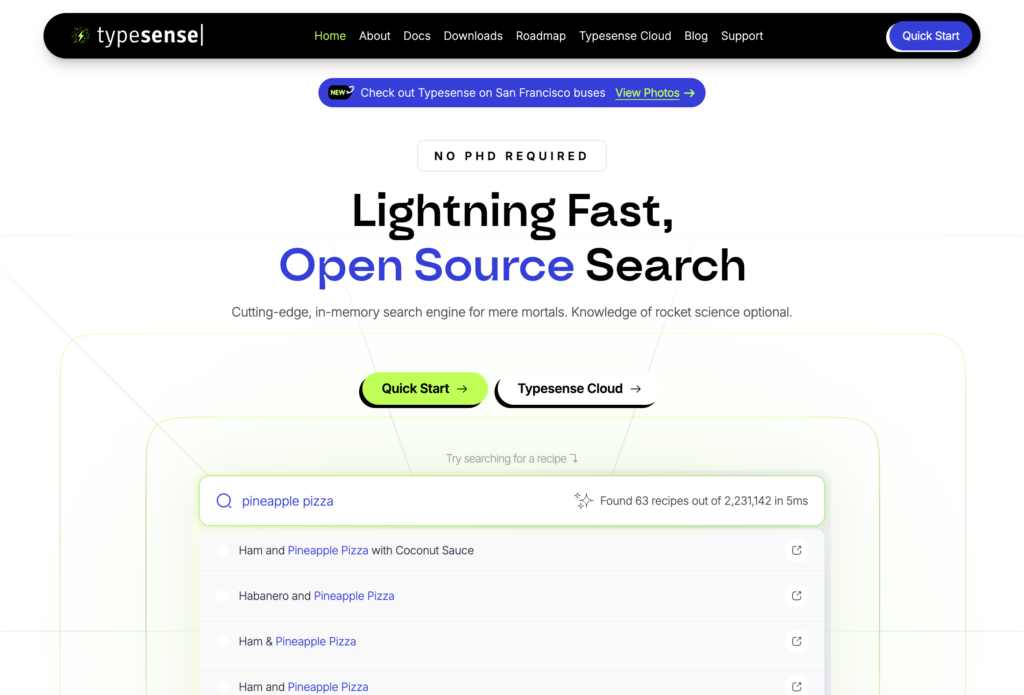
In 2026, Typesense added built-in retrieval-augmented generation support and automatic embedding generation, which lets developers build AI-powered search features without standing up a separate embedding pipeline. That’s a meaningful capability for a team building a custom AI search experience from scratch, but it’s still a very different starting point than Coveo’s managed, federated approach.
Typesense limitations to consider
- No federated search across enterprise systems. “Multi-search” here means querying multiple Typesense collections, not federating live CRM, CMS, or support-system content.
- It’s a developer tool. There’s no business-facing dashboard for non-technical teams to manage or adjust search, and no prebuilt enterprise connector library.
- Any conversational or RAG-style experience needs your own LLM provider and setup; it isn’t a managed feature.
- Pricing is resource-based rather than a simple flat tier, so estimating cost requires understanding memory, CPU, and traffic needs in advance.
Typesense Pricing:
Self-hosting is free. Typesense Cloud uses an hourly, resource-based calculator rather than a flat starting price. Cost depends on:
- RAM and CPU
- High availability setting
- Storage type
- Data center location
For an accurate figure, use Typesense’s own pricing calculator directly for your specific use case.
Best for: Developer-led teams who want a fast, self-hostable search engine they’re comfortable configuring and maintaining themselves, not organizations needing federated enterprise knowledge search.
8. Meilisearch
Meilisearch is an open-source search engine written in Rust, built for developer simplicity and speed. It’s fully free to self-host under the MIT license, with no feature gating on the open-source version. Meilisearch is used by organizations including Hugging Face and Louis Vuitton.
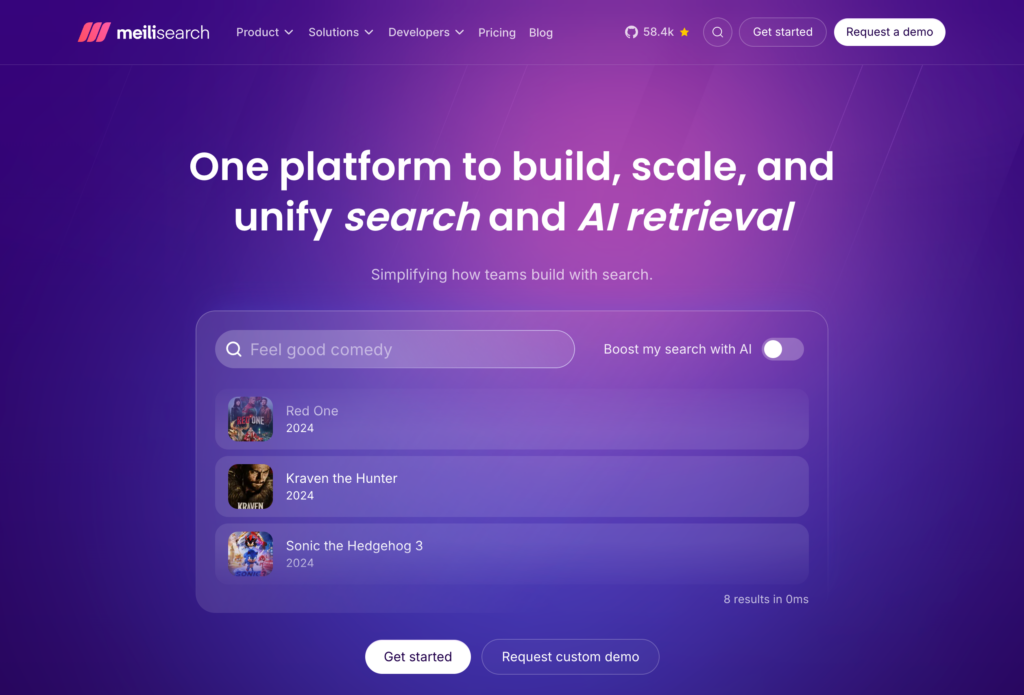
Meilisearch’s 2026 roadmap includes serverless indexes, its own AI gateway, and a more capable chat-style engine, and the platform now ships a built-in chat UI backed by retrieval-augmented generation. That narrows the AI-answers gap somewhat, but Meilisearch remains a developer-oriented search engine rather than a federated enterprise-knowledge platform.
Meilisearch limitations to consider
- No federated search across enterprise systems, and no prebuilt connectors to a CRM, CMS, or support platform.
- No business-facing dashboard. Non-technical teams can’t independently manage search configuration.
- The built-in chat and RAG features require bringing your own LLM provider.
- Support on the open-source tier is community-based rather than dedicated.
Meilisearch Pricing:
Self-hosting is free. Meilisearch Cloud starts at $20 per month. Their built-in cost estimator gives two examples:
- Usage-based: $30/month for a base configuration (100,000 documents, 50,000 searches)
- Resource-based: $23/month for a smaller instance
Enterprise: custom pricing, adding SSO, SOC 2 compliance, a dedicated Slack support channel, and an uptime SLA of up to 99.999%.
Best for: Developer teams and startups that want a fast, affordable, open-source search engine with optional built-in AI chat, not organizations needing federated enterprise knowledge search.
How These Coveo Alternatives Compare
| What matters | Coveo | AddSearch | Glean | Algolia | Elasticsearch | Bloomreach | Yext | Typesense | Meilisearch |
| Built for content-heavy and general-purpose sites | Yes, with high complexity | Yes | No, internal workplace, not public sites | Yes, but e-commerce and app search as primary focus | Partial (infra only) | No, enterprise retail only | No, structured location/entity data only | Partial (infra only) | Partial (infra only) |
| Direct, content-grounded AI answers | Yes, as a paid add-on | Yes | Yes | Yes, via Ask AI (requires bringing your own LLM) | No | Partial, product-focused (Loomi) | No | No, would need custom build | No, built-in chat requires your own LLM |
| Conversational search that remembers context | Partial, via add-on | Yes | Yes | Yes, via Ask AI | No | Partial, product-focused (Loomi) | No | No, would need custom build | Partial, via built-in chat UI |
| Manageable without developer resources | Partially, with training | Yes | Partially, IT-led setup | No | No | Partially, with training | Partially, with training | No | No |
| Publicly confirmed starting price | No amount published; Coveo for Salesforce starts from $100K | Yes, $119/mo for Keyword Search, $8,400 for AI Answers | No, quote-only | Partially (Grow/Grow Plus rates published; Elevate is not) | Yes, from $99/month (Cloud) | No, quote-only | No, quote-only; | No flat figure published | Yes, from $20/month |
| Typical setup time | Months | Days | Weeks to months | Days to weeks | Weeks to months | Months | Weeks to months | Weeks | Days to weeks |
| Works alongside an existing search provider | N/A (this is the existing provider in this comparison) | Yes | Partial, separate workplace layer | N/A | N/A | No | No | N/A | N/A |
Final Thoughts
For organizations seeking an enterprise-grade AI search and content discovery platform that delivers exceptional speed, precision, and reliability without the heavy burden of ongoing developer maintenance, AddSearch is engineered for exactly that.
It seamlessly unifies advanced keyword search, direct AI-generated answers, and context-aware conversations into a single secure experience, grounded strictly in your own data and backed by robust enterprise security. Unlike other federated enterprise platforms that take months to implement and add generative AI on top as a paid extra, AddSearch deploys in days and integrates smoothly with your existing infrastructure. You get a sophisticated, highly scalable search architecture with transparent, predictable pricing and a significantly lower total cost of ownership.
You can start a 14-day free trial using your own website content, or book a short walkthrough with our team to see how it would work on your site.
Start your 14-day free trial: https://app.addsearch.com/signup/user
Book a demo: https://www.addsearch.com/addsearch-experience-demo/
