



SearchStax has built a solid reputation as a website search platform, especially with content-heavy organizations in higher education, government, and healthcare. It pairs a marketer-facing Site Search product with a managed Apache Solr backend called Managed Search.. If your goal is a hosted search index with relevance controls and a familiar results page, SearchStax has earned its place on the shortlist.

But the way people expect to find information on a website has moved on. Visitors increasingly want a direct answer to their question, not just a page of results to sort through, and many want to keep asking follow-up questions until they get what they need. That shift is where a growing number of organizations start looking past SearchStax. Its AI feature, Smart Answers, sits on top of the results page as a generated summary, and its full site search pricing is quote-only, which makes it harder to compare and budget for. Add the decision between two separate products, and the buying process gets heavier than some teams want.
This article looks at seven of the best SearchStax alternatives in 2026 for website search. Every option here fits content-heavy sites in education, government, finance, healthcare, associations, manufacturing, telecom, and large corporate portals. We start with AddSearch, then work through the rest so you can match the right tool to your situation.
What SearchStax Is Built For
SearchStax describes itself as a search experience company, and its strength is website search for organizations with a lot of content to index. Two products sit under the brand.
Site Search is the marketer-facing product. It gives web and digital teams a way to configure relevance, promotions, synonyms, filters, and analytics without writing code, with Solr running underneath. Its AI layer, Smart Answers, generates a natural-language summary at the top of the results page, drawn from the site’s own indexed content and shown with source links.
Managed Search is the infrastructure product. It is a fully hosted, high-availability Apache Solr service aimed at engineering and IT teams who want to offload the operational work of running Solr clusters, with monitoring, backups, disaster recovery, and private-cloud options across AWS, Azure, and Google Cloud.
Both products are strong in their lane. Where they leave a gap is conversational discovery. Smart Answers is a summary above results rather than a back-and-forth experience that remembers what a visitor asked earlier, and buying often means choosing between the two products or combining them.
How SearchStax’s Pricing Works
SearchStax splits pricing across its two products, and only one of them is public.
Managed Search publishes tiers billed annually: a Development tier starting around $367 per month for a cluster (roughly $53 per month for a single node), a Core tier from about $2,499 per month, and an Enterprise tier from about $6,250 per month, with uptime SLAs and support scaling up each tier.
Site Search does not publish dollar figures. It lists two named tiers, Advanced and Premium, both of which route to a “get in touch” contact-sales flow, with the final price scaling on content indexed, monthly searches, analytics retention, and the number of search apps or sites. Smart Answers sits on the higher Premium tier.
Why Some Organizations Look for an Alternative
A few recurring reasons come up when teams start comparing options:
- The AI experience is a generated summary above results, not conversational search that remembers context across follow-up questions.
- Site Search pricing is quote-only, which makes early comparison and budgeting harder.
- Reviewers on G2 mention surprise overage charges and steep annual price increases.
- Advanced customization, such as bespoke result cards or moving changes between environments, tends to need developer involvement.
- Choosing between Site Search and Managed Search adds a scoping decision before you even start.
With that context, here are seven SearchStax alternatives worth a look.
1. AddSearch
AddSearch is a website search and content discovery platform that brings keyword search, AI Answers, and AI Conversations together on one platform. It is built for content-heavy organizations in education, government, finance, healthcare, associations, manufacturing, and telecom that want a modern search experience without a long build.
What Makes AddSearch Different from SearchStax
The clearest difference is scope. SearchStax gives you a strong results page with a summary layer on top, and asks you to pick between two products. AddSearch gives you one platform and all three capabilities available from day one. You choose how much to deploy and where.
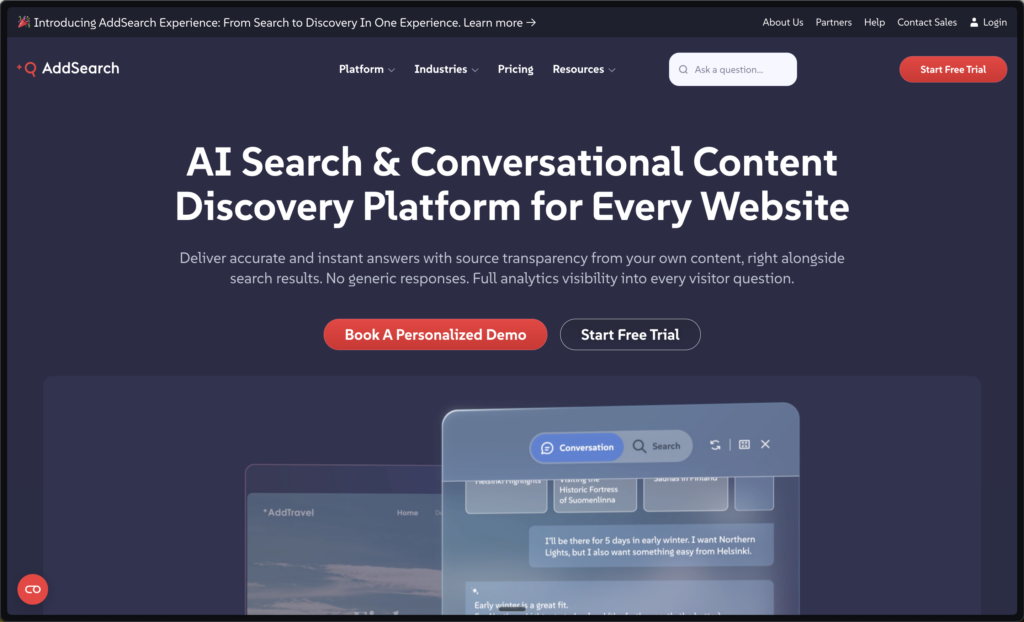
- Keyword search, AI Answers, and AI Conversations run on the same index, so you are not stitching products together or paying for each capability as a separate layer.
- AI Answers returns a direct answer grounded in your own content, with source citations, so visitors get a response and a link to verify it.
- AI Conversations is a conversational search that remembers earlier questions in the same session and lets a visitor switch to standard results in one click. It is not a scripted assistant. It works from your content and follows the thread of what someone is trying to find.
- Pricing is published up front, so you can compare and budget before you talk to sales.
- Setup is measured in days rather than weeks, and it can run alongside an existing search provider if you already have one in place.
AddSearch’s Pricing Is Publicly Available
AddSearch publishes its starting prices. Keyword Search starts from $119 per month billed annually, and AI Answers starts from $8,400 per year. AI Conversations and the full AddSearch Experience platform are custom-quoted based on scale and available on request. Pricing is based on usage rather than a percentage of your revenue, so costs stay predictable as you grow, and a 14-day free trial with your own website content is available.
How the AddSearch Experience Looks in Practice
- Keyword search that handles typos, synonyms, filters, and facets out of the box.
- AI Answers shown at the top of results, grounded in your content and cited with links.
- AI Conversations for visitors who want to keep asking and dig deeper, with a one-click switch back to standard results at any point.
- Ready-made UI patterns for higher-education and public-sector sites, including program, people, and document search.
- An analytics dashboard with full search and conversation logs, so you can see the real questions people ask.
Other Things Worth Knowing About AddSearch
- SOC 2 Type II certified, with enterprise-grade security across every capability.
- Accessibility support at WCAG 2.2.
- Answers are grounded only in your own content and shown with source citations. Your data is not used to train any AI model.
- All capabilities are available from day one, and you decide how much of the platform to switch on and where.
Best for: organizations of any size that want keyword search, direct AI answers, and conversational search available on one platform, with pricing they can see up front, a setup measured in days, and control over how much of it runs where.
Start a free trial now: https://app.addsearch.com/signup/user
2. Cludo
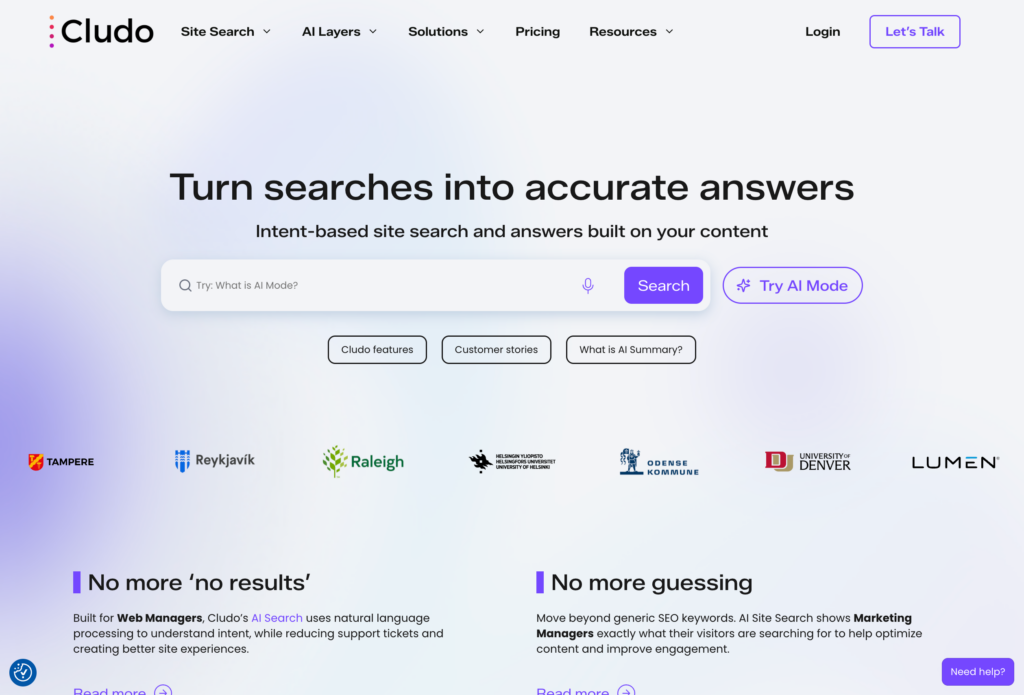
Cludo is a website search platform aimed at content-heavy higher-education and public-sector sites, with an AI layer made up of AI Summary, AI Chat, and a full-screen AI Mode. It is one of the closest matches to SearchStax’s audience, and it is built to be run by marketing and web teams rather than developers.
Cludo Limitations to Consider
- Its AI capabilities are delivered as separate layers, so a full conversational experience can mean combining and paying for multiple modules.
- Core search license pricing is quote-only, so early comparison is harder.
- Its integration and template ecosystem is smaller than the large enterprise platforms.
Cludo Pricing
Cludo splits its offering into three parts. AI Search and Enterprise Search are both quote-only, so the starting cost is not published. The AI capabilities sit in a separate line item: AI Layers start from $8,000 USD annually, per layer.
Since AI Summary, AI Chat, and AI Mode are each their own layer, the AI cost is priced separately from, and on top of, the underlying search license.
Best for: mid-sized universities and government bodies that want managed AI website search they can run without developer overhead.
3. Squiz Funnelback
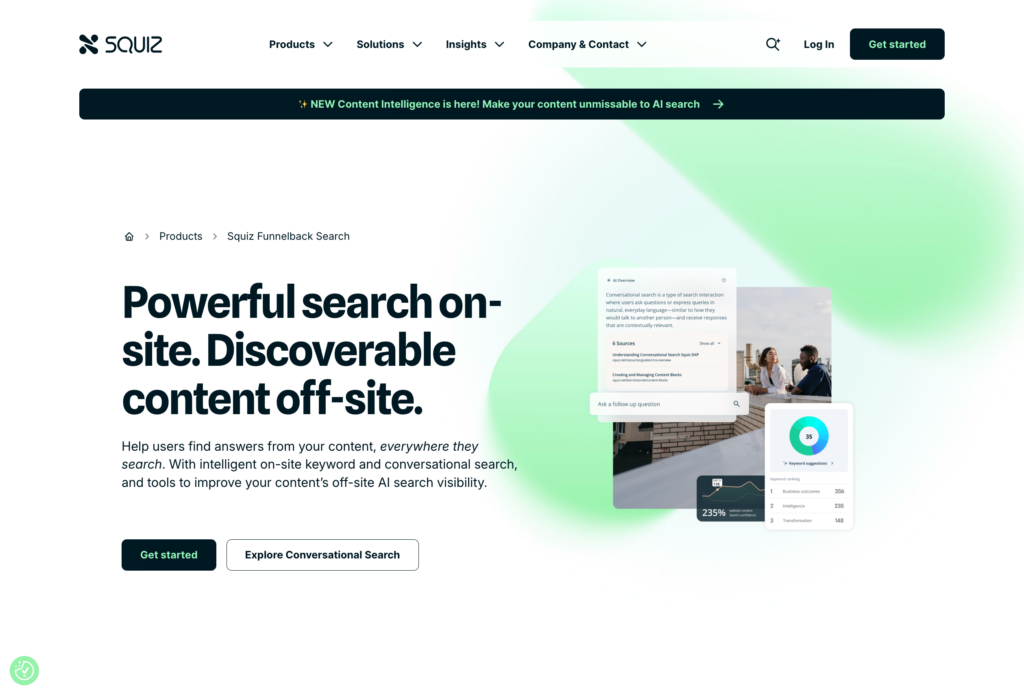
Squiz Funnelback is an enterprise website search platform with deep roots in higher education and government, now sitting inside Squiz’s broader digital experience platform. It offers conversational AI and content-health tooling, and it is a fit for large web estates that already lean on Squiz.
Squiz Funnelback Limitations to Consider
- Advanced configuration relies on developer templating, so it is less hands-off for marketing teams.
- Pricing is quote-only.
- It is a heavier platform than a focused website search tool, which can be more than smaller teams need.
Squiz Funnelback Pricing
Squiz does not publish Funnelback pricing. It is quote-only and scoped per deployment. Contact Squiz for a quote.
Best for: large public-sector and university web teams that want an enterprise, DXP-adjacent search platform and have the technical resources to run it.
4. Coveo
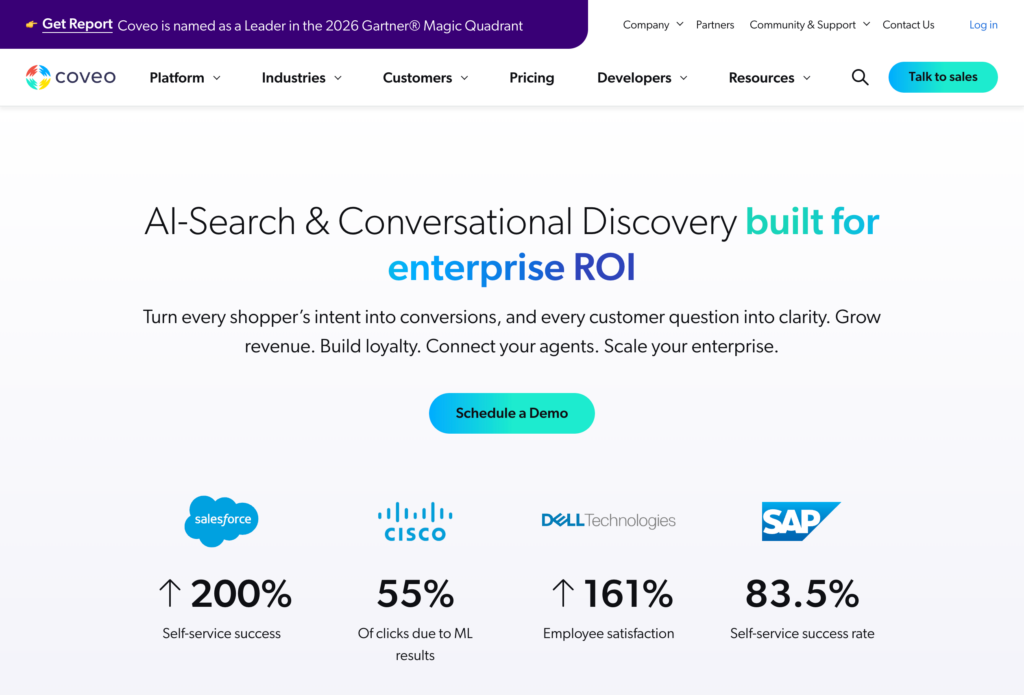
Coveo is an enterprise AI search and relevance platform built for large organizations with content spread across many systems. Its generative answering is a paid capability layered on top of the core platform, and it is aimed squarely at the enterprise end of the market.
Coveo Limitations to Consider
- Generative answering is a paid add-on rather than part of a single package.
- Implementations tend to run long and usually need specialists or a partner.
- It is priced and scoped for enterprise budgets, which can be more than a website search use case requires.
Coveo Pricing
Coveo’s pricing is quote-only and enterprise-scale. Packaged options such as Coveo for Salesforce are commonly reported to start $100k per year, but you should treat any specific figure as indicative and confirm current pricing with Coveo.
Best for: large enterprises with complex, multi-source relevance needs and the budget and resources for a full search platform.
5. Elasticsearch
Elasticsearch is the widely used open-source search engine that underpins a large share of custom search experiences. It is powerful and flexible, but it is infrastructure rather than a finished website search product, so the experience around it is yours to build.
Elasticsearch Limitations to Consider
- You build and maintain the front end, the relevance tuning, and any answer layer yourself.
- Running and scaling it well needs engineering resources.
- There is no content-grounded answer or conversational experience out of the box.
Elasticsearch Pricing
The open-source engine is free to self-host, so your cost is the infrastructure and the engineering time to run it. Elastic Cloud, the hosted service, starts from roughly $95 per month at the time of writing, scaling with resources.
Best for: engineering teams that want full control and are willing to build and maintain the search experience themselves.
6. Algolia
Algolia is a developer-first, API-first search provider known for fast, hosted search that teams build into their own applications. Its AI answering feature asks you to bring your own large language model, and its pricing is usage-based.
Algolia Limitations to Consider
- It is developer-first, so building the front end and tuning relevance is on your team.
- AI answering requires you to connect your own language model rather than getting a content-grounded answer capability out of the box.
- Usage-based pricing can be hard to predict as search volume grows.
Algolia Pricing
- Build: free, 10,000 search requests and 1 million records per month
- Grow: pay-as-you-go, 10,000 search requests per month included, then $0.50 per additional 1,000 requests, plus $0.40 per additional 1,000 records beyond 100,000
- Grow Plus: same usage allowances as Grow, plus AI Synonyms, AI Ranking, and Advanced Personalization, at $1.75 per additional 1,000 search requests
- Elevate: custom annual pricing with NeuralSearch, AI Collections, Smart Groups, real-time personalization, and enterprise-level SLA
Best for: product and engineering teams that want a fast, API-first search back end and can build the experience around it.
7. Site Search 360
Site Search 360 is a hosted website search tool built for smaller sites, with straightforward setup and public, tiered pricing. It is the most budget-friendly option on this list and a fit when the requirement is simple, reliable site search.
Site Search 360 Limitations to Consider
- It is built for smaller sites, with fewer enterprise controls and integrations.
- There is no content-grounded conversational search.
- It is a limited fit for large, regulated, or multi-site deployments.
Site Search 360 Pricing
Site Search 360 publishes its pricing. There is a free tier, and paid plans start from around $9 per month, with mid and higher tiers around $39 and $99 per month, scaling on pages indexed and query volume.
Best for: small organizations and single sites that want affordable, easy-to-run hosted search.
How These SearchStax Alternatives Compare
| Capability | SearchStax | AddSearch | Cludo | Squiz Funnelback | Coveo | Elasticsearch | Algolia | Site Search 360 |
| Built as a dedicated website search platform | Yes | Yes | Yes | Yes | Partial, broad enterprise search | No, infrastructure | Partial, API-first | Yes |
| Serves content-heavy education and government sites out of the box | Yes | Yes | Yes | Yes | Partial | No | Partial | Partial |
| Direct, content-grounded AI answers with citations | Yes, summary above results | Yes | Yes | Partial | Yes, paid add-on | No, build your own | Partial, bring your own model | No |
| Conversational search that remembers context | No | Yes | Yes | Partial | Partial | No | No | No |
| All AI included in one experience vs priced separately | No, AI on higher tier | Yes, one platform, one index | No, layers priced separately | No | No, add-on | No | No | No |
| Accessibility support | WCAG 2.2 Ready | WCAG 2.2 | WCAG support | WCAG 2.2 | WCAG support | Depends on your build | Depends on your build | Basic |
| Manageable without developer resources | Partial, advanced work needs developers | Yes | Yes | Partial, developer templating | No, needs specialists | No, engineering required | No, developer-first | Yes |
| Publicly confirmed starting price | Managed Search only, Site Search quote-only | Yes, from $119/mo billed annually | No, quote-only | No, quote-only | No, quote-only | Yes, from about $95/mo hosted | Yes, usage-based | Yes, from about $9/mo |
| Typical setup time | Weeks | Days | Weeks | Weeks to months | Months | Weeks to months | Weeks | Days |
| Works alongside an existing search provider | Partial | Yes | Partial | Partial | Yes | Partial | Yes | Partial |
Final Thoughts
SearchStax is a capable choice, and if what you need is managed Solr infrastructure or a proven results page for a large web estate, it holds up well. The reason teams look elsewhere is usually the same: they want direct answers and conversational discovery on one platform, pricing they can see before they talk to sales, and a setup they can stand up in days rather than weeks.
If you want managed search infrastructure to build on, SearchStax Managed Search or Elasticsearch make sense. If you need enterprise, multi-source relevance across many systems, Coveo or Squiz Funnelback are built for that scale. And if you want modern AI website search for education, government, and other content-heavy sites without developer overhead, AddSearch and Cludo are the closest fits.
AddSearch stands out because it brings keyword search, AI Answers, and AI Conversations together on one platform, with all capabilities available from day one, a setup measured in days, and a starting price published up front. You decide how much of it to switch on and where.
Start your 14-day free trial: https://app.addsearch.com/signup/user
Book a demo: https://www.addsearch.com/addsearch-experience-demo/
