


For years, website performance has been measured the same way.
Pageviews. Time on site. Pages per session. Bounce rate. The dashboards every marketing team and web team has lived in for over a decade.
These metrics made sense for a long time. They were built around how people actually used websites: type a query, scan a list of links, click through a few pages, piece together an answer themselves. More clicks and more time generally meant a website was doing its job.
But the way people find information on websites is changing fast.
We’ve already written about how conversational search reduces dependency on site navigation, and how that shift moves visitors away from menus and toward direct, conversational answers. That change doesn’t stop at the visitor experience. It reaches straight into the metrics teams use to judge whether a website is performing well.
The Metric That’s Now Wrong
Here’s the part most teams haven’t caught up to yet.
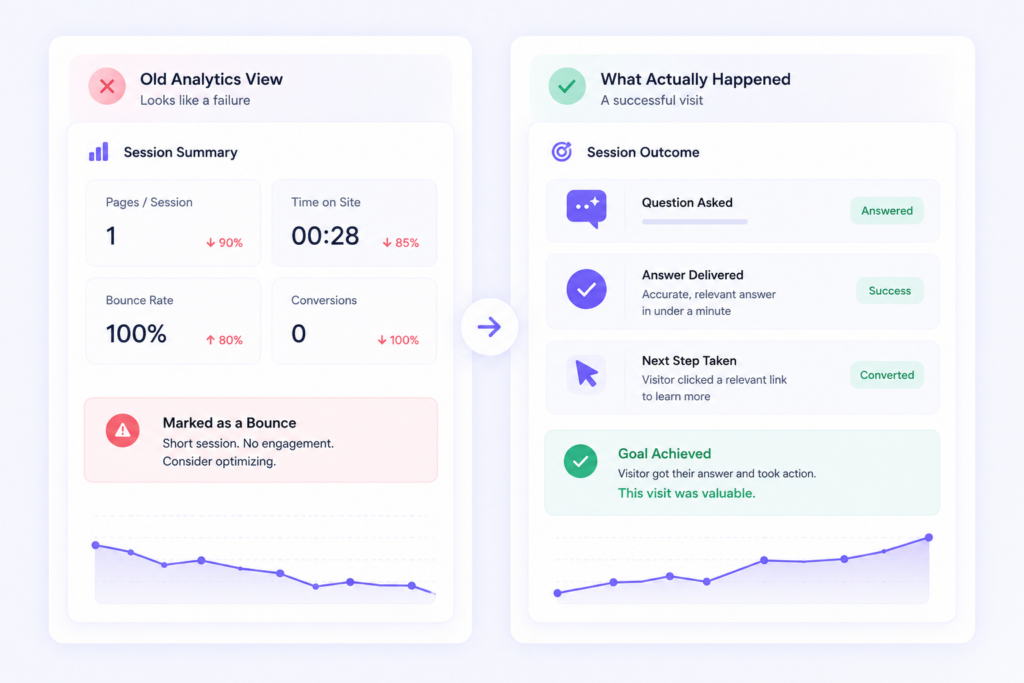
A visitor lands on your website with one specific question. They ask it through conversational AI search. They get a complete, accurate answer in under a minute. Satisfied, they leave.
Open your analytics dashboard the next morning, and that visit looks like a failure.
One page viewed. A few seconds on site. Counted as a bounce.
That’s the contradiction worth sitting with: the better your conversational search gets, the worse your traditional metrics may start to look.
It’s not a sign that something is broken. It’s a sign your metrics haven’t caught up to how people actually use your website anymore.
This article is about closing that gap, and about what “good website performance” should actually mean from here on.
Once a visitor stops needing five pages to get an answer, every metric built around “how many pages did they touch” stops measuring the thing you actually care about.
Here’s a simple way to think about why that happened.
The Core Idea: We’ve Been Counting Footsteps, Not Outcomes
Imagine a visitor walks into a building looking for one piece of information.
For years, the only way to judge whether your building was “doing well” was to count how many hallways they wandered through and how long they stayed.
That was never really what you wanted to know. You just didn’t have a better way to ask the real question: did they actually find what they came for?
That’s exactly what happened with website analytics.
- Pageviews, time on site, and pages-per-session were never the goal.
- They were stand-ins. Best guesses for whether someone got value from your site.
- We measured the footsteps because we couldn’t measure the outcome.
Conversational search finally lets us ask the real question directly:
Did this person get their answer? And did they do something valuable afterward?
That changes the scoreboard. A short visit isn’t automatically a weak one anymore. A visit that ends quickly, with a clear answer, might be the best kind of visit your site can deliver.
Even Google Analytics has quietly admitted this. The old “bounce rate,” which punished any single-page visit, has given way to “engaged sessions,” a metric far closer to asking “did this person actually get something out of being here?”
Conversational search just takes that idea the rest of the way.
What the Data Actually Shows
Once you stop counting pages and start looking at outcomes, an interesting pattern shows up.
People who arrive through AI tools view fewer pages, but convert more often.
- Ahrefs studied roughly 82,000 sites and found AI-referred visitors viewed about 4 pages on average, fewer than visitors who arrived through traditional search. (Ahrefs, 2025)
- A separate Ahrefs analysis found AI search visitors converting at meaningfully higher rates than traditional organic visitors. (Ahrefs, 2025)
- Semrush found a similar pattern: AI-referred visitors converting well above the traditional organic average. (Semrush, 2025)
In plain terms: fewer clicks, better outcomes.
People still want a human-style search experience for the questions that matter most.
Research from Nielsen Norman Group found that people lean on AI tools to explore and compare. But when they want to double-check something important, they go back to a more traditional search-and-click experience. (NN/g, 2025-2026)
Neither approach replaces the other. People move between them depending on what they need in the moment, which is exactly why combining traditional search with conversational AI search, rather than picking one over the other, matches how people actually behave.
The Same Metrics, A Different Meaning
Before we get into the new metrics worth tracking, it’s worth pausing on the familiar ones. They’re not obsolete. They just mean something different now.
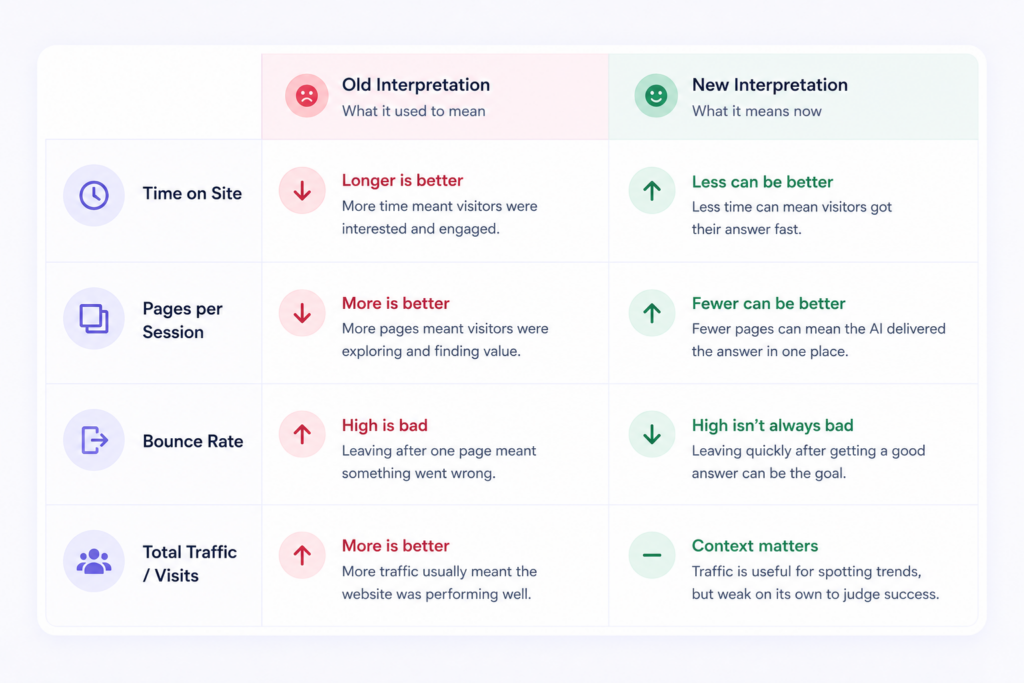
- Time on site. Used to mean “interested.” Now, less time can mean “got their answer fast,” which is the goal, not the problem.
- Pages per session. Used to mean “exploring a lot.” Now, fewer pages can mean the AI consolidated what used to take five clicks into one answer.
- Bounce rate. Used to mean “something’s wrong, they left.” Now, for an answer-style experience, leaving quickly after getting a good answer is the whole point.
- Total visits and traffic. Still useful for spotting trends. But a weak way to judge whether your website is actually working for the people who show up.
None of these old metrics is wrong to track. They’re just no longer enough on their own. A few of them now mean the opposite of what we trained ourselves to believe.
The Metrics That Actually Tell You If Your Website Is Working
This is where it gets practical. If pageviews and bounce rate no longer tell the full story, what should you be watching instead?
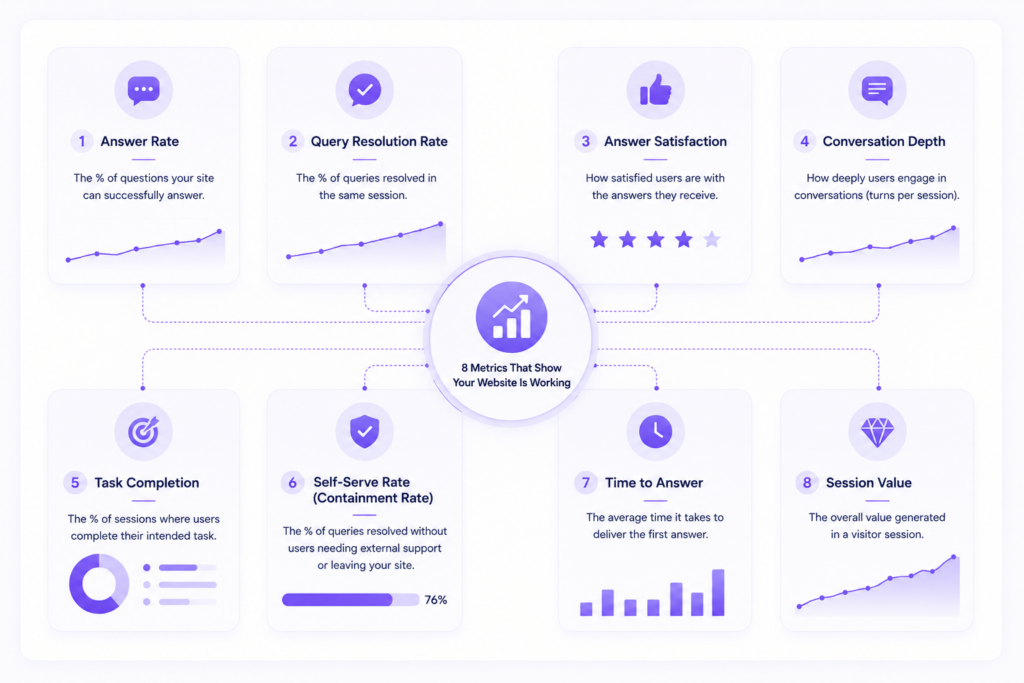
Here are seven metrics that actually reflect whether your conversational search experience, and your website overall, is doing its job.
1. Answer Rate
What it is: The percentage of questions your website can actually generate an answer for, out of all the questions visitors ask.
Why it comes first: Before you measure whether answers are good, you need to know whether your site is producing them at all. A low answer rate means visitors are asking questions and hitting a dead end, no answer, no direction, nothing.
What causes a low answer rate:
- Content gaps: the topic simply isn’t covered anywhere on your site
- Poor content structure: the information exists, but it’s buried in formats that AI search can’t easily read or surface
- Outdated content: pages exist, but they no longer reflect current products, policies, or services
Why it matters: Answer rate tells you about coverage. You can’t resolve a question your website was never able to answer in the first place. For content-heavy B2B and public-sector websites, where visitors often come with very specific questions about programs, policies, or services, a coverage gap is a conversion gap.
What good looks like: A consistently high answer rate, combined with low zero-result or “I couldn’t find that” rates, tells you your content is both comprehensive enough and structured well enough to actually do the job conversational AI search was built to do.
2. Query Resolution Rate
What it is: Did the visitor get a real answer, without needing to search again, contact support, or give up?
Why it matters: This is the single clearest signal that your conversational AI search is working. Everything else is secondary to this one question.
The benchmark to know: Even with traditional self-service tools, most companies only fully resolve about 1 in 7 customer questions on their own (Gartner, 2024). That’s a low bar. It means there’s enormous room for conversational AI search to do meaningfully better.
3. Answer Satisfaction
What it is: Simple signals that tell you whether an answer actually landed, not just whether one was given.
What to watch for:
- Thumbs up / thumbs down feedback
- Whether someone immediately asks a follow-up question
- Whether someone re-types the same question in different words
Why it matters: A system can technically “answer” every question and still leave visitors unsatisfied. This metric catches that gap.
4. Conversation Depth (Read the Right Way)
What it is: How many back-and-forth turns a visitor takes in a conversation.
The nuance: This one cuts both ways.
- More turns on a genuinely complex question, like comparing two programs or understanding a multi-part policy, is a good sign. It means the visitor is engaged and getting real value.
- More turns on something that should be simple is a warning sign. It usually means the AI is struggling to understand what’s being asked.
Why it matters: Don’t treat conversation length as automatically good or automatically bad. Context decides which one it is.
5. Task Completion
What it is: Did the visitor actually accomplish what they came to do?
Examples:
- Found the tuition number they needed
- Located the right form
- Compared two policies side by side
- Got the spec sheet they were looking for
Why it matters: This ties answer quality directly to real-world usefulness. An answer can be technically correct and still fail to help someone complete their task.
6. Self-Service / Containment Rate
What it is: The share of questions fully handled on your website, without a phone call, email, or support ticket.
Why it matters most for: Government agencies, financial institutions, and membership organizations, where every avoided support contact is a real, measurable cost saved.
The trap to watch for: High containment paired with rising support contacts elsewhere is a red flag, not a win. It can mean visitors are being deflected rather than actually helped. Resolution and containment need to be tracked together, never one without the other.
7. Time to Answer
What it is: How fast a visitor goes from asking a question to having a real, usable answer.
Why it matters: This flips the old assumption on its head. Under the old model, longer meant more engaged. Under the new model, faster and more direct is better. Speed is now a feature, not a shortcut.
8. Session Value
What it is: Of the visitors who use conversational AI search during their visit, how many go on to take a meaningful next step?
Examples:
- Request a demo
- Start an application
- Submit an inquiry
- Download a key document
Why it matters most: This is the metric that ties everything above back to business results. It’s the one to lead with when reporting up to leadership, because it answers the question every executive actually cares about: did this experience move the needle?
Why This Matters Even More for B2B and Content-Driven Websites
If you run a higher education, government, financial services, association, or manufacturing website, here’s why this shift matters more for you than almost anywhere else.
Your visitors aren’t completing a single transaction in one sitting. They’re researching something important, a program, a benefit, a policy, a product spec, often before a much bigger decision: applying, enrolling, opening an account, or requesting a quote.
That journey can span weeks. It can span multiple visits. A single short session was never the full story for your audience, and that’s even more true now.
Here’s the part that should change how you think about your funnel:
Bain & Company found that a large share of B2B buyers already have a shortlist of organizations in mind before they ever start actively searching. (Bain & Company, 2025)
That means two things now matter equally:
- Earning a spot on that shortlist in the first place. This is where content authority, traditional SEO, and visibility inside AI-generated answers come in. If you’re not findable before someone starts searching, you may never get the chance to convert them at all.
- Making the visit count once someone arrives. This is where conversational search does its work, resolving the visitor’s question quickly and moving them toward the next real step, rather than just being one more confusing pit stop.
Traditional traffic and search rankings still matter here. They’re just one part of a bigger picture now, not the whole scoreboard.
Redefining What “Good” Means
Let’s land where we started.
A high-performing website in the conversational search era is one that resolves a visitor’s question quickly and moves them toward the next meaningful action.
It is not one that keeps them clicking around the longest.
Speed and clarity are signs of success now, not warning signs. A visitor who gets what they need in 30 seconds and starts an application isn’t a bounce. That’s the entire point of the experience working as intended.
So here’s the call to action, plainly stated: stop punishing your AI search for doing exactly what it was built to do.
Audit your website performance dashboard. Retire the metrics that no longer tell the truth about your visitors. Start measuring resolution, satisfaction, task completion, and conversion instead.
Your website’s job has changed. It’s time your website performance metrics caught up.
