


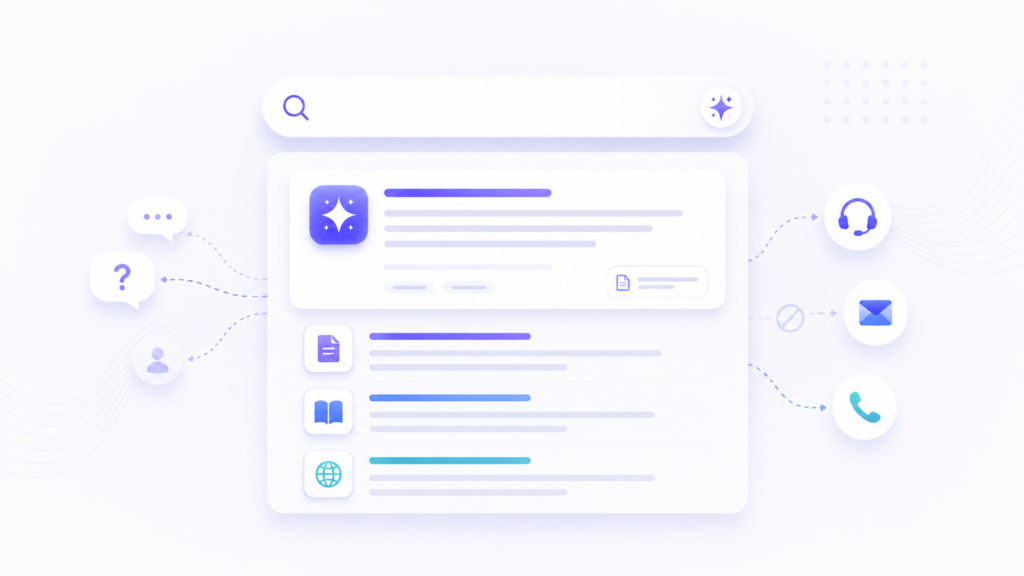
Someone lands on your website with a question. They type it into the search box, scan the results, and do not find a clear answer. So they give up on the site and do the next easiest thing: they email, fill out a form, open the chatbot or pick up the phone. That question just became a support ticket.
Now multiply that by every visitor who could not find what they came for. You end up with a support queue full of questions your website already had answers to, somewhere. The content existed. The visitor just could not get to it.
This is the quiet, expensive gap between the answers you have published and the answers people can actually find. It is exactly the gap that better site search and conversational content discovery are built to close.
Your visitors already try to help themselves. Most of the time, they can’t.
It is easy to assume people reach for the phone by default. They don’t. Harvard Business Review found that 81% of customers try to solve a problem themselves before they ever contact a live representative. The instinct to self-serve is already there.
The problem is what happens next. Gartner, studying more than 8,000 customer journeys, found that 70% of customers use a self-service channel at some point, yet only 9% fully resolve their issue there. A later Gartner survey put full self-service resolution at just 14%. Most people who start on your site do not finish there.
And when they do not finish, they escalate. That is where the cost lands. Gartner’s 2019 research found that live channels such as phone, live chat, and email cost an average of $8.01 per contact, while self-service costs about $0.10, and pulling a customer into even one live channel makes resolution 80 to 100 times more expensive.
Here is the part worth sitting with. When your self-service does not work, you do not save the cost of the ticket. You pay for the help experience the visitor gave up on, and then you pay for the live contact anyway. Gartner estimates that as much as 40% of today’s live volume could be handled in self-service. That is the size of the prize, and most of it is being left on the table.
Why a page of search results rarely answers the question
A keyword index does one thing: it hands back a list of documents and asks the visitor to do the rest. Read this page, then that one, cross-reference a third, and work out the answer yourself. On a small site, that is fine. On a content-heavy institutional site with decades of pages, overlapping policies, and PDFs three clicks deep, that reading and synthesis is exactly where people give up.
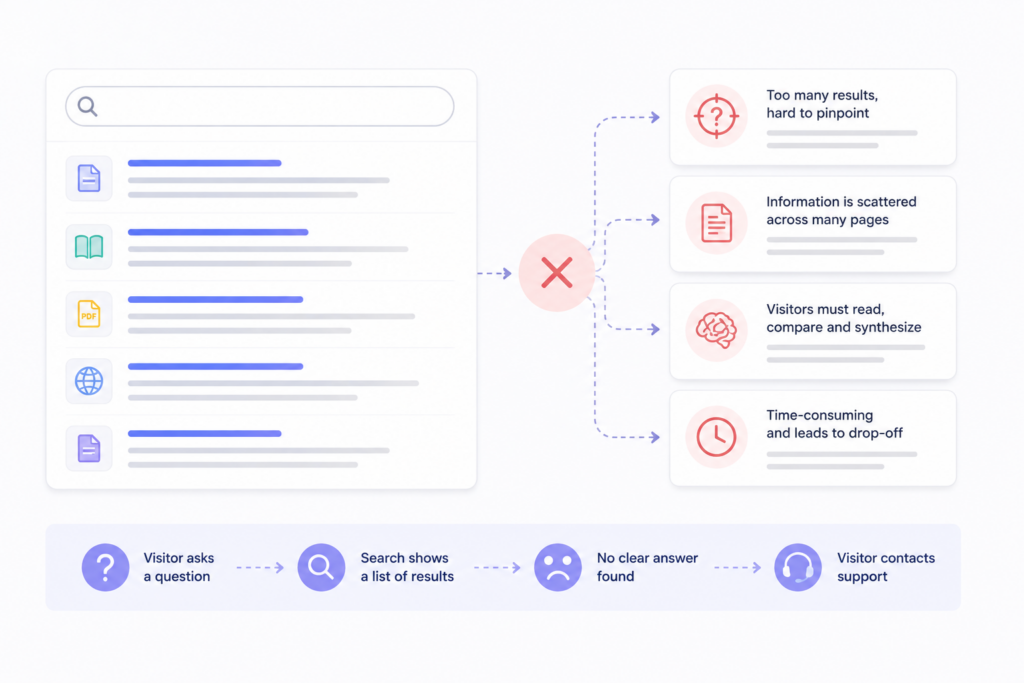
The data backs this up. In Gartner’s 2024 research, the single most common reason self-service failed was that customers could not find content relevant to their issue, in 43% of cases, and 45% of those who started in self-service felt the company did not understand what they were trying to do. The content is usually there. The search experience just cannot connect the question to it.
The way people ask has changed too. Visitors no longer type “refund.” They ask “how do I get a refund on my membership.” They are asking full, specific questions and expecting a direct answer, with the source right there to check. Against that expectation, a page of ten blue links no longer reads as helpful. It reads as a dead end, and the next click is your contact form.
The jobs your website visitors are really trying to do
To understand which tickets you can prevent, look at what visitors are actually trying to do when they arrive. Nobody comes to your site to browse a knowledge base. They come with a specific job in mind, and a ticket is what happens when the site cannot help them finish it. Here is how that plays out across four industries.
| Industry | What your visitors are trying to do | It becomes a support ticket when… |
| Higher education | Find out if they can defer enrollment. Understand what their financial aid covers. Register for a course or check graduation requirements. | The site returns a list of policy pages, so they call admissions, the registrar, or the IT service desk during the busiest weeks of the year. |
| Government | Check if they qualify for a benefit. Track an application or renew a license. Confirm which documents they need to bring. | Search surfaces dense pages with no clear answer, so they phone the agency, and volume spikes around deadlines and enrollment periods. |
| BFSI | Understand what a policy or rider covers. Learn how to dispute a charge. Clarify a specific term or fee. | The answer is buried in a PDF, so a routine question ties up a call-center agent who should be handling advice and hardship cases. |
| Manufacturing | Find which part fits a specific model. Look up a spec or installation step. Locate the current version of a manual. | A dealer or installer cannot find current documentation, so they open a technical support case that takes a long call to close. |
The pattern is the same in every row. The visitor arrived with a clear job and a specific question. Answer it on the page, and the ticket is never created.
What actually answers those questions: three capabilities, one experience
Closing this gap is not about bolting on a single feature. It takes three distinct capabilities, working together, because visitors arrive with three different kinds of questions.
| Capability | What it does | Best for |
| Keyword search | Fast, forgiving lookups with synonyms, promoted and pinned results, recommendations, and filters. | Visitors who already know what they want and just need to reach it quickly. |
| Gen AI answers | Returns one direct answer to one question, grounded in your content with source citations. | A single, specific question that deserves a straight answer instead of a list. |
| Conversational content discovery | A multi-turn, context-aware experience that handles follow-up questions and refinements. | Exploratory, multi-part questions that no single answer can fully close. |
The real value shows up when these three work as one experience, on one platform and one index, all capabilities available from day one. A visitor can start with a quick lookup, get a grounded answer to a specific question, and then keep the conversation going when their need is more complex, without ever switching tools or losing context. That is what a unified conversational AI search and discovery experience delivers, and it is what turns a large share of would-be tickets into self-serve resolutions.
For regulated verticals, trust is the deciding factor
In government, BFSI, and healthcare, a wrong answer is worse than no answer at all. An answer experience only earns a place on these sites if it can be trusted, so this is where the details matter most.
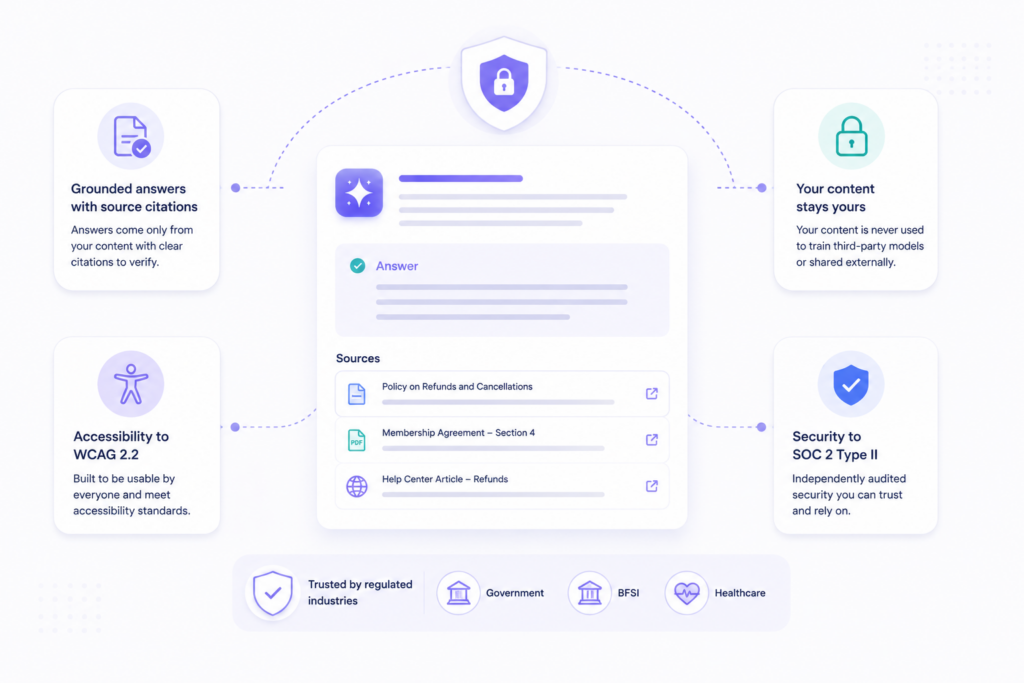
- Answers are grounded in your content, with source citations. Every answer is built only from your own published content, and the visitor can click through to the exact page or policy it came from. That verifiability is what turns an answer into something a visitor, or a compliance reviewer, will rely on.
- Your content stays yours. It remains in your environment and is not used to train third-party models.
- Accessibility to WCAG 2.2. The experience has to be usable by everyone, which is a legal requirement across government and public-sector sites, not a nice-to-have.
- Security to SOC 2 Type II. Independently audited security is the baseline these verticals require before anything ships.
Get these right, and the same answer experience that reduces tickets also clears the compliance gate that would otherwise stop the project.
How to measure ticket deflection and prove the impact
If you want to build the internal case, measure the problem before you fix it, then track the outcome after. Start with three baseline numbers that are usually higher than anyone expects:
- No-results rate: how often a search returns nothing at all.
- Searches without clicks: how often people search, see results, and click none of them.
- A ticket audit: what share of your support tickets are informational questions already answered somewhere on your site.
After launch, track two outcome metrics, and keep them separate. Conflating them is how teams end up overclaiming.
| Metric | What it measures | Why it matters |
| Self-service success rate | The share of all search interactions that end with the visitor finding what they needed. | Tells you whether your content is answering questions at all. |
| Case deflection rate | The share of interactions where the visitor intended to contact you but did not need to. | Ties directly to the support tickets you avoided, which is the number your finance team will believe. |
Better answers mean fewer tickets, in every industry
Support tickets are not a fact of life. A large share of them are just questions your website could have answered, if the visitor had been able to find the answer.
That is the whole case for conversational AI search. When keyword search, grounded AI answers, and conversational content discovery work together as one experience, the routine questions get answered on the page, before they ever reach your queue. The student finds the deferral policy, the citizen confirms their eligibility, the policyholder understands their coverage, the dealer locates the right part. The ticket is never created. And your live support, which Gartner rightly call a precious resource, is freed up for the questions that genuinely need a human.
The AddSearch Experience brings all three capabilities together in one unified conversational AI search and discovery platform, on one platform and one index, so your visitors get answers grounded in your own content and your team gets a lighter support load.
See it working on your own content. Book a demo or start a free trial.
