


University and college websites carry an enormous amount of information. Course catalogs, program requirements, tuition fees, application deadlines, financial aid guides, library resources, campus services – it is all there.
The problem is that most students cannot find what they are looking for quickly. And when they cannot, they do not dig deeper. They leave, or they send an email, or they call the front desk.
Search is usually the first real interaction a student has with a university online. What happens in that moment shapes how they feel about the institution. This post looks at how that experience is changing, and what it means for universities and colleges trying to meet students where they are.
How Students Used to Search College and University Websites
Not long ago, searching a university website looked something like this. A prospective student interested in studying psychology would go to the university website, type something like “psychology degree requirements” into the search bar, and get back a list of links. Ten results, maybe more. Some would be relevant. Some would be outdated pages from three years ago. Some would be internal documents, clearly not meant for students to read.
The student would click the first link, skim it, realize it was not quite what they needed, go back, try the second link, and so on. After a few minutes of this, if they still had not found a clear answer, most would give up on the website entirely.
What happens next is the part that costs universities time and money. The student sends an email to the admissions office. Or they call. Or they post a question in a Facebook group for prospective students and wait for someone else to answer. Meanwhile, someone on the university staff has to respond to that email, take that call, and answer a question that the website should have been able to handle automatically.
This cycle plays out thousands of times across every university, every week. The website has the information. Students just cannot get to it efficiently through keyword search alone.
How Student Search Behavior Has Changed
Something shifted in how people search, and it happened faster than most organizations expected. A few years ago, people searched with keywords. Short phrases, a couple of words.
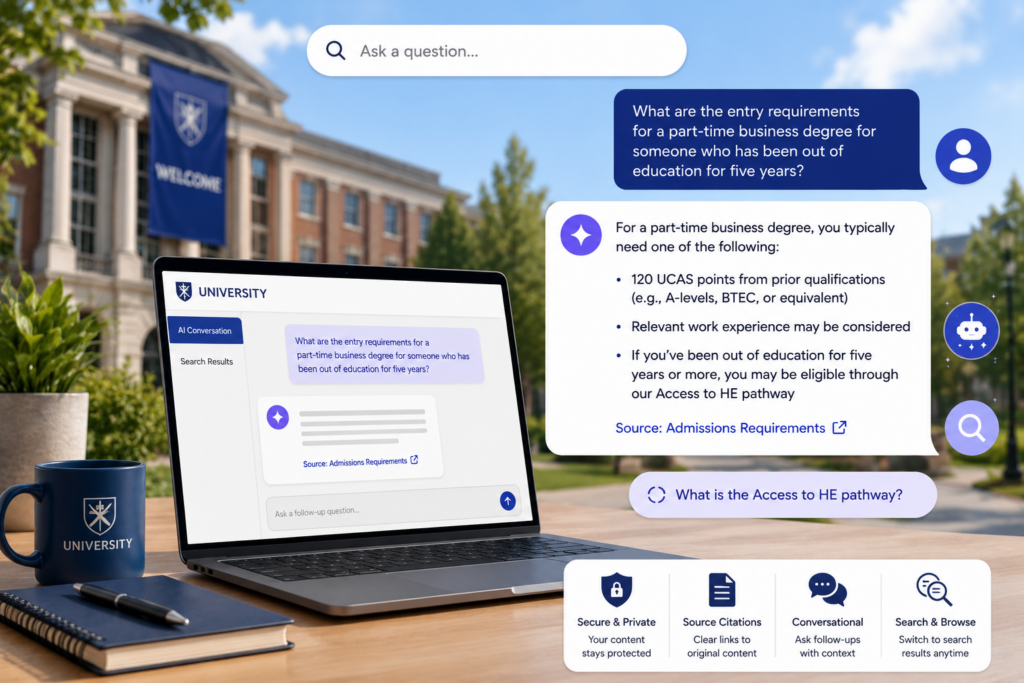
Today, most people ask full questions. They go to Google, or to ChatGPT, or to Perplexity, and they type something like: “What are the entry requirements for a part-time business degree for someone who has been out of education for five years?” That is not a keyword search. That is a conversation starter.
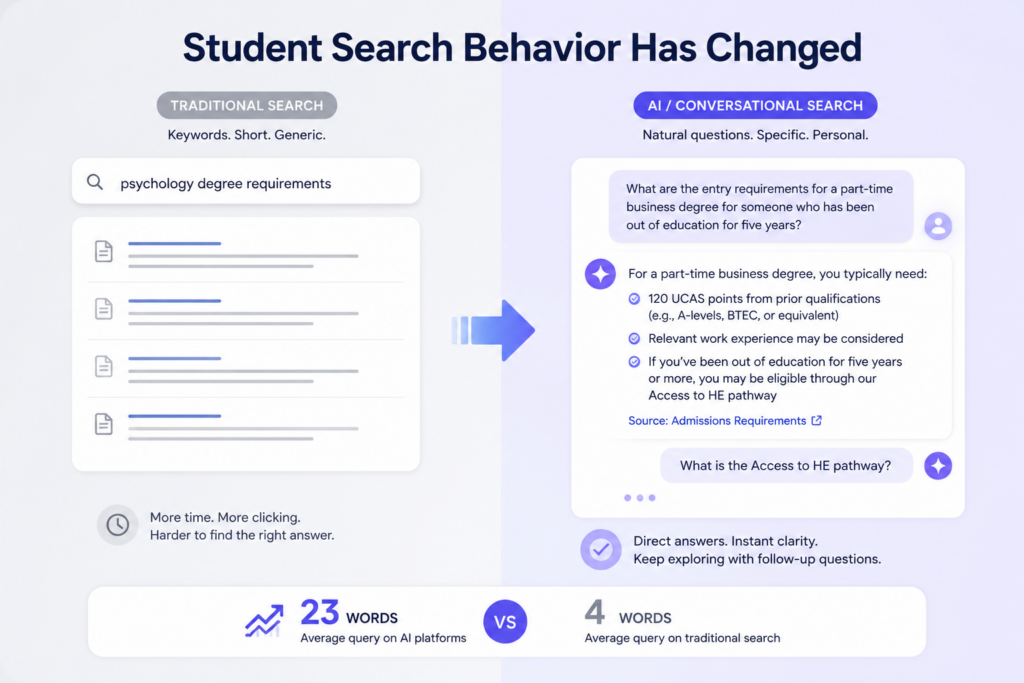
Research from SOCi shows that queries on AI platforms now average 23 words, compared to around 4 words on traditional search. People are not just looking for links to follow. They want a direct answer, and they want it immediately.
Students carry these same expectations onto every website they visit, including university and college websites. If a student can ask ChatGPT a nuanced question and get a clear, accurate answer in seconds, they expect the same from a university site. When they type a question into the search bar and get back a page of links instead, the experience feels broken. And for many universities and colleges, it is.
What Students Are Looking For and Why Most University Websites Still Struggle to Deliver It
Students are not always searching for obscure information. Most of the time, they are looking for things that every university publishes, and every student needs. Things like: what courses are included in a specific program, what the application deadline is for international students, what financial aid options are available for part-time students, where to access the library off-campus, or how to enroll in a module from a different department.
These are reasonable questions. The answers exist on the website. But university websites are typically organized around how the institution is structured, not around how students think. The admissions information is in one section, financial aid is in another, and academic programs live somewhere else entirely. A student does not know which department owns which piece of information. They just know what they want to find out.
This is where keyword search consistently falls short for colleges and universities. It returns links based on matching words, not based on understanding what the student is actually asking. It treats “financial aid for part-time students” as a set of keywords to match rather than a question to answer. It cannot hold context. If a student searches for a program and then follows up with a more specific question, the search starts from scratch each time.
The result is a frustrating experience for students and an invisible drain on university staff who end up fielding questions the website was supposed to answer.
What Conversational AI Search Does Differently on University Websites
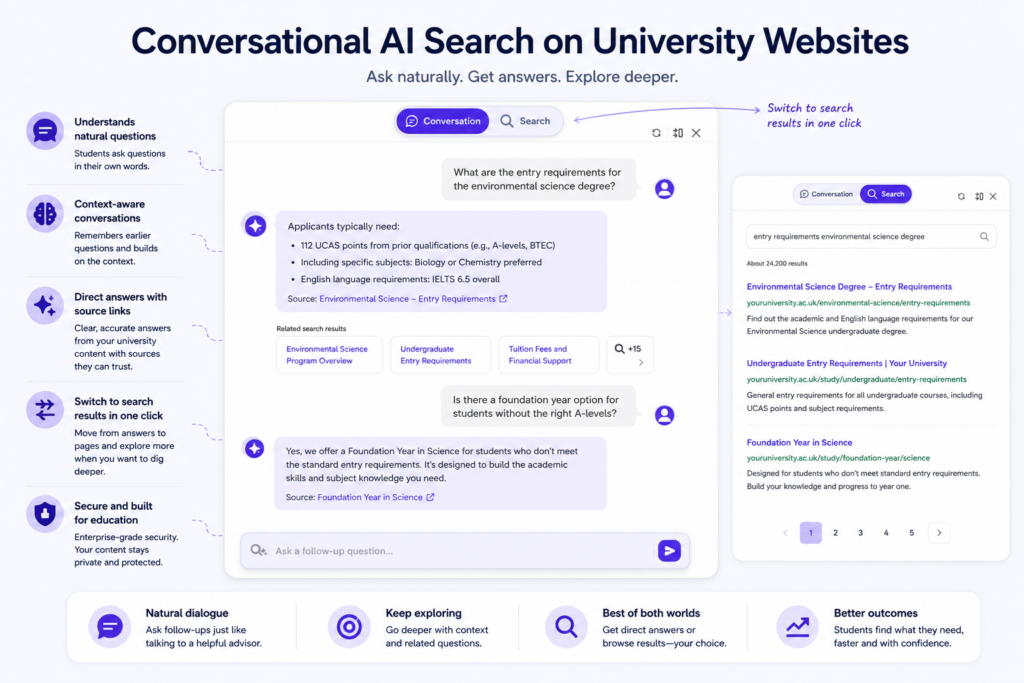
Conversational AI search takes a different approach entirely. Instead of matching keywords and returning a list of pages, it understands the question and surfaces a direct answer. The answer comes from the university’s own website content, with source links the student can click to read more or verify what they found.
When a student asks a follow-up question, the conversation continues with context. If they ask “What are the entry requirements for the environmental science degree?” and then follow up with “Is there a foundation year option for students without the right A-levels?”, the system knows what they were asking about before. It does not reset. It builds on the conversation, the same way a helpful member of staff would.
At the same time, students still have access to traditional search results within the same interface. They can ask a question and read the direct answer, or they can switch to search results and browse related pages if they prefer. Both are available in one place, and students can move between them however they want. They do not have to choose between asking and searching.
A few things matter a great deal in a university context, specifically.
Answers come from your content only. The AI does not pull information from the open internet. It only answers from the pages and documents your institution has indexed. That means no hallucinated degree requirements, no conflicting information from another university’s website accidentally surfaced, no outdated third-party content. If the answer is not in your indexed content, the system says so rather than guessing.
Sources are always shown. Every answer includes the source pages it was drawn from. Students can see where the information came from and click through to the original page. This matters for trust, especially when students are making decisions about where to study and what courses to take.
You stay in control of what gets indexed. Universities can choose which sections of the website the AI can draw from. Sensitive or internal content can be excluded. The search scope can be adjusted for different parts of the site if needed.
Conversation logs reveal content gaps. When students ask questions the system cannot answer, those gaps get logged. Over time, the analytics show which questions are coming up repeatedly and going unanswered, which is a direct signal of where the website needs better content. It turns every search interaction into feedback about what students need but cannot find.
What This Looks Like in Practice: AddSearch Offerings for University Websites
AddSearch offers three AI products designed for institutions that want to give students a better way to find information on their website. Each one addresses a different level of need, and they are built to work together.
AI Answers
AI Answers gives students a direct answer to their question the moment they search. Instead of a list of links, they see a clear, accurate response pulled from the university’s own indexed content, with source links they can click to verify or read further. Traditional search results still appear below the answer, so students have both options in one place.
It works alongside whatever search setup is already in place. There is no need to replace existing infrastructure.
Lone Star College, a large community college system in Texas, uses AI Answers on their website to help students get direct answers to the kinds of questions that used to be handled by staff. Questions about enrollment, programs, and campus services are answered instantly, from the college’s own content, without students having to navigate through multiple pages to find what they need.
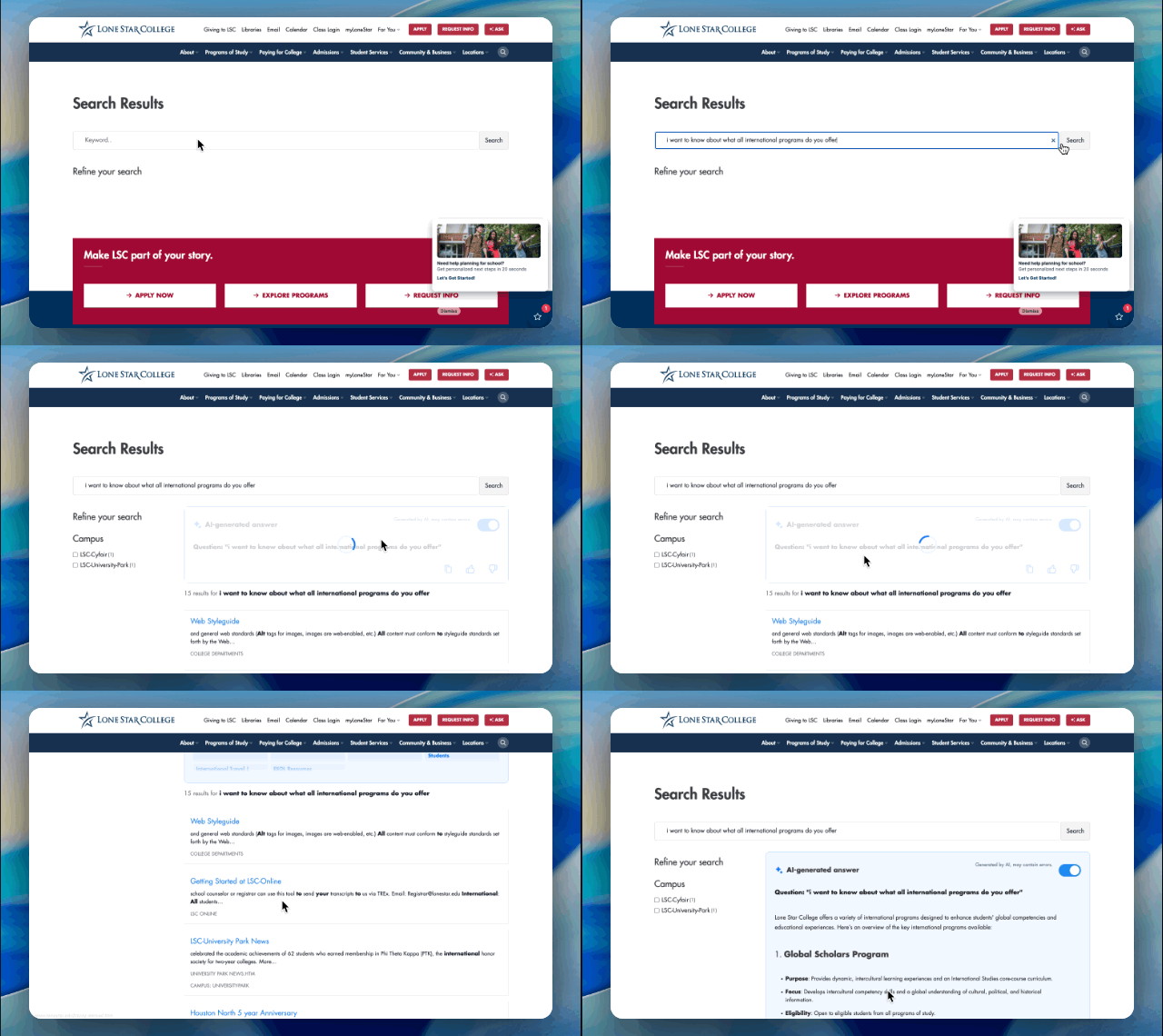
For universities that are not sure where to start, AI Answers is a practical first step. It can be added quickly and immediately changes the experience for students who are asking questions rather than typing keywords.
AI Conversations
AI Conversations is built for students who need to explore, not just look something up. Instead of a single answer, students can have a full back-and-forth conversation with the site. They can ask follow-up questions, go deeper on a topic, and switch to search results at any point to browse further.
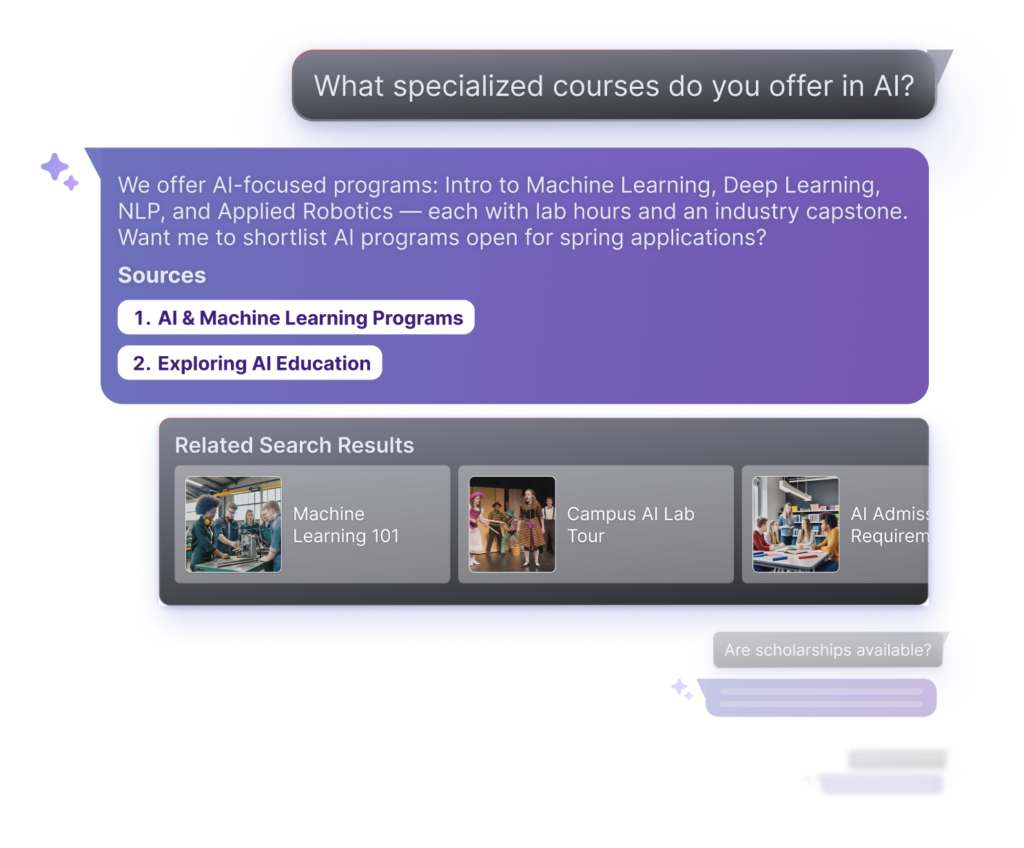
A prospective student researching graduate programs, for example, might start by asking about a specific course, then ask about funding options, then ask about the application process, and then ask whether the program is available part-time. Each answer builds on the last. The conversation carries context throughout rather than resetting with every new question.
This is not a scripted flow or a decision tree. It works entirely from the university’s actual website content, following the conversation wherever the student takes it.
AddSearch Experience
AddSearch Experience is the unified platform that brings keyword search, AI Answers, and AI Conversations together in one place. It is the most complete version of what AddSearch offers and is suited to universities and colleges that want to handle every kind of student interaction from a single, consistent search experience.
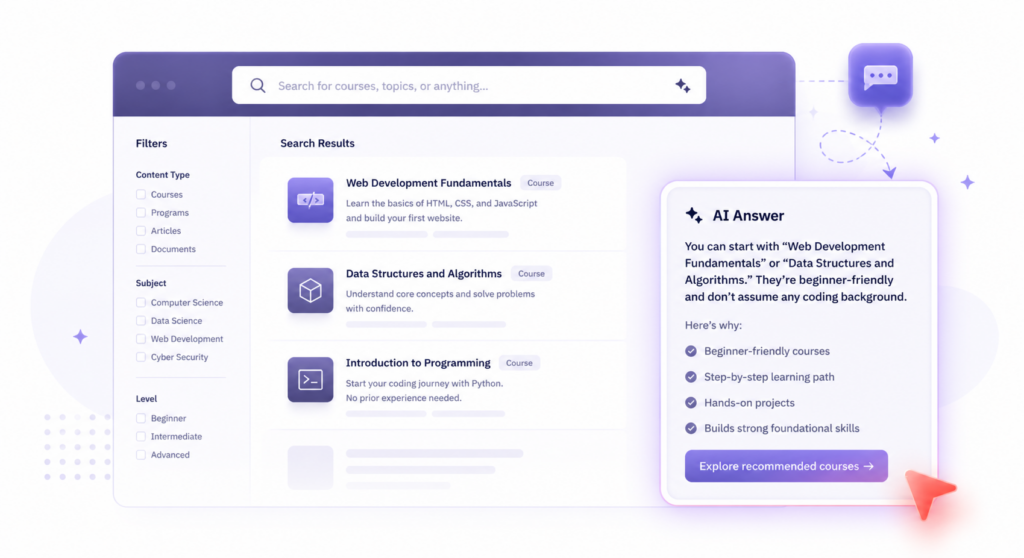
Whether a student is doing a quick lookup, asking a direct question, or exploring a topic across multiple follow-ups or even comparisons, AddSearch Experience covers all of it. The institution manages everything from one dashboard, with full visibility into how students are searching, what they are finding, and where the gaps are.
What This Means for the University’s Digital Experience Team
The benefits for students are clear. But there are real operational benefits for the university as well.
Fewer Routine Inquiries to Staff
When students can get accurate answers directly from the website, the volume of routine inquiries to admissions offices, academic departments, and student services teams goes down. Staff can focus on the queries that genuinely need human attention, rather than answering the same questions over and over.
A Clearer Picture of What Students Cannot Find
Conversation logs from AI search are a practical content intelligence tool. Every question a student asks and cannot get a good answer to is a signal. The analytics dashboard shows which topics are coming up most often, which answers are getting good engagement, and where the gaps in the website content are. That is something no traditional search analytics tool provides.
No Need to Replace Existing Infrastructure
Adding conversational AI search does not require replacing anything that is already in place. It works alongside existing search infrastructure and can be set up in a matter of days. The institution provides the indexed content, and the AI works from that.
Built for Enterprise Security Standards
Student data is never used to train any external model. AddSearch is SOC 2 Type II certified, which matters for universities handling sensitive student information at scale.
Search Is the First Impression Your Institution Makes Online
Most prospective students research universities online before they ever attend an open day or speak to anyone from the institution. The website is where the decision process starts. And for most of them, that process starts with search.
If a student asks a clear question and the website cannot give them a clear answer, that friction is the first impression. It does not stop students from eventually finding out what they need, but it shapes how they feel about the institution before they have even applied.
Conversational AI search is not about replacing the website or redesigning how content is organized. It is about making the content that already exists actually accessible to the students who need it, in the way they now expect to find it.If you want to see how this works with your own university or college content, you can book a personalized demo and explore the experience with your actual website indexed.
