


Your content ranks on page one of Google. Your technical SEO is solid. Your backlink profile is healthy. And yet, when someone asks ChatGPT or Perplexity to recommend a tool like yours, your brand is nowhere to be found.
This is the new visibility gap, and it’s reshaping how marketers need to think about content, on-site search, and the entire user experience.
In a recent webinar, Helena Rebane, CEO of AddSearch, sat down with Benjamin Thornton, Head of Growth at Keyword.com, to unpack what’s actually changing in search behavior, what it means for content strategy, and how businesses can adapt. Here’s what every marketer needs to know.
Search Behavior Has Fundamentally Changed, and Your Website Reflects It
Think about how people used to search on Google: a three-to-five word keyword, a list of results, and a few clicks to find what they needed. That’s no longer the dominant pattern.
Today, users open ChatGPT, Perplexity, or Gemini and type full, conversational questions that span multiple stages of the buyer journey in a single prompt. As Thornton put it: “What is an affiliate marketing tool, and can you recommend one for B2B SaaS with HubSpot integration and a free trial?” That’s not a keyword. That’s a self-qualifying conversation.
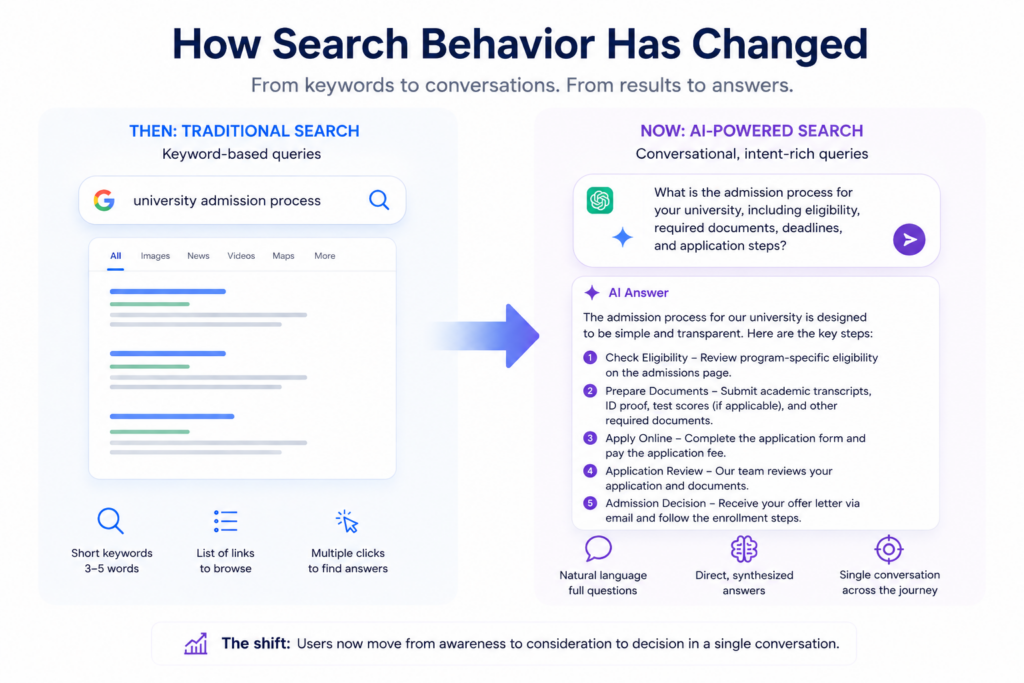
This shift isn’t just happening on external AI platforms. It’s showing up on your own website too. AddSearch customers are seeing the same pattern in their on-site search data: users are increasingly typing full questions rather than short keyword fragments. Instead of searching “site search tool,” they ask “how do I help users find answers on my website faster.” The language has changed because user expectations have changed.
What makes this shift significant is that users are now moving from awareness to consideration to decision within a single conversation thread, whether that’s on ChatGPT or on your own site. For marketers, the old model of mapping individual content pieces to individual keywords is increasingly insufficient on its own.
SEO Isn’t Dead, but It’s No Longer Enough Alone
Here’s the good news: everything you’ve built for SEO still matters. Original content, strong Core Web Vitals, solid backlink profiles, clear heading structures, schema markup. These fundamentals remain the foundation of visibility, both on Google and in AI-generated answers.
As Thornton explained, good SEO gets you 80 to 90% of the way to AI visibility. The reason is straightforward: when ChatGPT or Perplexity generate an answer, they perform what’s called a search query fan-out, searching the web using specific terms to find content to cite. If your pages rank well on Google, they’re more likely to surface in that process.
But the remaining 10 to 20% requires a mindset shift. The question is no longer just “Does my content rank for this keyword?” It’s “Does my content fully answer the question a user might ask in a conversational prompt?”
And critically, does your own website experience reflect that same standard? AddSearch’s conversational AI search is built on exactly this principle: users expect direct, synthesized answers to their questions, not a list of blue links to dig through. When your website search works like an AI assistant rather than a keyword matcher, it doesn’t just improve the on-site experience. It signals the kind of answer-first thinking that carries over into how you create and structure all your content.
What AI Actually Rewards: Richer, Journey-Spanning Content
Traditional SEO often rewarded producing many pieces of thin content targeting different keyword variations. AI rewards the opposite: fewer, richer pieces of content that guide a user from “What is this?” all the way to “Which specific tool should I choose and why?”
This has practical implications for how you structure and write content.
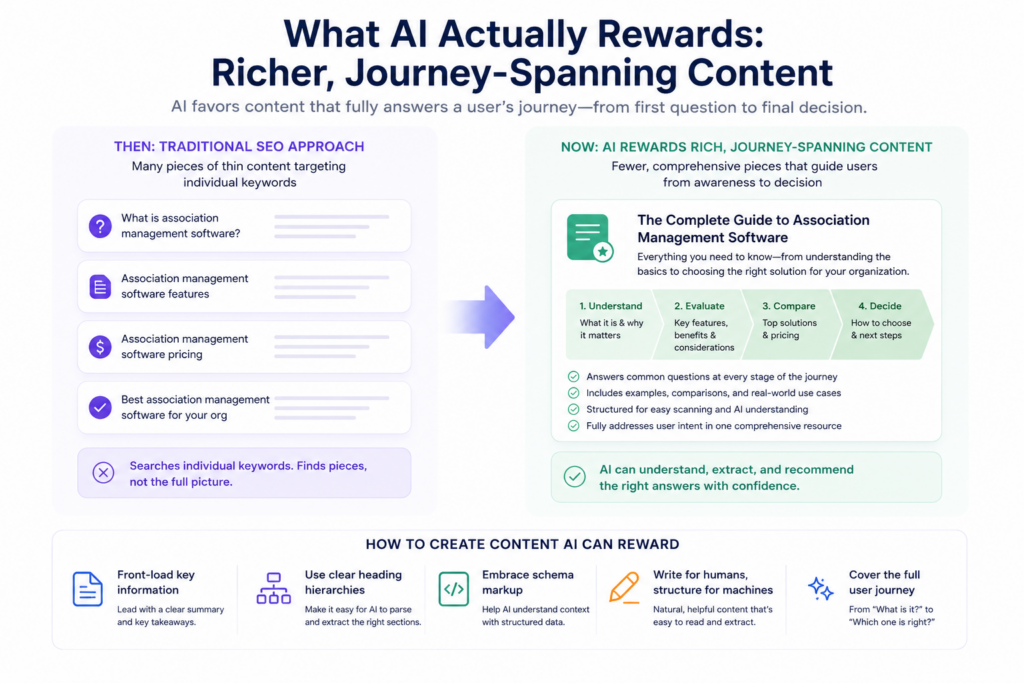
Front-load key information
Place your most important takeaways at the top of an article as a clear summary. AI systems scan for extractable answers, and content that leads with the answer rather than burying it is more likely to be cited.
Use clear heading hierarchies
Well-structured H1s, H2s, and H3s aren’t just good for readers. They make it easier for AI systems to parse and extract the right sections of your content in response to specific prompts.
Embrace schema markup
FAQ schema, organization schema, and other structured data formats help AI systems understand the context and relevance of your content. This is established SEO practice that pays dividends in AI visibility.
Write for humans, structure for machines
The goal isn’t to stuff prompts into headings or write in a robotic, keyword-dense style. It’s to write genuinely useful, natural language content that clearly addresses what users are trying to accomplish, and then structure it so AI systems can easily extract and cite it.
This is the same philosophy behind AddSearch’s AI Answers product. Rather than returning a list of matching pages, it synthesizes a direct answer from your site content, rewarding exactly the kind of well-structured, answer-ready writing described above. If your content works well inside AddSearch’s on-site search, it’s a strong indicator it will perform well in external AI platforms too. Think of your website search as a live testing ground for your AI visibility strategy.
The Hidden Goldmine: Your Own Website Search Data
One of the most underutilized sources of AI visibility intelligence sits right on your own website: your internal search data.
When users search on your website, they reveal exactly how they think about your product and what problems they’re trying to solve. Increasingly, those searches look less like keywords and more like full questions, mirroring the kinds of prompts people type into ChatGPT or Perplexity.
AddSearch captures this behavior in real time, giving marketers a direct window into user intent. The data can show you:
- What language your users actually use to describe their problems, which may differ significantly from how you describe your own product
- Where your content has gaps, since queries that return no good answers are a clear signal of topics you should be writing about
- What follow-up questions users have after their initial search, pointing to content that can guide them further down the journey
- Where users hit dead ends, because seeing what the AI answered (and how) lets you verify your brand is being represented accurately on your own site
If your users are asking a specific question on your website, there’s a strong chance people are asking the same question in ChatGPT or Perplexity. The queries you see in AddSearch’s search analytics aren’t just an on-site UX metric. They’re a content brief for your next AI-visible article.
A Practical Framework for Improving AI Visibility
Making this actionable doesn’t require starting from scratch. AddSearch advises customers to work through a simple four-step loop:
- Observe. Use AddSearch’s search analytics to track how users search on your website: what they ask, how they phrase it, what topics keep coming up.
- Identify gaps. Find the questions that either go unanswered or receive thin, unsatisfying responses, both on your site and in external AI tools.
- Create answer-ready content. Write content that directly and fully responds to those questions, structured for easy extraction by both on-site AI search and external LLMs.
- Test and refine. Monitor whether the content improves the answers your site delivers via AddSearch AI Answers, and whether it starts showing up in AI citations externally.
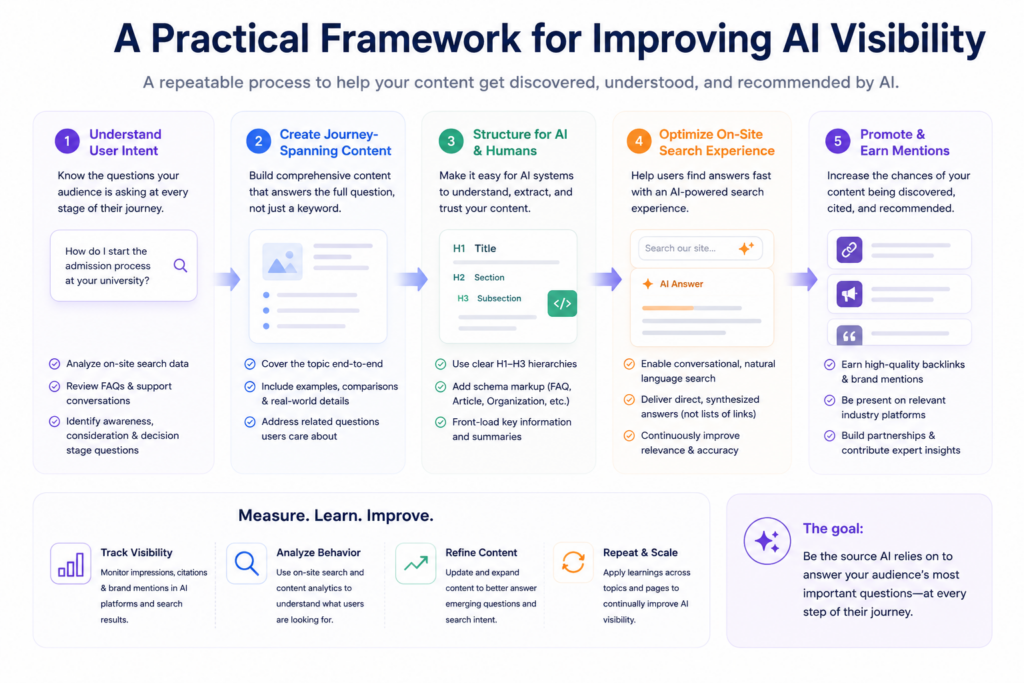
The loop closes the circle: what you learn from your on-site search informs content creation, and better content improves both the on-site experience and your external AI visibility simultaneously. You’re not running two separate optimization efforts. You’re running one.
Tracking AI Visibility: From Manual to Automated
Knowing whether your content is appearing in AI-generated answers requires active tracking. Manual tracking means opening ChatGPT or Perplexity, typing your target prompts, and recording citations in a spreadsheet. It’s free but time-consuming.
Tools like Keyword.com automate this. You can track specific prompts across multiple AI platforms on a daily, weekly, or monthly basis, monitor which citations those platforms are pulling from, analyze competitor visibility, and understand sentiment: how your brand is being described in a positive, neutral, or negative way.
One particularly powerful insight is understanding which citations are being consistently used by AI platforms when forming answers in your category. If Reddit, Medium, or a specific industry publication keeps appearing as a citation source for prompts relevant to your business, that tells you where to build a presence.
Pairing Keyword.com’s external tracking with AddSearch’s on-site search analytics gives you a complete picture: what users are asking before they reach your site, and what they’re asking once they’re there. Together, they close the loop between external AI visibility and on-site content performance.
Will Websites Still Matter? On Traffic, Intent, and the On-Site Opportunity
A common worry: if AI tools answer questions directly, will people stop visiting websites? The short answer is no, but the nature of that traffic is changing.
Websites that relied heavily on top-of-funnel informational content are already seeing traffic declines, because AI tools summarize that content directly. Users no longer need to visit a blog post to understand what a concept means.
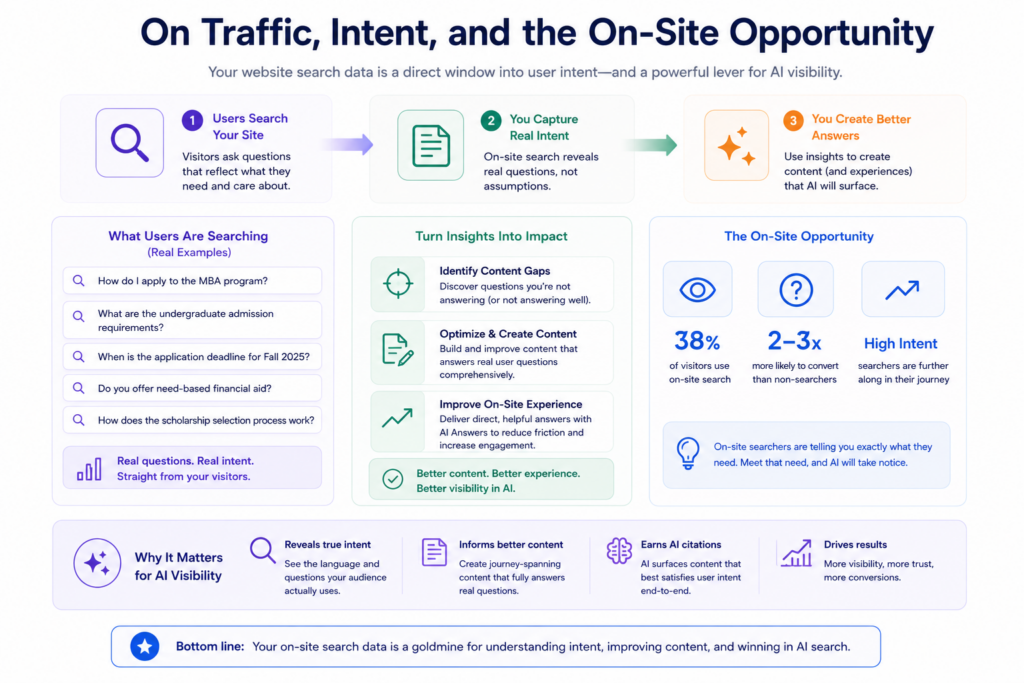
But users who do arrive via AI referrals are already further along in their decision-making. They’ve done their research. They know what they want. When they land on your site, they’re often ready to engage seriously: ask a specific question, compare options, start a free trial.
This is exactly where AddSearch becomes critical. A visitor who arrives from a ChatGPT conversation has already self-qualified. They don’t need an explanation of what you do. They need to find the specific answer or feature that closes their decision. If your on-site search can’t meet them at that level of specificity, you risk losing a high-intent visitor at the worst possible moment.
AddSearch’s conversational AI search is built for precisely this scenario, synthesizing direct, accurate answers from your content for users who already know what they’re looking for. As Rebane noted from AddSearch’s own customer data, there may be fewer visitors overall, but the ones who arrive are higher intent, and the on-site experience needs to match.
The Bottom Line
Search hasn’t disappeared. It’s evolved. The fundamentals of great SEO remain essential, but they now need to be paired with a new way of thinking about content and on-site experience: not as a collection of keyword-targeted pages, but as a comprehensive, structured answer to the full range of questions your users are asking.
The businesses that will win AI visibility are those that:
- Write content that genuinely guides users through their entire decision-making journey
- Structure that content for easy extraction by AI systems, both external LLMs and on-site search
- Use their own website search data as a real-time content intelligence feed
- Meet high-intent AI-referred visitors with an on-site experience that matches their expectations
- Track AI visibility systematically and refine based on what they learn
The shift from Search Engine Optimization to Answer Optimization is already happening. Your website search is both a symptom of that shift and, with the right tool, one of your most powerful levers for navigating it.Want to see how AddSearch can help you capture user intent, deliver AI-powered answers on your website, and inform your broader content strategy? Start a free trial or book a demo and discover what your users are really looking for.
