


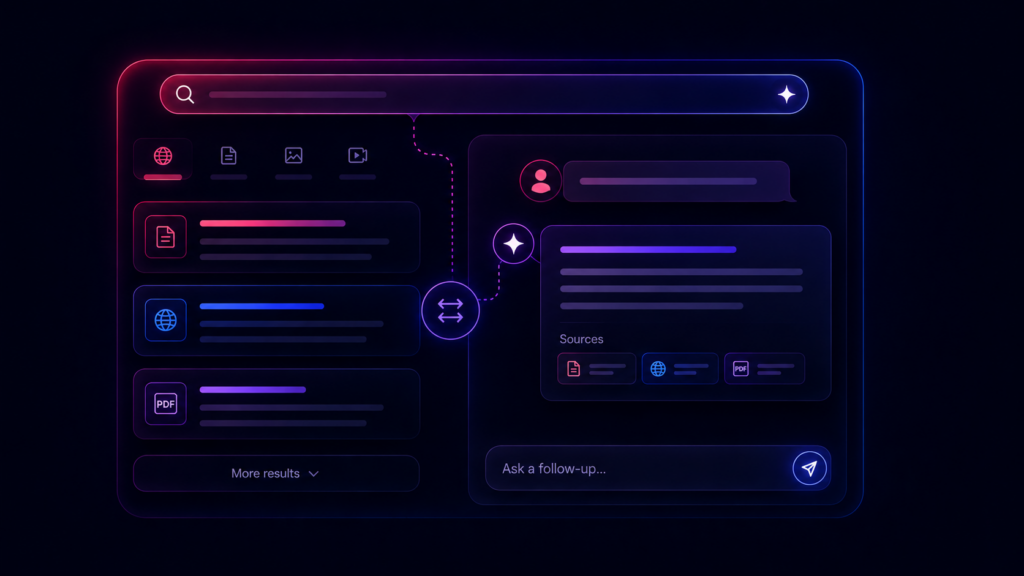
For most of the web’s history, searching meant the same thing: type a few keywords, get a page of links, and click through until you found what you needed. That is changing. People increasingly expect to ask a full question, in their own words, and get a direct answer they can build on with follow-ups.
That approach has a name: conversational search. It is a way of interacting with information, and the idea has been studied in information retrieval research for years, long before tools like ChatGPT and Perplexity made it familiar to everyone.
This article explains what conversational search is, the properties that define it, how it works, and, just as important, what it is not.
What is conversational search?
Conversational search is an approach to finding information where a person and a system exchange natural-language messages, back and forth, to satisfy an information need. Instead of matching keywords to a list of links, the system interprets the question, returns a direct answer, and lets the person refine or extend it through follow-up questions.
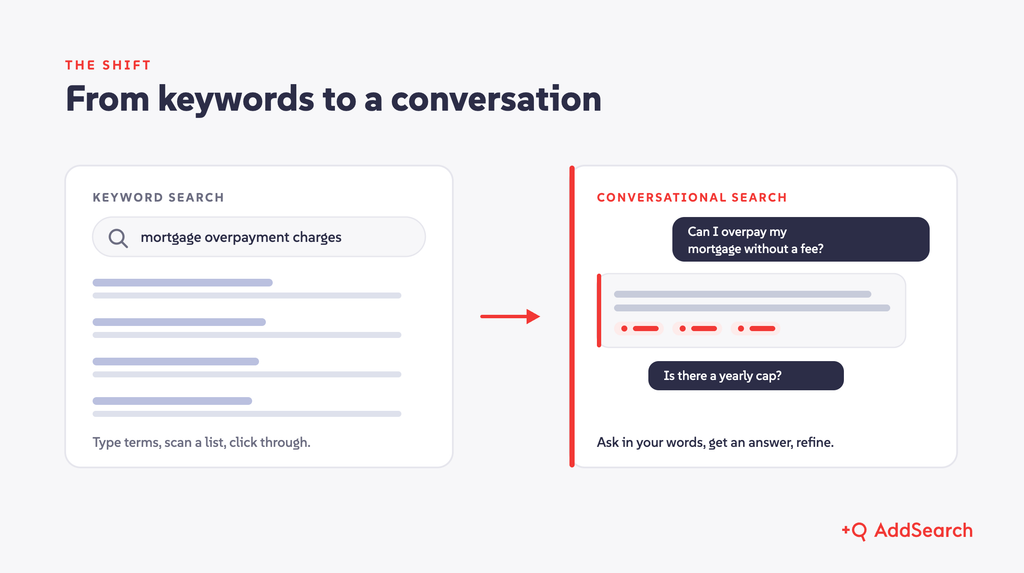
The key word is interaction. Conversational search is defined by how you engage with it, asking in plain words and getting answers in context, not by any single underlying technology. Information retrieval researchers describe it as interacting with a system through natural conversation to search for information, and have recognized it as an important new direction for the field.
What makes a search “conversational”?
Not every search box that accepts a question is truly conversational. In a foundational 2017 paper, researchers Filip Radlinski and Nick Craswell proposed a set of properties that together measure how conversational a system actually is (A Theoretical Framework for Conversational Search, Microsoft Research, CHIIR 2017). It’s an useful way to separate genuine conversational search from a search engine wearing a chat-style skin:
- Drawing out what you need. The system helps you express what you are really looking for over the course of the exchange, rather than expecting a perfect query up front.
- Being clear about what it can do. The system makes its capabilities and the scope of what it can answer clear, so you know what to expect.
- Mixed initiative. Either side can steer. The system can ask a clarifying question, and the person can redirect at any time.
- Memory. Both sides can refer back to earlier parts of the conversation, so follow-ups build on what came before instead of starting over.
- Set retrieval. The system can reason about groups of related results, which helps when the answer is a set of options rather than a single fact.
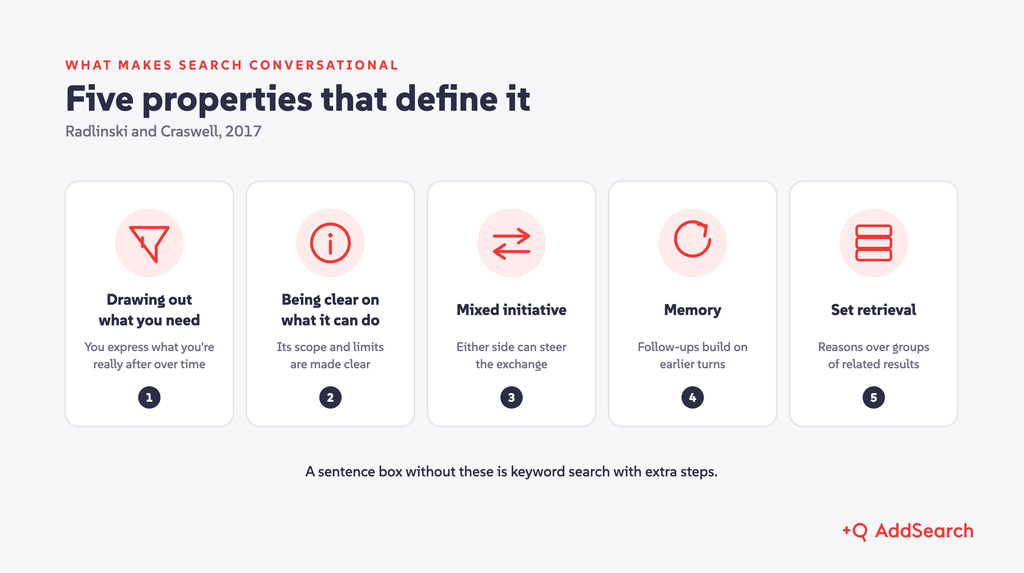
A tool that accepts natural-language input but forgets the last question, never asks for clarification, and cannot handle follow-ups is closer to a keyword engine with extra steps than to conversational search.
How conversational search works
Between your question and its answer, a conversational search system generally moves through four stages. The details differ from one tool to the next, but the underlying flow is broadly the same.
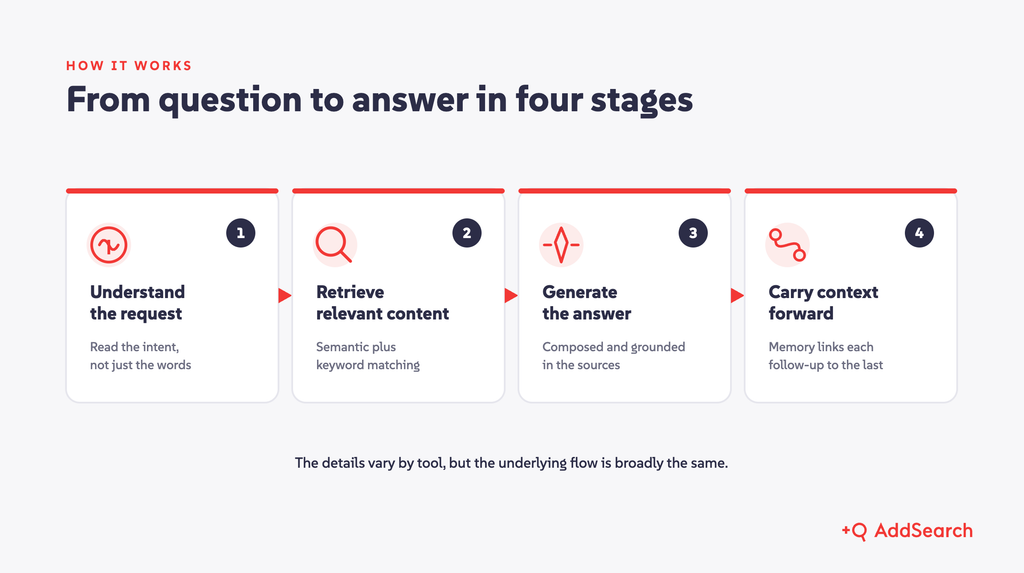
Understanding the request
The first job is to work out what you actually mean, not just which words you typed. Natural-language understanding breaks the question down to identify the intent behind it, the entities involved, and how they relate, so a question like “how do I move my start date” is read as a request about rescheduling rather than a search for the words “move” and “start.”
This stage also copes with the messiness of real language: synonyms, incomplete sentences, typos, and the many different ways people phrase the same need. In a multi-turn conversation, it often rewrites your question into a self-contained form first, folding in context from earlier turns so the rest of the system has something clear to work with.
Retrieving relevant information
Once the intent is clear, the system looks for the content most likely to answer it. Rather than matching exact keywords, conversational search usually relies on semantic retrieval: pages, passages, and documents are converted into vectors, which are numerical representations of meaning, and the system compares the meaning of your question against them.
That is why it can surface the right passage even when the source uses completely different wording from your question. Many systems combine this with keyword matching in a hybrid approach, then rank the candidates so the strongest few are passed forward. This step carries a lot of weight, because an answer can only ever be as good as the material gathered to build it.
Generating the answer
With the relevant material in hand, a language model composes a direct, readable answer instead of handing back a list of links. Most current systems use retrieval-augmented generation, or RAG, which means the model is given the retrieved passages and asked to base its answer on them, rather than relying only on what it absorbed during training.
This keeps the response tied to actual source material and makes it possible to point back to where each part of the answer came from. The model also does the work of phrasing, summarizing across several sources and shaping the response to fit the specific question you asked.
Carrying context forward
What makes the experience a conversation, rather than a series of separate searches, is memory. The system keeps track of what has already been asked and answered, so a follow-up like “and what about the deadline for that” is understood in light of the previous turn instead of starting from scratch.
It resolves references, such as pronouns like “it” or “that” and vague follow-ups, back to their subject, and carries that thread forward through the exchange. This is what lets you refine and build on an answer naturally, narrowing in on exactly what you need over several turns.
These stages describe the common pattern. Implementations vary widely, and not every conversational search tool uses the same techniques.
What conversational search is not
Because the term gets used loosely, it helps to be precise about what conversational search is not.
| Often confused with | Why it is different from conversational search |
| A scripted chatbot | A rule-based chatbot follows predefined decision trees and can only handle the paths its designers anticipated. Conversational search handles open-ended, unanticipated questions and reasons over real content. |
| Voice search | Voice is an input method, speaking instead of typing. Conversational search is about the interaction. You can have voice-driven conversational search, text-based conversational search, or voice search that is not conversational at all. |
| Semantic search | Semantic search matches on meaning rather than exact keywords. It is often a component of conversational search, but on its own it still returns a ranked list, not a conversation. |
| A keyword box that accepts sentences | Taking a full sentence as input is not enough. Without memory, mixed initiative, and follow-up handling, it is still keyword search. |
| RAG | Retrieval-augmented generation is a technique for grounding generated answers in retrieved content. It is one way to build conversational search, not the thing itself. |
| One specific product | Google’s AI Mode, Perplexity, and ChatGPT’s search are instances of conversational search, not definitions of it. The concept is bigger than any single tool. |
Where you encounter conversational search
Conversational search shows up in several contexts, and you have probably used more than one:
- AI answer engines on the open web: Tools like Google’s AI Mode, Perplexity, ChatGPT search, and Microsoft Copilot let people ask questions and get synthesized answers with follow-ups, drawing on the wider web.
- Voice assistants: Amazon Alexa, Apple’s Siri, and Google Assistant were among the earliest mainstream conversational search experiences, answering spoken questions in natural language.
- Search on individual websites: Many organizations add conversational search to their own sites so visitors can ask questions and get answers drawn from that site’s content, rather than hunting through pages.
- Workplace and knowledge search: Inside organizations, conversational search helps people find answers across documents, wikis, and internal systems.
The common thread is the interaction, not the setting. Whether the source is the open web, a single website, or an internal knowledge base, the experience is the same: ask, get an answer, refine.
Why conversational search is taking off now
The idea is not new. Information retrieval researchers have explored conversational approaches for years, and intelligent assistants brought a simple version to millions of people over a decade ago. What changed is capability.
Large language models made it practical to understand messy, open-ended questions and to generate fluent answers on almost any topic, which moved conversational search from research prototypes and narrow assistants into everyday tools.
User behavior has shifted in step. Nielsen Norman Group’s research finds that generative AI is meaningfully reshaping how people search, easing the friction of keyword foraging where users had to think up the right terms and sift through results themselves (How AI Is Changing Search Behaviors, NN/G, 2026). The result is a move away from the older model of ten links toward a question-and-answer style of finding information.
Benefits and limitations of conversational search
Conversational search has clear strengths:
- People can ask in their own words, without guessing the right keywords or the exact title of a page.
- It handles complex and exploratory needs well, where the answer builds across several turns.
- It lowers the effort of assembling an answer from multiple sources by hand. Nielsen Norman Group describes generative AI tools as substantially reducing the interaction cost of information foraging by aggregating knowledge from several sources into one response.
It also has real limitations worth understanding:
- Answers can obscure uncertainty. A generated answer compresses several sources into one fluent response, which can make it sound more confident and complete than the underlying evidence supports.
- Accuracy depends on the sources and the system. A conversational answer is only as reliable as the content behind it and the way the system uses that content.
- The interaction hides the trail. When several sources are folded into a single answer, it is harder for a person to see where a claim came from or to compare conflicting evidence.
This is where design choices come in. To make answers easier to trust and check, some conversational search implementations restrict responses to a defined set of sources and show citations, so a person can see where an answer came from and click through to verify it. Grounding answers in a specific content set with citations is not part of the definition of conversational search. It is a value-add that particular systems layer on to improve reliability and let users verify. Whether a given tool does this, and how well, varies from one implementation to the next.
The next step: agentic search
Conversational search is already evolving toward what many call agentic search, where a system does not just answer a question but takes steps toward completing a task: comparing options, pulling from several sources, and carrying out actions on the person’s behalf. The line between finding information and acting on it is starting to blur, and the multi-turn, mixed-initiative nature of conversational search is the foundation that makes it possible.
Conclusion
Conversational search is a shift in how people interact with information: from typing keywords and scanning links to asking questions in plain language and refining the answer through conversation.
The properties that define conversational search, expressing intent over time, mixed initiative, memory, and reasoning over sets of results, are what separate genuine conversational search from a search box that merely accepts a sentence.
How any particular system retrieves content, generates answers, and earns trust is where implementations differ, and where the more interesting design decisions get made.
Curious what conversational search looks like on your own website’s content? You can see it in action with AddSearch.
Frequently asked questions
Is conversational search the same as a chatbot?
No. A scripted or rule-based chatbot follows predefined flows and answers only the questions it was built to handle. Conversational search handles open-ended questions and reasons over real content, and it typically supports memory and follow-ups that a scripted chatbot does not.
What is the difference between conversational search and voice search?
Voice search refers to the input method, speaking a query rather than typing it. Conversational search refers to the interaction, a natural-language exchange with follow-ups. A system can be one, the other, both, or neither.
What technologies power conversational search?
Commonly natural-language understanding, semantic or vector retrieval, large language models, and often retrieval-augmented generation, along with mechanisms to maintain context across turns. The exact mix varies by system.
Is conversational search the same as generative AI search?
They overlap. Generative AI search uses a language model to produce answers, and most conversational search today is generative. But conversational search is defined by the back-and-forth interaction, and the concept predates modern generative models.
What are examples of conversational search?
On the open web, Google’s AI Mode, Perplexity, ChatGPT search, and Microsoft Copilot. Voice assistants like Alexa and Siri are earlier examples, and many individual websites now offer conversational search over their own content.
