



Cludo is a dedicated AI site search platform built for content-heavy websites, with a strong presence in higher education and local government. It combines keyword and semantic search with a set of AI Layers, all grounded in a site’s own content. It is a capable, purpose-built search product, and for many web and marketing teams, it does the core job well.
But a growing number of institutions looking at Cludo want something a little different. They want keyword search, AI summaries, and conversational search in one unified experience rather than as separately priced layers. And they want to be live in days. This article looks at where Cludo fits and seven alternatives worth comparing with it.
What Cludo Is Built For
Cludo’s core strength is intent-based site search for content-heavy websites. It uses natural language processing to interpret what a visitor means, not just the keywords they type, and it gives web managers and marketing teams control over ranking, synonyms, and content gaps.
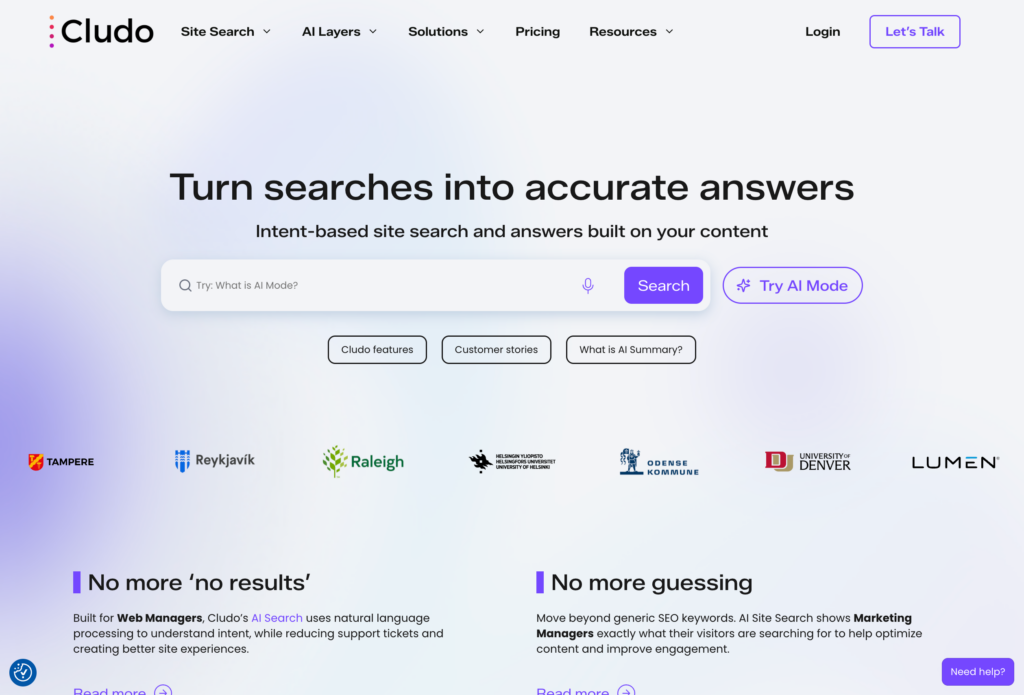
Its AI comes as three separate AI Layers that sit on top of search. AI Summary places a generated, citation-backed answer above the results. AI Chat adds a conversational experience with follow-up questions, where you can set internal sources and public pages as the knowledge base. AI Mode combines AI Summary and AI Chat into a full-screen, chat-style search experience that keeps context across a conversation. The platform emphasizes accessibility, with W3C and European Accessibility Act alignment, and it serves higher education, public sector, and commercial websites.
How Cludo’s Pricing Works
Cludo splits its offering into three parts. AI Search and Enterprise Search are both quote-only, so the starting cost is not published. The AI capabilities sit in a separate line item: AI Layers start from $8,000 USD annually, per layer.
Since AI Summary, AI Chat, and AI Mode are each their own layer, the AI cost is priced separately from, and on top of, the underlying search license. AI Mode, the most complete conversational experience, is currently delivered as a custom implementation, with self-serve configuration through Cludo’s Experience Builder listed as a planned future release. That modular structure is worth understanding early, because it shapes the total cost and rollout more than the headline figure suggests.
This article looks at 7 top Cludo alternatives: what each one does well, where it falls short, and which type of organization it tends to fit best.
1. AddSearch
AddSearch is an AI search and conversational content discovery platform. It brings keyword search, direct AI-generated answers, and context-aware conversational search onto one platform, and you decide how much of it to use and where.
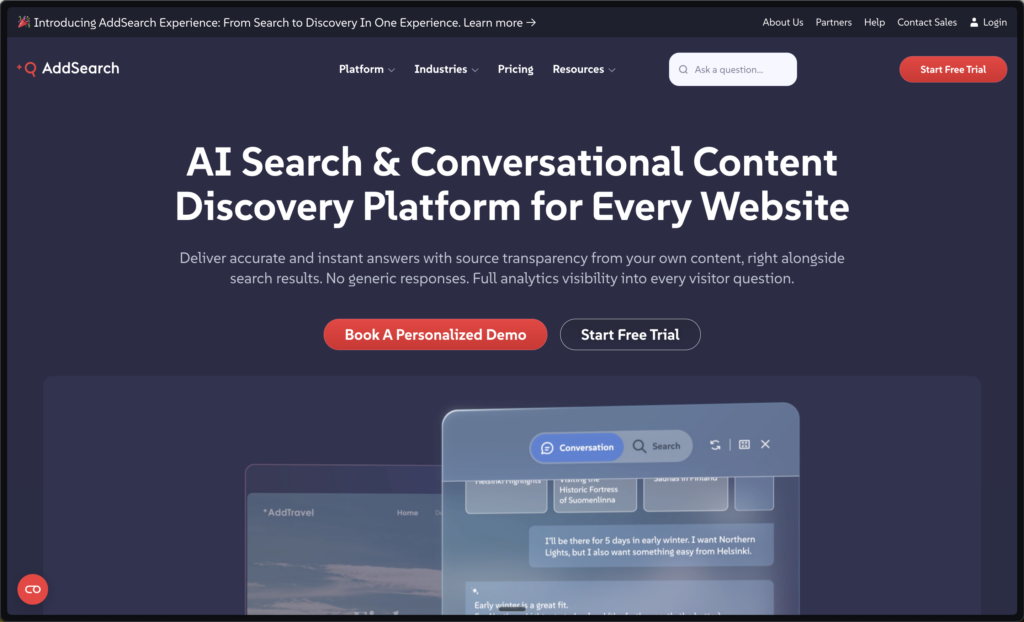
AddSearch is used by universities, government agencies, financial services firms, and associations. On a content-heavy site, it helps prospective students find program pages, residents find services and forms, and staff find policies, all through the same search experience. Rather than sitting on a single page, AddSearch acts as a federated search engine. It crawls and indexes content across an organization’s multiple domains, subdomains, and databases via its API, bringing siloed information into a single index.
What makes AddSearch different from Cludo
The clearest difference is how AI is packaged and delivered. Cludo offers its AI as three separate layers. AI Summary sits above the results, AI Chat adds conversation, and AI Mode combines the two into a full-screen conversational experience. Each layer is priced from $8,000 per year on top of a separately quoted search license, and AI Mode is currently delivered as a custom implementation rather than a self-serve setup.
AddSearch takes a different approach. Keyword search, AI Answers, and AI Conversations run on one platform and one index, so they can work together in whatever layout fits the site. That might be a single interface where a visitor moves from a keyword to a direct answer to a follow-up conversation and back, a split view showing keyword results and the conversational answer side by side, or another layout built around how visitors actually search. The full set is available from day one. You decide how much of it to deploy, where on your site, and how the layout brings the pieces together.
Pricing transparency is the second difference. AddSearch publishes real starting figures for its two most-adopted tiers, Keyword Search and AI Answers, so most buyers can see real numbers before talking to sales. With Cludo, the search products are quote-only, and only the AI Layers floor is public.
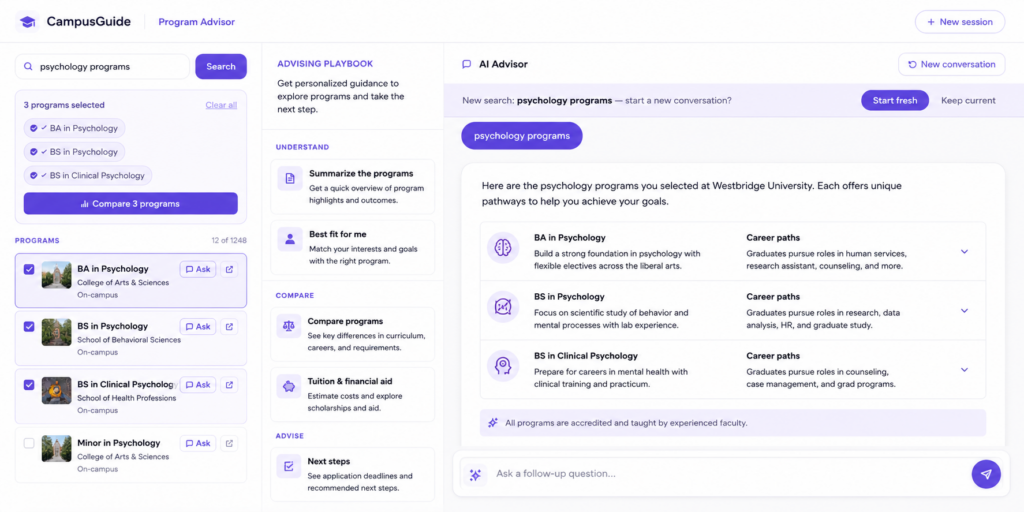
The third difference is higher-education depth. AddSearch offers specialized UI templates built for student use cases. Instead of reading through dense text, prospective students can find, filter, and compare programs and courses side by side, not just read a summary sitting above a list of links.
Developers get full documentation, libraries, and APIs to build and extend the experience. Marketing and content teams can manage and adjust search independently, without a dedicated technical team.
AddSearch’s pricing is publicly available
Keyword Search plans start at $119 per month on an annual plan. AI Answers, which adds GenAI answers with citations, starts from $8,400 per year. AI Conversations and AddSearch Experience are custom-quoted based on scale, so pricing is available on request.
How the AddSearch experience looks in practice
Every piece below runs on the same platform, so you can apply them selectively across your site rather than as a single fixed setup. See it in action in the AddSearch experience.
- Fast, accurate keyword search with typo tolerance and relevant filtering.
- Tailored higher-ed UI templates that make finding and comparing program and course details intuitive for students.
- Direct answers to specific questions, generated from the institution’s own indexed content, with source citations.
- Context-aware conversations that remember what a visitor has already asked and let them dig deeper naturally.
Other things worth knowing about AddSearch
- Answers are grounded only in the institution’s own indexed content. AddSearch does not pull information from external sources.
- Source citations appear on every response.
- Your data is not used to train any AI model.
- AddSearch is SOC 2 Type II certified.
- WCAG 2.2 is supported.
- Standard setup is typically completed in a few days.
- AddSearch works alongside an existing search provider, so it does not require a rip-and-replace.
- All three layers are available from the start. You choose where each one applies, such as keyword-only search for one part of the site and full conversational search for another.
- A 14-day free trial is available using the institution’s own website content.
Best for: Organizations that want keyword search, direct AI answers, and conversational search available on one platform, with pricing they can see up front, a setup measured in days, and control over how much of it runs where.
Start a free trial now: https://app.addsearch.com/signup/user
2. SearchStax
SearchStax is a site search specialist with a large higher-education and public-sector footprint, serving more than 700 customers across education, healthcare, government, manufacturing, and financial services. It is the closest head-to-head with Cludo on this list, built around the same buyer: web and marketing teams that want better website search without heavy engineering.

SearchStax offers two products. The Site Search Solution is the marketer-facing website search, and the Managed Search Service is hosted Solr infrastructure for engineering teams.
Its generative AI feature, Smart Answers, places an AI-generated summary above the search results, drawn from the customer’s own content, similar to an AI overview. It also includes Smart Ranking and Smart Match Assist for relevance and spelling, plus integrations with Acquia, Adobe, Optimizely, Sitecore, and Modern Campus.
SearchStax limitations to consider
- Its AI is focused on the summarized answers above results. A full multi-turn conversational experience is less of an emphasis than the summary layer.
- The split between the Site Search Solution and the underlying Managed Search Service can add a decision layer when scoping which product you actually need.
- Pricing is quote-based and scales with indexed content, monthly searches, and analytics retention, so an accurate figure requires a sales conversation.
SearchStax Pricing
SearchStax does not publish standard rates. Annual subscriptions are custom-quoted and scale with usage, and qualifying nonprofit organizations may be eligible for a discount. A 14-day free trial is available. For an accurate figure, contact SearchStax directly.
Best for: Higher-education and government web teams that want a marketer-friendly site search specialist with AI summaries and strong analytics, and are comfortable with quote-based pricing.
3. Squiz Funnelback
Squiz Funnelback is an enterprise site search platform with deep roots in higher education and government. It can be purchased standalone without the full Squiz DXP, and it is designed for complex environments: many pages, multiple repositories, and fragmented content.
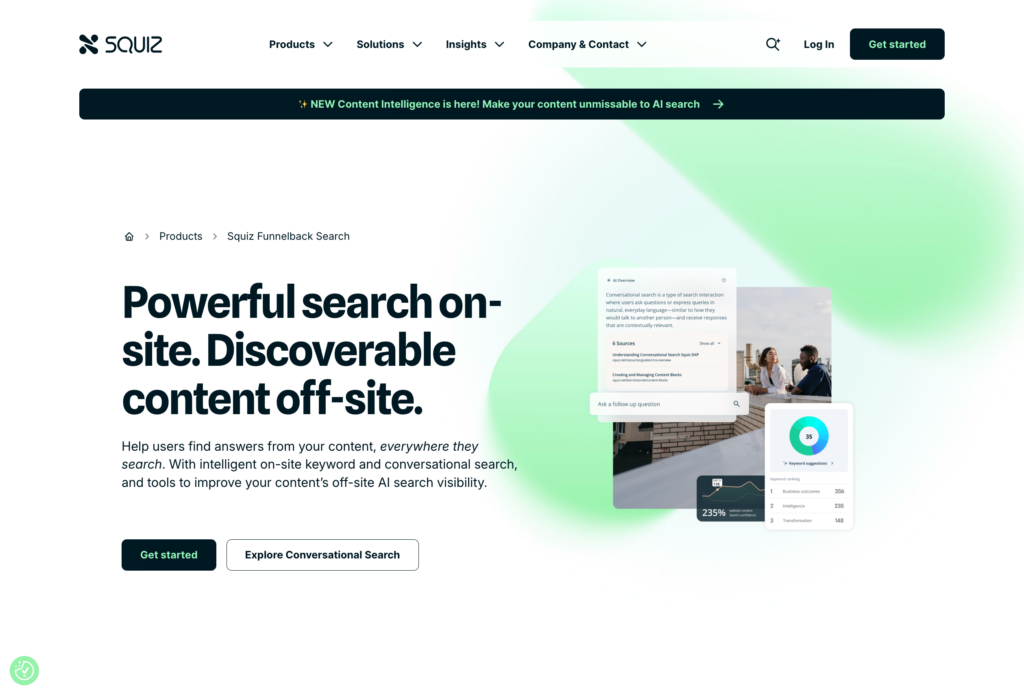
Funnelback offers keyword search and conversational AI search grounded in your own content, plus Squiz Content Intelligence, a content-health tool that audits AI readiness and WCAG 2.2 accessibility issues. Its ranking algorithm draws on more than 70 signals refined over years, and pre-built higher-ed templates are available.
Squiz Funnelback limitations to consider
- Developer reliance is real. Configuring and maintaining Funnelback layouts typically involves custom Freemarker template coding and ongoing technical work. Marketing teams rarely run it without engineering support.
- Implementation is heavier, and scoping usually involves professional services.
- Pricing is quote-only, so budgeting requires a full sales cycle.
Squiz Funnelback Pricing
Squiz does not publish pricing for Funnelback Search. Plans are custom-quoted based on scale and configuration. For an accurate figure, contact Squiz directly.
Best for: Large university systems and government bodies with dedicated web engineering teams that want a proven enterprise search backend and can absorb the technical overhead.
4. Coveo
Coveo is an enterprise AI search and personalization platform. Its core strength is federated search, pulling content from a CRM, CMS, knowledge base, support portal, and website into one experience, with deep integrations into Salesforce, Sitecore, ServiceNow, and SAP.
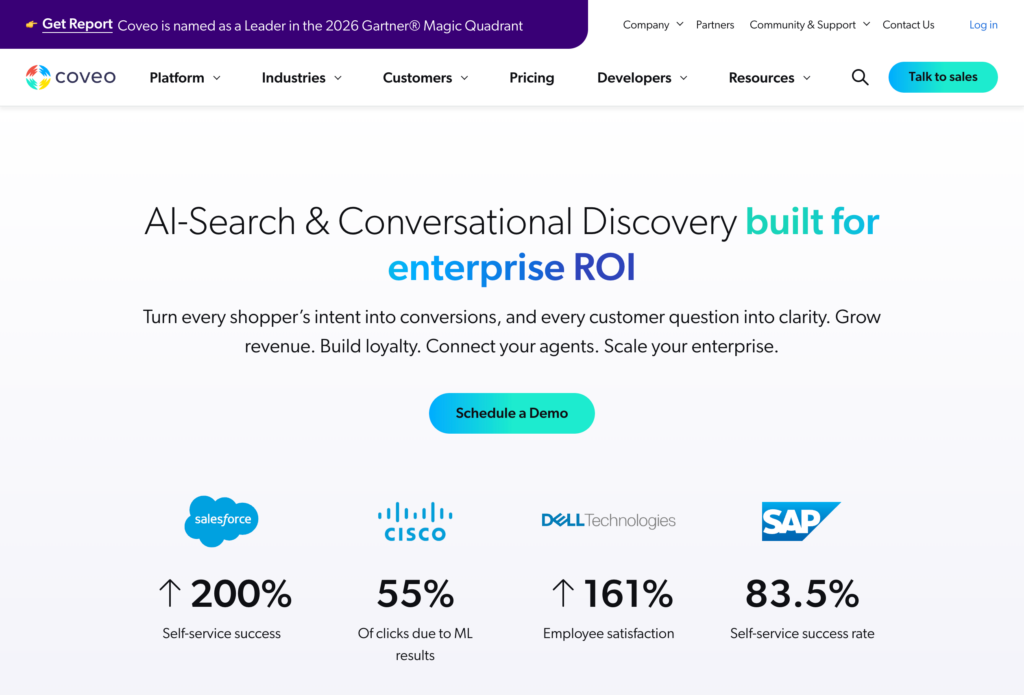
Coveo’s platform is organized around two offerings. Service, Website, and Workplace covers knowledge experiences for customers, agents, and employees. Commerce covers product discovery. Both are structured around a base unit of 100,000 queries per month, and the generative AI capabilities, including Conversational Search and Generative Answering, are listed as add-ons rather than included in the base package.
Coveo limitations to consider
- Generative AI and conversational capabilities are paid add-ons on top of an already substantial base price.
- Implementation typically takes months and benefits from a dedicated internal search team, which is a heavy lift for a single content-focused website.
- Buyers consistently describe the consumption-based, query-volume pricing as difficult to forecast at scale.
Coveo Pricing
Coveo for Salesforce starts at $100,000 per year. Pricing for the Service/Website/Workplace and Commerce offerings is not published. For an accurate figure, contact Coveo’s sales team directly.
Best for: Large enterprises with complex, multi-source content ecosystems and the budget and team to support a longer implementation.
5. Algolia
Algolia is a developer-first, API-first search platform used by thousands of businesses to power product, app, and documentation search. It is known for fast, hosted search that engineering teams assemble and tune themselves.
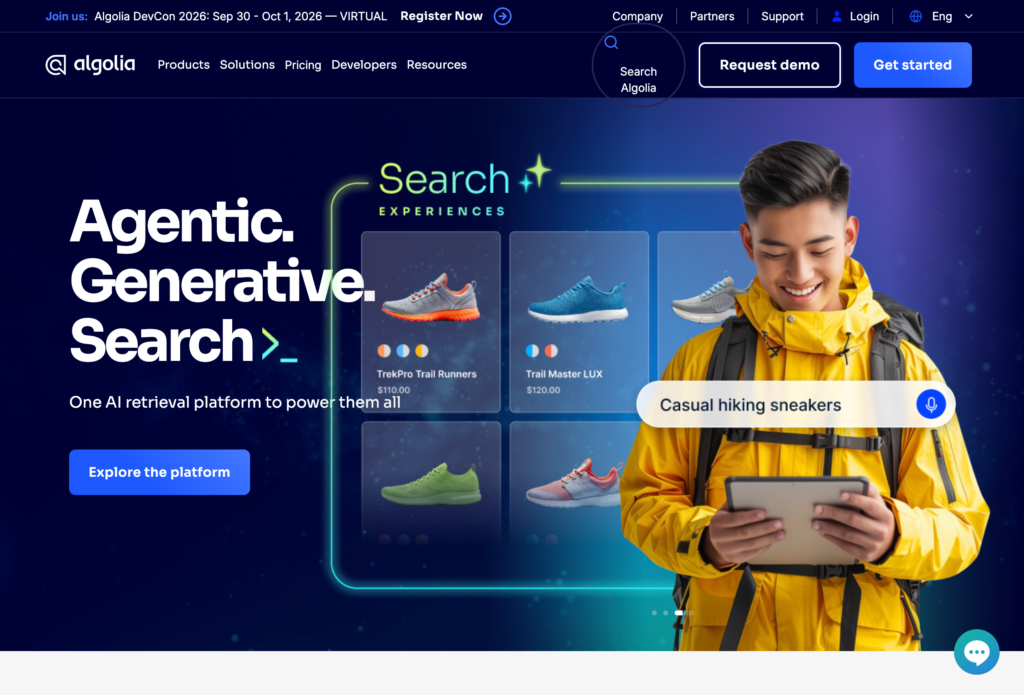
Algolia has moved into generative territory with Ask AI, a cited-answer layer for the search bar, along with a separate Generative Experiences toolkit for building broader features. Ask AI requires you to bring and manage your own LLM provider and API key, and it is positioned primarily for documentation and support content rather than general content-heavy websites.
Algolia limitations to consider
- Implementing and tuning it well, configuring indices, and building ranking rules generally requires engineering resources.
- AI features require the Grow Plus tier, whose per-request rate is more than three times the standard Grow rate.
- Semantic search and real-time personalization are reserved for the custom-quoted Elevate tier.
- It is built primarily around product and app search, so configuring it for non-product content takes extra work.
Algolia Pricing
- Build: free, 10,000 search requests and 1 million records per month.
- Grow: pay-as-you-go, 10,000 search requests per month included, then $0.50 per additional 1,000 requests, plus $0.40 per additional 1,000 records beyond 100,000.
- Grow Plus: same usage allowances as Grow, plus AI Synonyms, AI Ranking, and Advanced Personalization, at $1.75 per additional 1,000 search requests.
- Elevate: custom annual pricing with NeuralSearch, AI Collections, real-time personalization, and enterprise SLA.
Best for: Product, engineering, and digital teams that need fast, developer-controlled search and are comfortable building the experience themselves.
6. Elasticsearch
Elasticsearch is the open-source search and analytics engine built on Apache Lucene, and one of the most widely deployed search technologies anywhere. It is infrastructure, not a finished product, so what it does well depends on the team building on top of it.
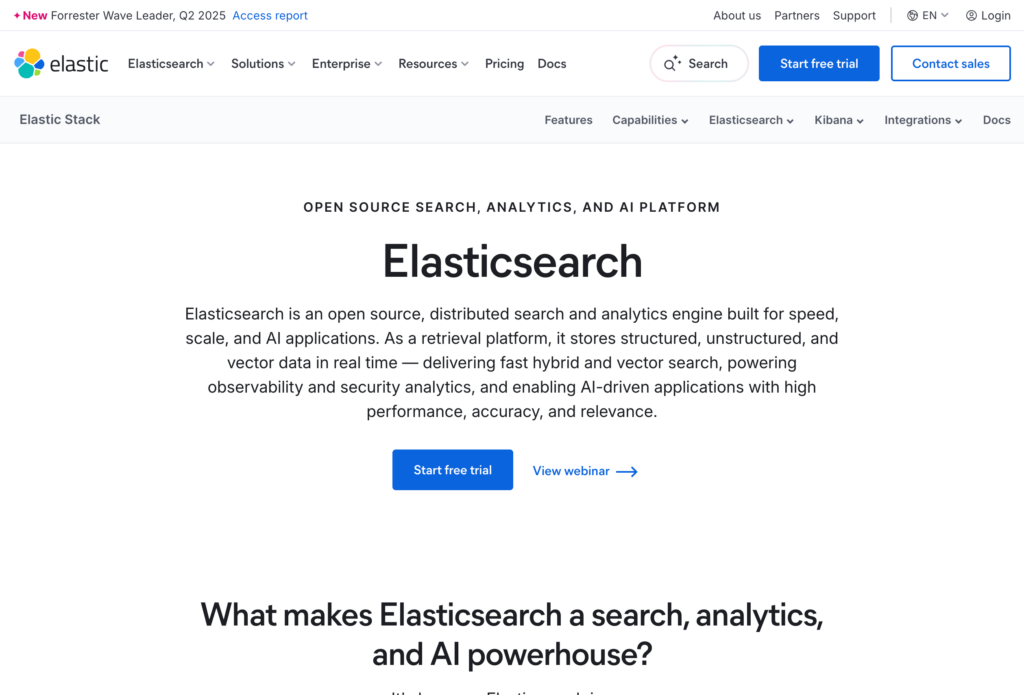
In 2026, Elastic has continued to expand its AI tooling, including semantic reranking, an AI Playground, and Agent Builder for constructing retrieval pipelines. These are useful for engineering teams with the resources to use them, but they do not change the nature of the platform: it is something you build and operate, not something a marketing team configures through a dashboard.
Elasticsearch limitations to consider
- No business-facing dashboard for non-technical teams to manage search independently.
- No managed AI answers or conversational search out of the box. You build the answer layer yourself.
- Requires meaningful engineering expertise to configure, scale, and maintain, with ongoing operational overhead.
Elasticsearch Pricing
Self-hosted Elasticsearch is free and open-source, though you carry the full operational cost. Elastic Cloud Hosted starts around $95 to $99 per month for a small production configuration, scaling to around $175 to $184 per month for the Enterprise tier. Elasticsearch Serverless is metered by usage; Elastic’s own examples show small development environments around $24 to $27 per month and moderate production environments around $190 to $210 per month.
Best for: Organizations with engineering teams that need full infrastructure control and are prepared to build the search experience and answer layer themselves.
7. Google Programmable Search Engine
Google Programmable Search Engine, formerly Google Custom Search Engine, is the embeddable search widget that many institutions have used for years. It is free, familiar, and quick to add to a site, and it is still viable for organizations with tight budgets that just need basic search.
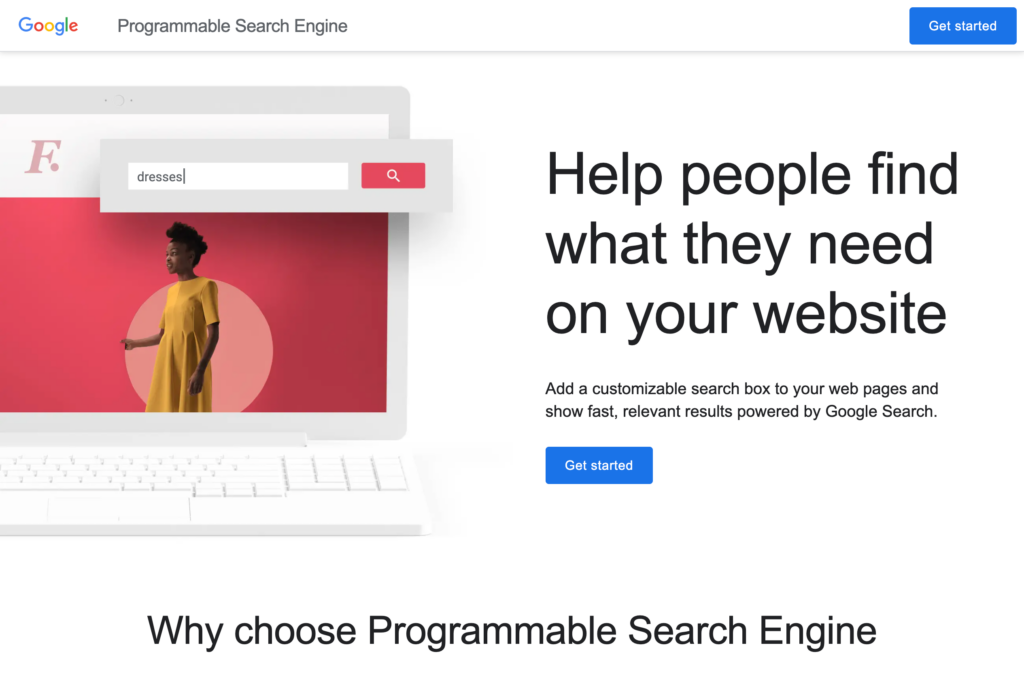
For public-sector and education websites, though, the trade-offs matter. The free version is ad-supported, and Google can display ads inside your results, including from other organizations.
Qualifying government, education, and nonprofit organizations can get an ads-free edition of the client-side element for free, but the deeper limitations remain: no search analytics on the free tier, accessibility gaps in the JavaScript-rendered results, limited control over branding and relevance, and indexing that is not real-time.
There is also a timeline to plan around. Google is limiting the free tier to 50 domains and ending free full-web access, with a transition deadline of January 1, 2027, and it now points new customers toward Vertex AI Search on Google Cloud for AI-powered search.
Google Programmable Search limitations to consider
- No managed AI answers or conversational search in the free product. Those capabilities live in Vertex AI Search, a separate Google Cloud product with its own setup and cost.
- No analytics on the free tier, so you cannot see what visitors search for or which queries return nothing.
- Accessibility, branding, and relevance control are limited compared with a dedicated search platform.
- The 50-domain cap and January 1, 2027 transition deadline mean existing setups will need a migration plan.
Google Programmable Search Pricing
The ad-supported version is free, and an ads-free edition is available at no cost to qualifying government, education, and nonprofit organizations. The Custom Search JSON API is priced at $5 per 1,000 queries and is closed to new customers, with existing users supported until January 1, 2027. Google directs new customers to Vertex AI Search, which starts around $2.50 per 1,000 queries plus ingestion and storage charges, with AI features priced higher.
Best for: Budget-constrained sites that need basic search and can accept the accessibility, analytics, and control trade-offs, with a plan for the 2027 migration.
How These Cludo Alternatives Compare
| What matters | Cludo | AddSearch | SearchStax | Squiz Funnelback | Coveo | Algolia | Elasticsearch | Google Programmable Search |
| Built as a dedicated website search platform | Yes | Yes | Yes | Yes | Yes, with high complexity | Partial, product and app focus | Partial, infrastructure only | Partial, embeddable widget |
| Serves content-heavy edu and gov sites out of the box | Yes | Yes | Yes | Yes | Partial, enterprise federation | Partial | Partial, infrastructure only | Partial |
| Direct, content-grounded AI answers with citations | Yes | Yes | Yes, summary above results | Yes | Yes, as a paid add-on | Yes, via Ask AI (bring your own LLM) | No, build your own | No, requires Vertex AI Search |
| Conversational search that remembers context | Yes, via AI Chat and AI Mode | Yes | Partial, summary-focused | Yes | Partial, via add-on | Yes, via Ask AI | No, build your own | No |
| AI included in one experience vs separately priced | Separate layers: Summary, Chat, Mode | Unified experience | Scales within plans | Varies by configuration | Add-ons on top of base | AI on higher tiers | Build your own | No managed AI |
| Accessibility support | Yes, W3C and EAA | Yes, WCAG 2.2 | Yes | Yes, WCAG 2.2 audit | Partial | Partial | Partial, depends on your build | No, gaps out of the box |
| Manageable without developer resources | Yes | Yes | Yes | No, developer support needed | Partially, with training | No | No | Yes, basic setup |
| Publicly confirmed starting price | Partial, AI Layers from $8,000/yr per layer; search quote-only | Yes, $119/mo Keyword Search, $8,400/yr AI Answers | No, quote-only | No, quote-only | No amount published; Coveo for Salesforce from $100K | Partial, Grow rates published; Elevate is not | Yes, from around $95 to $99/mo (Cloud) | Yes, free tier; JSON API $5 per 1,000 queries |
| Typical setup time | Weeks | Days | Days to weeks | Weeks to months | Months | Days to weeks | Weeks to months | Days |
Final Thoughts
The right Cludo alternative depends on the job you are hiring it for. If you have a dedicated web engineering team and want a proven enterprise backend, Squiz Funnelback is built for that. If you need to federate content across many internal systems, Coveo is designed for that scale. If you want developer-controlled infrastructure, Algolia and Elasticsearch give you the building blocks. And if budget is the only constraint, Google Programmable Search still works, with the trade-offs and 2027 migration in mind.
But if the core goal is to give every visitor, whether a prospective student, a resident, or a staff member, keyword search, direct AI answers, and conversational search in one experience, a unified platform like AddSearch serves you better than assembling separately licensed layers. AddSearch is not an all-or-nothing switch. You can start with keyword search on one part of your site, add AI answers where they matter most, and expand into a fully unified experience where it makes sense. The platform is modular by design, so you choose how much of it you use and where. AddSearch unifies keyword search, direct AI answers with source citations, and context-aware conversations into one experience, grounded strictly in your own content. It deploys in days, works alongside whatever search you already run, and publishes its starting price up front.
You can start a 14-day free trial using your own website content, or book a short walkthrough with our team to see how it would work on your site.
Start your 14-day free trial: https://app.addsearch.com/signup/user
Book a demo: https://www.addsearch.com/addsearch-experience-demo/
